Bird
Bird
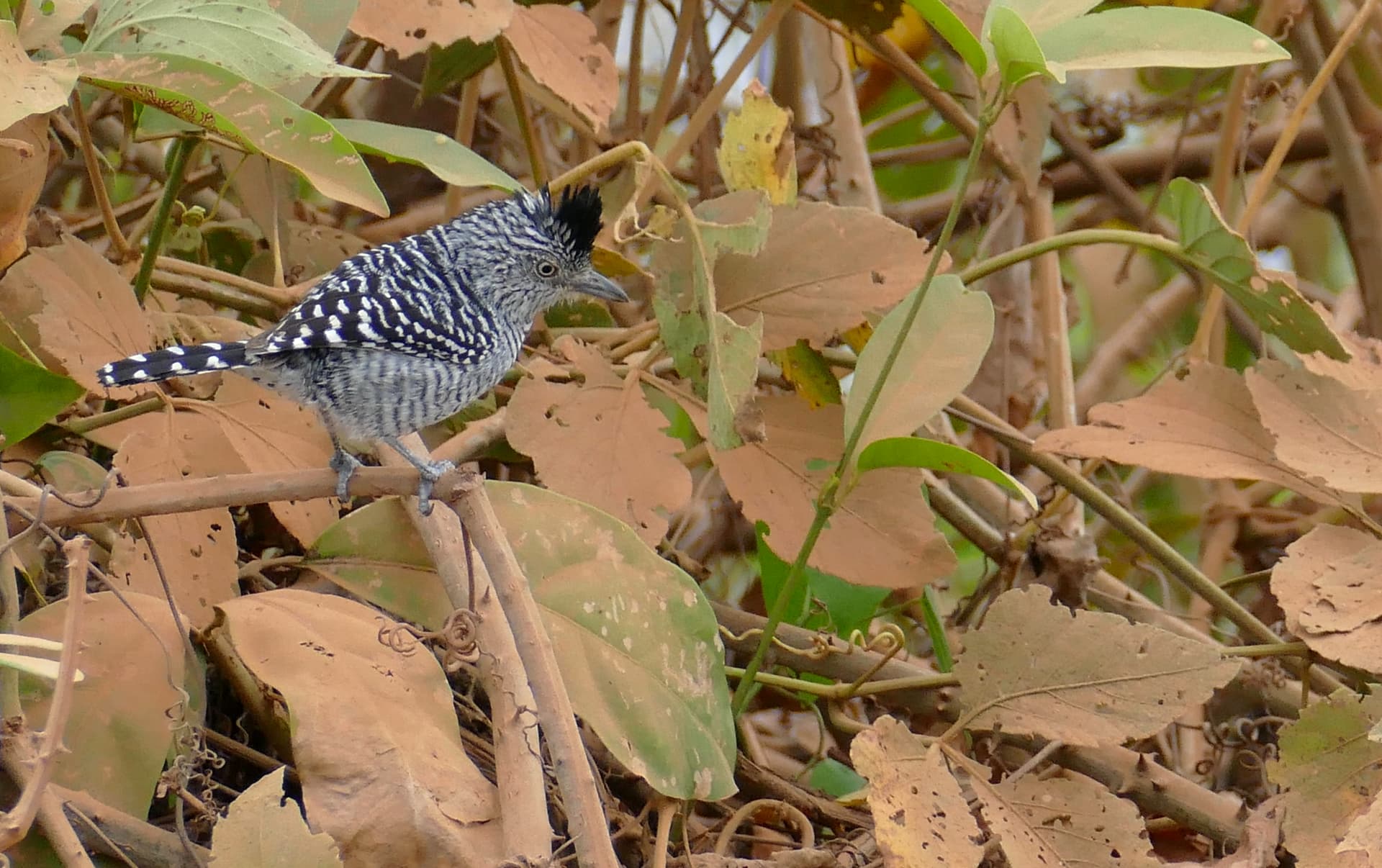
Barred Antshrike
Thamnophilus doliatus
The Barred Antshrike is one of the most frequently heard birds of Trinidad and Tobago's thickets and forest edge, a boldly barred black-and-white bird whose distinctive accelerating, bouncing-ball call is a familiar sound of scrubby and second-growth habitats across both islands.
The Barred Antshrike is one of the most frequently heard birds of Trinidad and Tobago's thickets and forest edge, a boldly barred black-and-white bird whose distinctive accelerating, bouncing-ball call is a familiar sound of scrubby and second-growth habitats across both islands.
Identification
A medium-sized antbird around 15 to 16 cm long. Males are strikingly barred black and white overall with a shaggy black crest that can be raised into a crown; females are warm rufous-brown above with a chestnut crown and buffy underparts, entirely lacking the male's barring. Both sexes have a bushy crest and bright reddish eyes.
Behaviour
Skulks low in dense scrub, second growth, forest edge, and overgrown gardens, gleaning insects, spiders, and small vertebrates from foliage and rarely venturing into the open. Its far-carrying song, a rising, accelerating series of nasal notes ending in a slurred note, is delivered from cover and is one of the most recognisable sounds of scrubby habitat on both islands. Pairs are highly territorial and often duet.
Status in T&T
Common and widespread in Trinidad and Tobago in second growth, forest edge, plantations, and overgrown gardens at low to middle elevations. Not threatened, and one of the species that has adapted well to disturbed and regenerating habitats. It is protected as native wildlife under the Conservation of Wildlife Act.