Bird
Bird
Blue-crowned Motmot
Momotus momota
The Blue-crowned Motmot is one of Trinidad and Tobago's most beautiful and distinctive forest birds, instantly recognisable by its elaborate racket-tipped tail and vivid combination of green, blue, and rufous plumage.
The Blue-crowned Motmot is one of Trinidad and Tobago's most beautiful and distinctive forest birds, instantly recognisable by its elaborate racket-tipped tail and vivid combination of green, blue, and rufous plumage. A patient, sit-and-wait predator of the forest understorey, the motmot is often encountered perching motionlessly on a shaded branch, swinging its pendulum-like tail in a slow arc that has puzzled naturalists for generations.
Identification
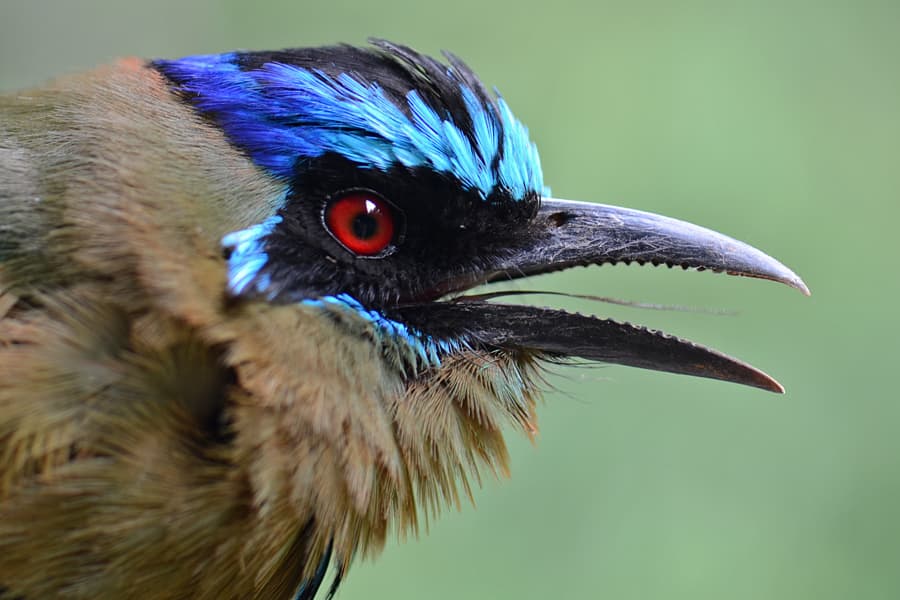
The Blue-crowned Motmot measures 38 to 48 cm, much of that length contributed by the remarkable tail. The central pair of tail feathers is elongated with bare shafts forming a racket-shaped tip; birds create this shape themselves by preening away the barbs from the central shaft section shortly after the feathers grow. The head has a brilliant blue crown with a black central patch, a broad black mask, and green upperparts. The breast is rufous-olive, and the belly is greenish. Immatures lack the full tail rackets. The bill is broad, slightly curved, and serrated, adapted for catching prey.
Ecology
Motmots are sit-and-wait predators of forest understorey and edges, taking a wide variety of prey including large insects, spiders, small lizards, small snakes, frogs, and fruit. They typically perch silently for extended periods before making a short, agile sally to snatch prey from the ground or vegetation. The distinctive pendulum tail-swinging behaviour, also called "wagging," is thought to be a signal to predators that the bird has already detected them, reducing the probability of an attack. The Blue-crowned Motmot nests in burrows excavated in earthen banks or flat ground, laying three to four white eggs. Both sexes incubate and care for chicks.
Status in T&T
The Blue-crowned Motmot is found on both Trinidad and Tobago, favouring the forest interior, well-shaded garden margins, and woodland ravines. It is fully protected under the Conservation of Wild Life Act and is not a game species. The species is highly valued by ecotourists visiting T&T and is a regular feature at forest sites such as Asa Wright Nature Centre and the Main Ridge Forest Reserve on Tobago. Its tolerance of shaded secondary forest and large gardens gives it some resilience to habitat modification, though loss of primary forest degrades nesting and foraging conditions.
Threats
- Primary forest loss
- Nest burrow disturbance
- Reduction of understorey prey