Bird
Bird
White-tipped Dove
Leptotila verreauxi
The White-tipped Dove is a shy, ground-dwelling dove of forest floors and shaded plantations across Trinidad and Tobago, more often heard than seen, its low, mournful, owl-like cooing carrying through the understorey at dawn and dusk.
The White-tipped Dove is a shy, ground-dwelling dove of forest floors and shaded plantations across Trinidad and Tobago, more often heard than seen, its low, mournful, owl-like cooing carrying through the understorey at dawn and dusk.
Identification
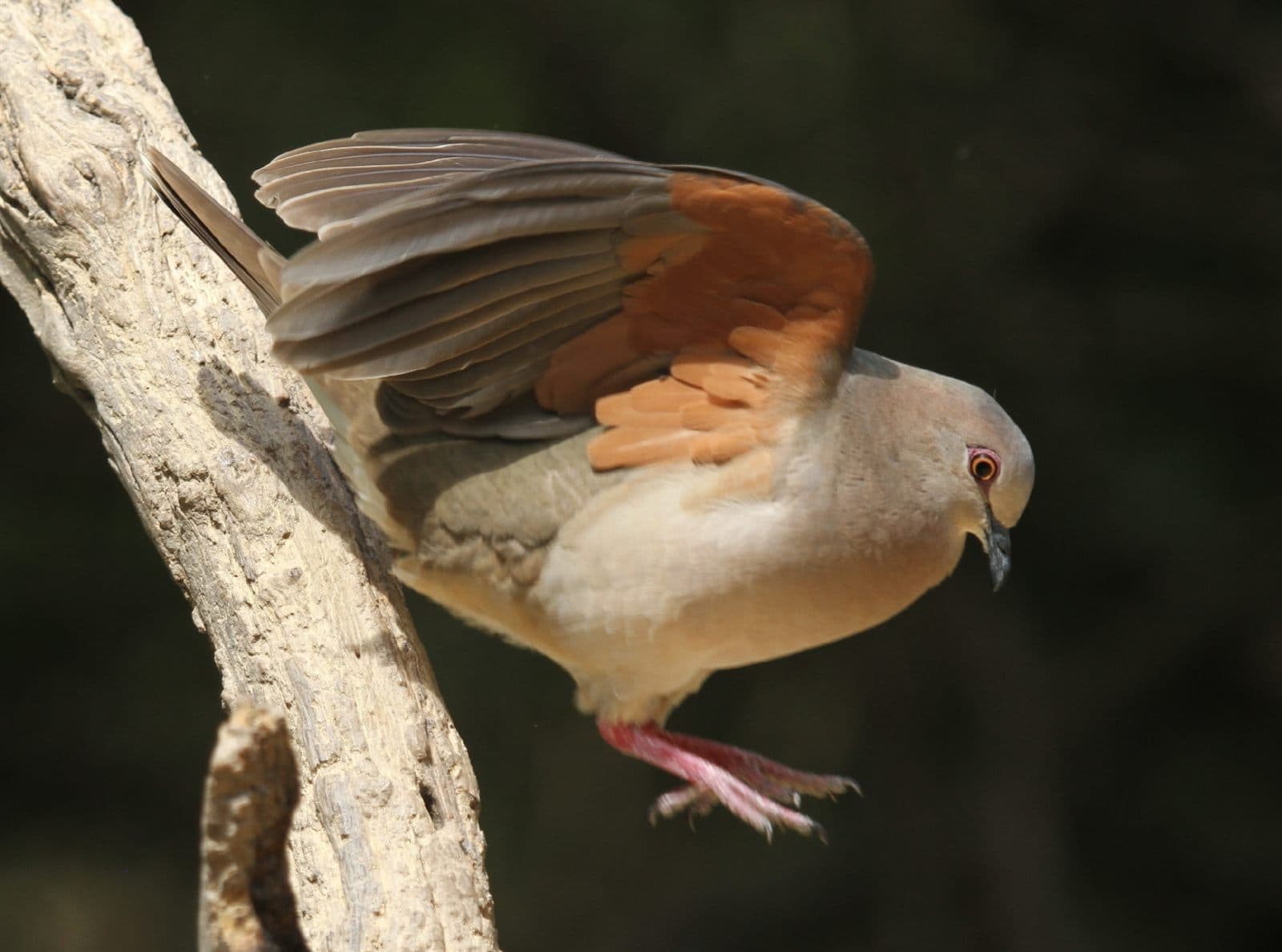
A medium-sized dove around 27 to 30 cm long, warm pale brown above and pinkish-buff below, with a pale forehead and face and a subtle iridescent sheen on the neck. The outer tail feathers are broadly tipped white, visible when the tail is fanned in flight, giving the species its common name. It walks with a characteristic bobbing, forward-and-back head motion typical of many ground doves.
Ecology
A shy, largely solitary forager, the White-tipped Dove feeds on fallen fruit, seeds, and small invertebrates picked from the forest floor and shaded plantation understorey, typically remaining hidden in dense cover and flushing explosively at close range when disturbed. Its deep, resonant, four-note cooing call, often mistaken for an owl by unfamiliar listeners, is delivered from a concealed perch and is one of the most distinctive forest sounds at dawn and dusk. Nests are simple twig platforms placed low in dense vegetation.
Status in T&T
Common in forest, forest edge, and shaded plantations across Trinidad and Tobago, generally avoiding open, cleared land in favour of cover. It is not threatened. It is protected under the Conservation of Wildlife Act; unlike some larger native doves, it is not a legally hunted game species.
Threats
- Forest clearance reducing shaded understorey habitat
- Localised hunting pressure in some rural areas despite protected status