Bird
Bird
Orange-winged Parrot
Amazona amazonica
The Orange-winged Parrot is the common large green amazon parrot of Trinidad and Tobago, named for the splash of orange in the wing that flashes in flight.
The Orange-winged Parrot is the common large green amazon parrot of Trinidad and Tobago, named for the splash of orange in the wing that flashes in flight. Loud, gregarious and gathering in noisy evening roosts, it is one of the most conspicuous and best-loved birds of the local skies at dusk.
Appearance
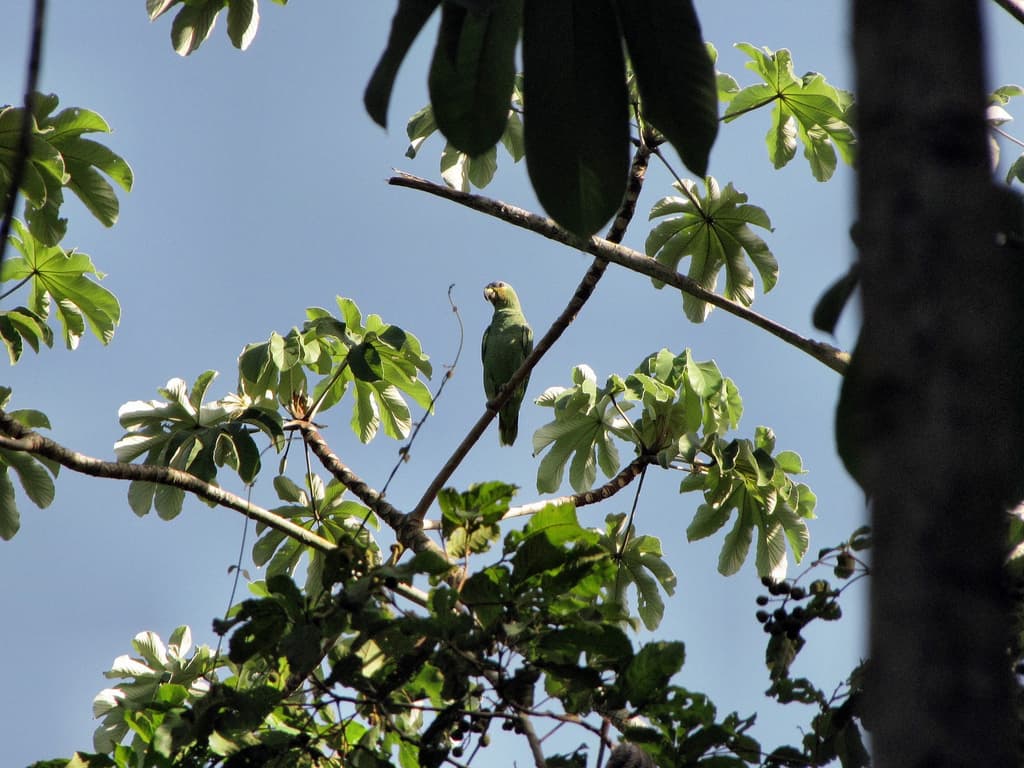
It is a stocky, mainly green parrot about 33 cm long and weighing around 340 g, with a short squared tail. The crown and cheeks are washed with blue and yellow, and the wing bears a patch of orange in the speculum that is most obvious when the bird opens its wings. The tail also shows orange and yellow at the base, while the strong hooked bill is horn-coloured.
Behaviour
Orange-winged Parrots are highly social and travel in pairs or noisy flocks, calling raucously as they fly overhead. They like to be near water and gather in large communal roosts before nightfall, sometimes numbering several hundred birds in clumps of trees, bamboo or palms.
By day they spread out to feed in the canopy, where their green plumage makes them surprisingly hard to spot among the leaves despite their noise.
Diet and breeding
The diet is built on fruit, seeds, nuts, palm fruits, flowers and buds, and birds will visit cultivated mango and citrus when wild food is scarce. They use their powerful bill and dexterous foot to manipulate hard seeds and fruit. Breeding in Trinidad falls mainly between May and July, when pairs nest in tree and palm cavities; the female lays two to five white eggs and incubates them alone for about three weeks. The species is popular in the pet trade, which adds pressure from trapping in some areas.
In Trinidad and Tobago
The Orange-winged Parrot is a common resident on both Trinidad and Tobago, found in forest, mangrove, swamp woodland and cultivated land, with the local population referred to the subspecies tobagensis. It remains widespread, though trapping for the pet trade is a local concern. Globally it is listed as Least Concern and is protected under CITES Appendix II, which regulates international trade.