Bird
Bird
Bananaquit
Coereba flaveola
The Bananaquit is a tiny, restless nectar-feeding songbird and one of the most familiar garden birds of the Caribbean and tropical America.
The Bananaquit is a tiny, restless nectar-feeding songbird and one of the most familiar garden birds of the Caribbean and tropical America. Known locally in Trinidad and Tobago as the sucrier or sugar bird, it is famous for raiding sugar bowls and feeders, and for its sharp, slightly down-curved bill built for sipping nectar.
Appearance
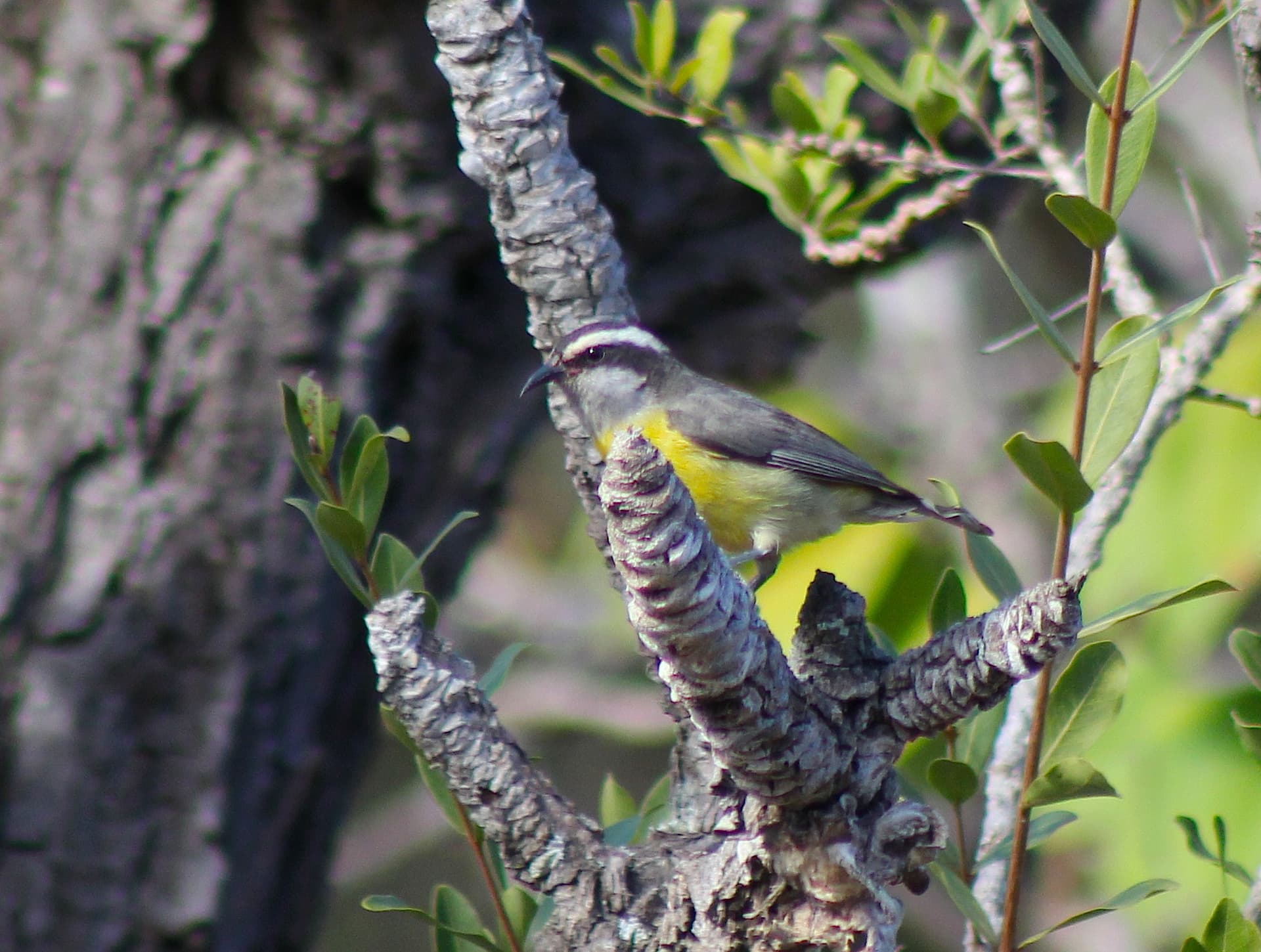
This is a small bird, about 10 to 11 cm long, with a slim, sharply pointed and slightly decurved bill. The typical plumage shows dark grey to black upperparts, a bold white eyebrow stripe, a grey throat and bright yellow underparts and rump. A small white wing patch is visible in flight, and the legs are dark; the bird's plumage varies considerably across its huge range, with some island forms looking quite different.
Behaviour
Bananaquits are active and acrobatic, hopping and clinging among flowers and foliage in constant motion as they search for food. They are bold and tame around people, readily visiting gardens, balconies and feeders.
The song is a thin, high-pitched, slightly buzzy series of notes, often delivered from a low perch. Birds are usually seen singly or in pairs rather than large flocks, and they defend small feeding territories around good nectar sources.
Diet and breeding
Nectar is a mainstay of the diet, and the bird often pierces the base of a flower with its sharp bill to steal nectar without pollinating it, a habit known as nectar robbing; it also takes small insects, spiders and soft fruit. A notable habit is its fondness for sugar and fruit at feeders, which gives it its local sugar bird name. The Bananaquit builds a globular, domed nest with a side entrance, and pairs may build extra roosting nests for sleeping in as well as breeding nests for the eggs.
In Trinidad and Tobago
The Bananaquit is a common and widespread resident on both Trinidad and Tobago, found everywhere from forest edges and second growth to suburban gardens and city parks. It is one of the birds most likely to be noticed at a feeder or flowering shrub, and its adaptability to human surroundings keeps it abundant. It is listed as Least Concern, reflecting its very large range and secure population.