Bromeliads
Bromeliads
Spanish Moss
Tillandsia usneoides
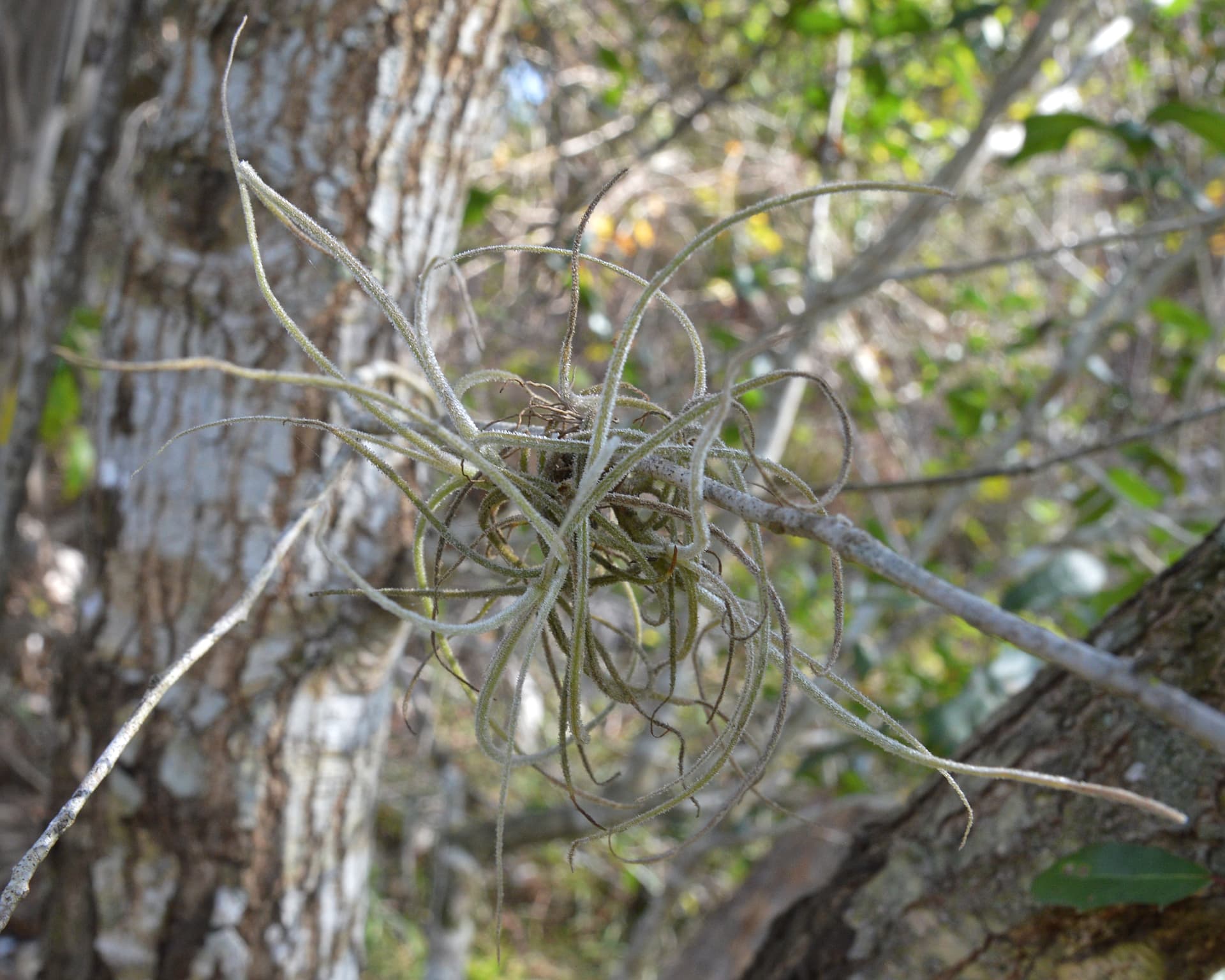
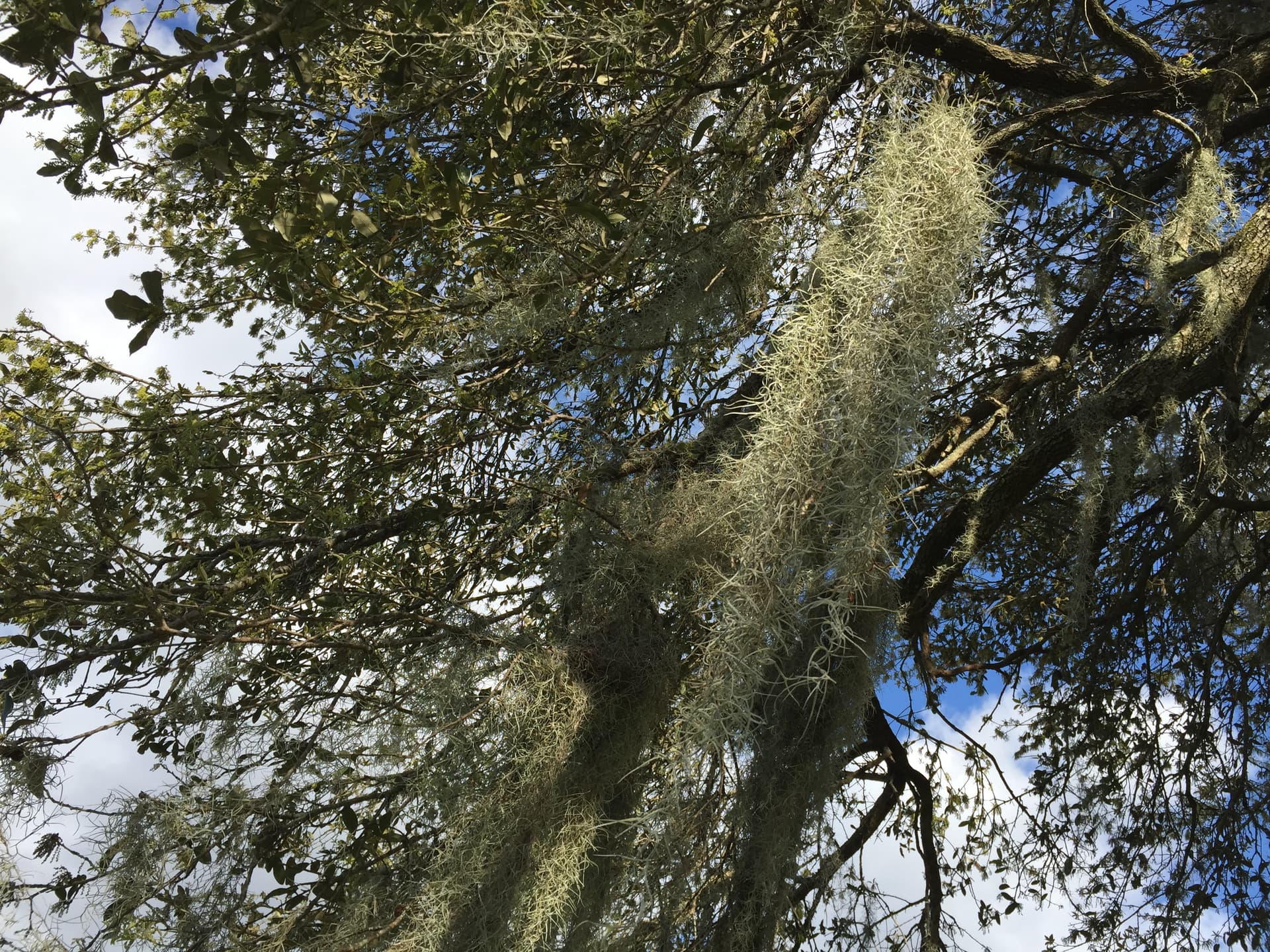
Photo: Famartin · Saint Martin Parish, Louisiana (CC BY-SA 4.0)
Spanish Moss is one of the most evocative plants of Trinidad and Tobago's montane forest, draping from the branches of cloud forest trees in long, silvery-grey curtains that move in the mountain breeze.
Spanish Moss is one of the most evocative plants of Trinidad and Tobago's montane forest, draping from the branches of cloud forest trees in long, silvery-grey curtains that move in the mountain breeze. Despite its name and appearance, it is neither a moss nor native to Spain: it is a bromeliad, a relative of the pineapple, and one of the most specialised epiphytes in the plant kingdom. It has no roots at all, absorbing water and nutrients entirely through specialised scales on its grey-green stems, and contributes significantly to the microhabitat diversity of T&T's upper Northern Range forest.
Description
Spanish Moss is a rootless, pendulous epiphyte forming long, tangled, feather-like grey-green to silver strands that hang from tree branches in festoons up to several metres long. It is composed of many small, overlapping plants growing in chains; each has tiny, scale-like leaves covered in trichomes (specialised water-absorbing scales) that give the plant its characteristic silver-grey colour when dry and grey-green when wet. Small, inconspicuous pale yellow flowers are produced in spring. The plant has no roots and no contact with soil; it is supported entirely by the branches it drapes over and feeds on moisture and dust in the air.
Ecology
Spanish Moss thrives in conditions of high air humidity, moderate to strong air movement, and good light. In T&T it is most abundant in the cloud forest and upper montane forest of the Northern Range, where mist and high humidity provide the moisture the plant needs. It also occurs on large trees in parks and gardens where air humidity is sufficient. The tangled festoons provide nesting material and shelter for birds, particularly oropendolas and caciques, and shelter for insects, spiders, and small frogs. The plant is spread by fragments carried by the wind or by birds, and a single piece dropped on a suitable branch can grow into a large colony.
Uses
Spanish Moss has been used across the Americas for insulation, stuffing, weaving, and packing material. In the past it was used as a substitute for horsehair in upholstery and as a packing material for fragile goods. In folk medicine preparations of the plant have been used for fever and skin complaints. In T&T it is primarily appreciated as part of the visual character of the mountain forest and is used decoratively in Christmas and Carnival arrangements.
Threats
- Air pollution damaging absorptive scales
- Humidity reduction from forest fragmentation