Bromeliads
Bromeliads
Ball Moss
Tillandsia recurvata
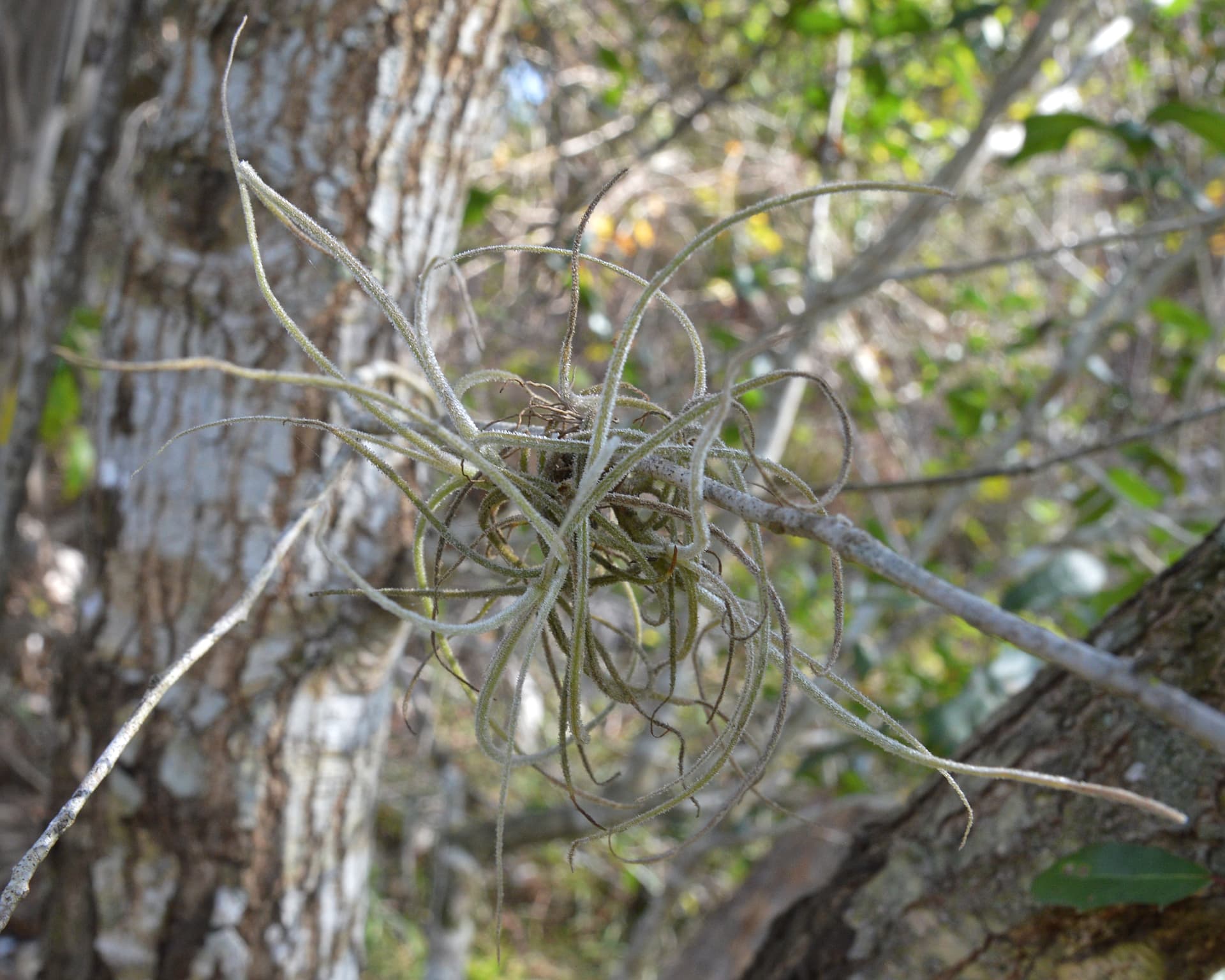
Photo: Ryan Hodnett · Collier County, Florida (CC BY-SA 4.0)
Ball Moss is one of the most visible plants in Trinidad and Tobago despite being one of the least noticed: a small, grey-green atmospheric bromeliad that forms dense ball-like tufts on utility wires, fence posts, roadside trees, and urban street trees across both islands.
Ball Moss is one of the most visible plants in Trinidad and Tobago despite being one of the least noticed: a small, grey-green atmospheric bromeliad that forms dense ball-like tufts on utility wires, fence posts, roadside trees, and urban street trees across both islands. Despite its common name it is not a moss at all, but a true flowering plant in the pineapple family, surviving entirely on moisture and nutrients absorbed from the air through specialised silvery scales on its leaves.
Description
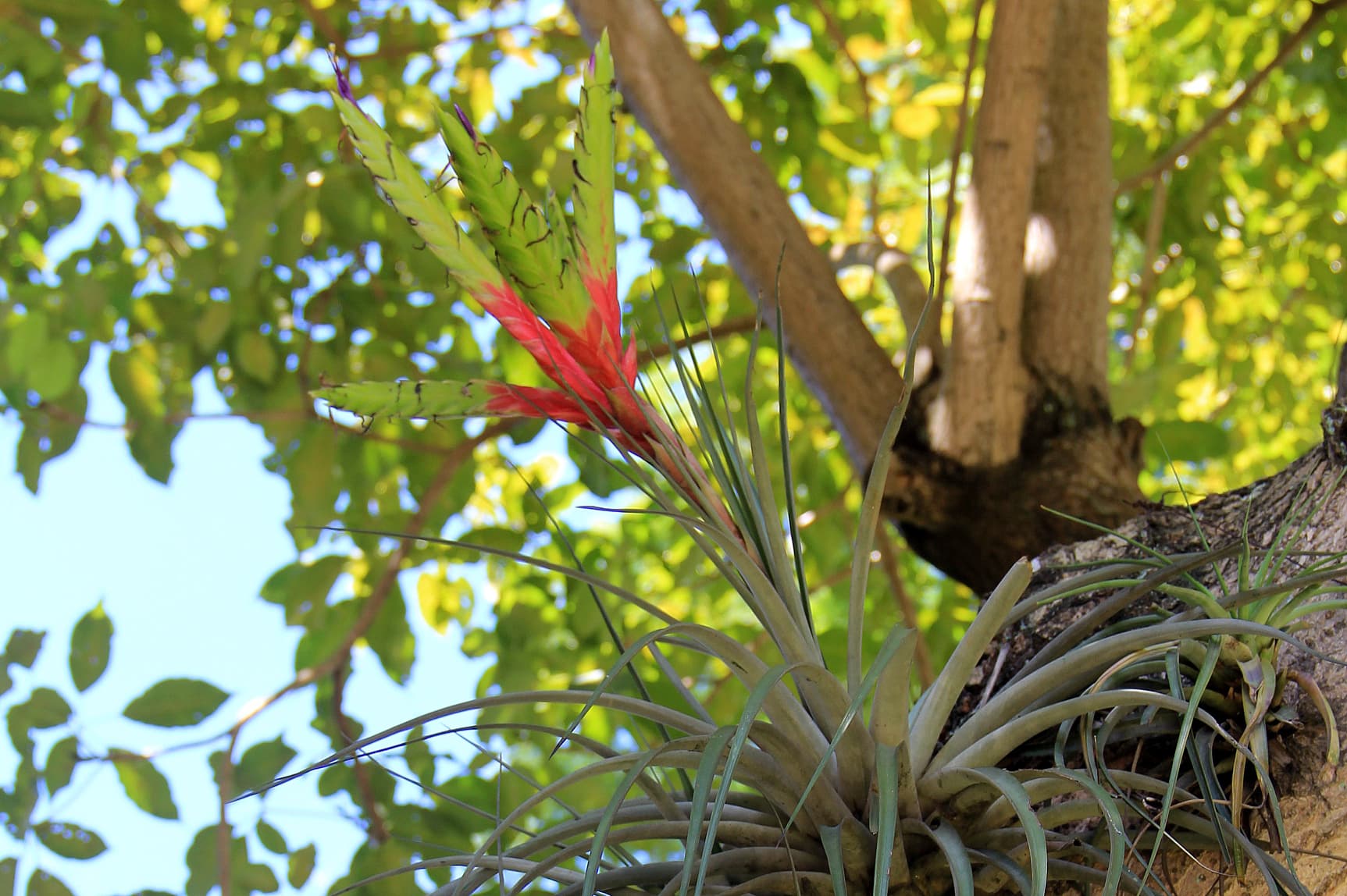
A small, tufted atmospheric bromeliad forming ball-shaped clumps typically 5 to 20 cm across. Leaves are very narrow, curved, and covered in dense silvery-grey scale-like trichomes that give the plant its characteristic pale grey-green colour and allow it to absorb water and nutrients directly from rainfall, humidity, and airborne dust. There are no roots capable of absorbing nutrients; the plant attaches to its substrate by a small holdfast of wiry root-like structures used purely for anchorage. Flowers are tiny, tubular, violet-purple, produced singly or in short spikes, with a delicate fragrance. Seeds have feathery appendages for wind dispersal.
Ecology
Ball Moss is an atmospheric epiphyte (technically a tillandsia or "air plant"), meaning it obtains all water and nutrients from the atmosphere rather than from soil or a host plant. It is therefore not parasitic: it simply uses whatever surface it can grip as a mechanical anchor - tree branches, telephone wires, fences, and even corrugated iron roofs. It grows most abundantly in open, sunny, slightly humid conditions and is extremely drought-tolerant. In T&T it is most visible in urban and coastal areas where the open canopy provides the light and air movement it needs. It is less common in dense, closed rainforest.
Misconceptions
Ball Moss is widely and incorrectly believed to harm or parasitise the trees it grows on. It has no capacity to penetrate bark or extract nutrients from its host; it simply sits on the surface. Heavy infestations occur on trees that are already weakened or dying from other causes, which gives the misleading impression that the Ball Moss is responsible. Removing it from stressed trees does not improve tree health. It is a native plant and a component of T&T's natural flora, not an invasive pest.
Threats
- No conservation concern; very common
- Incorrectly removed from urban trees as a perceived pest