Bird
Bird
Yellow Warbler
Setophaga petechia
The Yellow Warbler is a small, bright, resident songbird found in mangroves and coastal scrub across Trinidad and Tobago, one of the few warblers to breed locally, distinct from the many purely migratory warblers that pass through T&T without nesting.
The Yellow Warbler is a small, bright, resident songbird found in mangroves and coastal scrub across Trinidad and Tobago, one of the few warblers to breed locally, distinct from the many purely migratory warblers that pass through T&T without nesting.
Identification
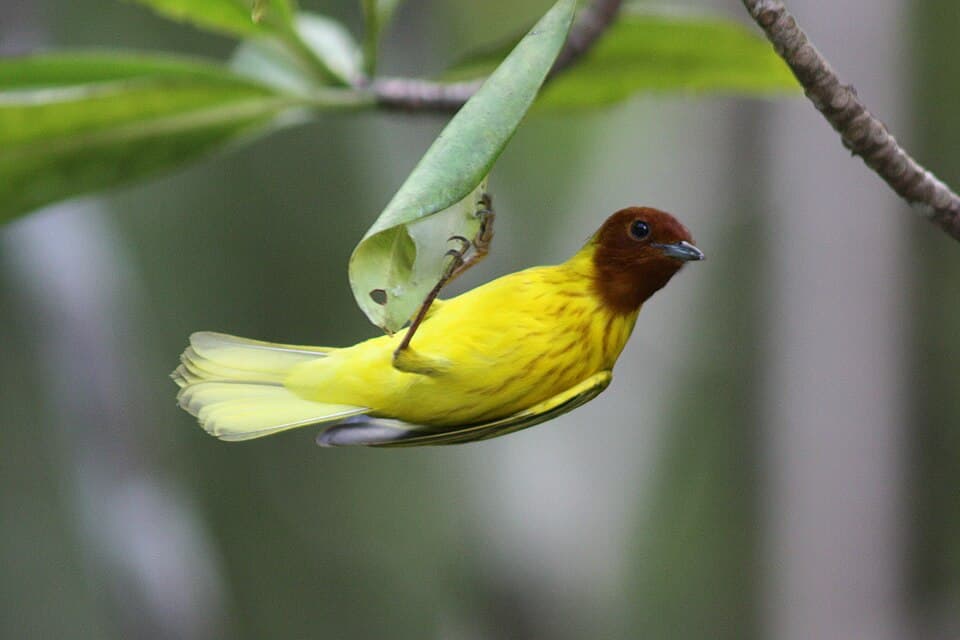
A small warbler around 12 to 13 cm long, bright yellow overall, brighter on the underparts, with an olive-yellow back and, in adult males, fine reddish streaking across the breast, absent or much reduced in females and immatures. The resident Caribbean and coastal populations, sometimes recognised as the "Mangrove Warbler" group, can show a chestnut cap in some individuals, a feature not typical of the migratory North American populations of the same species.
Ecology
The Yellow Warbler feeds on small insects, spiders, and caterpillars, gleaned actively from leaves and branches in mangroves, coastal scrub, and adjacent gardens. Unlike the many Yellow Warblers that pass through T&T on migration from northern breeding grounds without stopping to breed, the resident coastal and mangrove population breeds locally, building a compact cup nest low in mangrove or scrub vegetation. It is a frequent host of Shiny Cowbird brood parasitism, a pressure faced by many small open-cup-nesting passerines in the region.
Status in T&T
The resident population breeds in mangroves and coastal scrub on both Trinidad and Tobago, while additional non-breeding individuals from North American migratory populations may pass through or overwinter in the same habitat, making status assessment at any given sighting dependent on timing and plumage. It is not threatened. It is protected under the Conservation of Wildlife Act and is not a game species.
Threats
- Mangrove clearance and coastal habitat loss
- Brood parasitism by Shiny Cowbird