Bird
Bird
American Oystercatcher
Haematopus palliatus
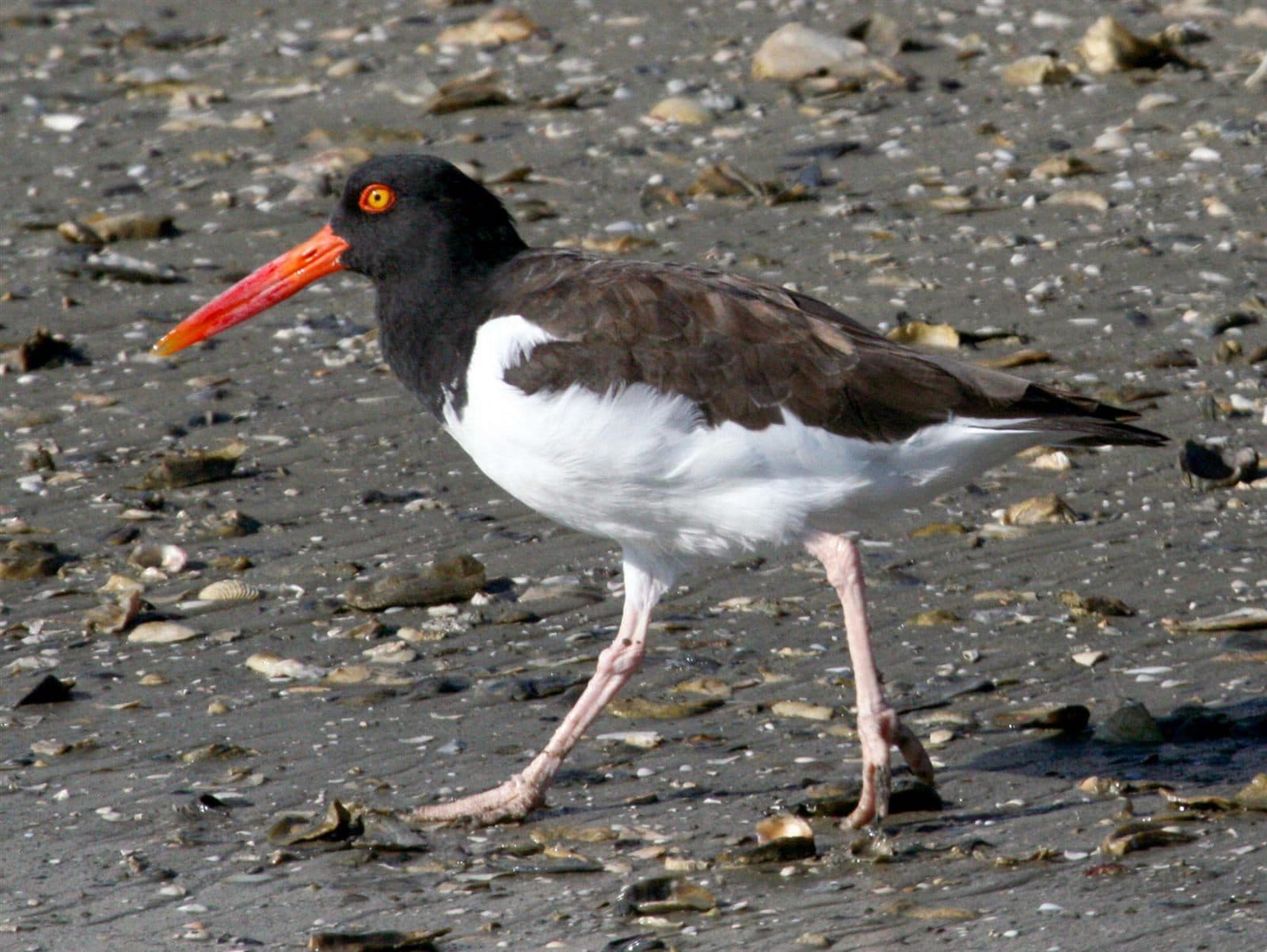
The American Oystercatcher is a large, boldly patterned shorebird of Trinidad and Tobago's rocky and sandy coastlines, easily identified by its long, blade-like orange-red bill specialised for prying open bivalve shellfish.
The American Oystercatcher is a large, boldly patterned shorebird of Trinidad and Tobago's rocky and sandy coastlines, easily identified by its long, blade-like orange-red bill specialised for prying open bivalve shellfish.
Identification
A large, heavy-bodied shorebird around 40 to 44 cm long, with a blackish-brown head and upper breast, dark brown back, and white underparts and wing bar visible in flight. The long, thick, blade-shaped bill is bright orange-red, and the legs are pale pink. The pale yellow eye is ringed by an orange eye-ring, adding to the bird's distinctive appearance.
Ecology
The American Oystercatcher specialises in feeding on bivalve molluscs, particularly oysters and mussels, which it opens using its strong, flattened bill either by hammering through the shell or by inserting the bill between the valves and severing the adductor muscle before the shell can close. It also takes other marine invertebrates from rocky shores and mudflats. It forages on rocky coastlines, oyster beds, and sandy or muddy intertidal flats, typically in pairs or small, loose groups.
Status in T&T
Found along suitable rocky and sandy coastlines of Trinidad and Tobago where bivalve prey is available, generally in low numbers and localised distribution. It is not threatened globally, but is sensitive to disturbance of coastal foraging and roosting sites. It is protected under the Conservation of Wildlife Act and is not a game species.
Threats
- Coastal development and shoreline hardening reducing foraging habitat
- Disturbance of feeding and roosting sites by recreational beach use
- Degradation of oyster beds and other bivalve habitat