Bird
Bird
Caribbean Flamingo
Phoenicopterus ruber
The Caribbean Flamingo is the most intensely coloured of all flamingos, a tall wading bird whose deep rose-pink to vermilion plumage is unmistakable across coastal lagoons and mudflats.
The Caribbean Flamingo is the most intensely coloured of all flamingos, a tall wading bird whose deep rose-pink to vermilion plumage is unmistakable across coastal lagoons and mudflats. It does not breed in Trinidad and Tobago but appears as a wandering visitor from colonies elsewhere in the Caribbean, feeding in the shallows of Caroni Swamp and other coastal wetlands.
Appearance
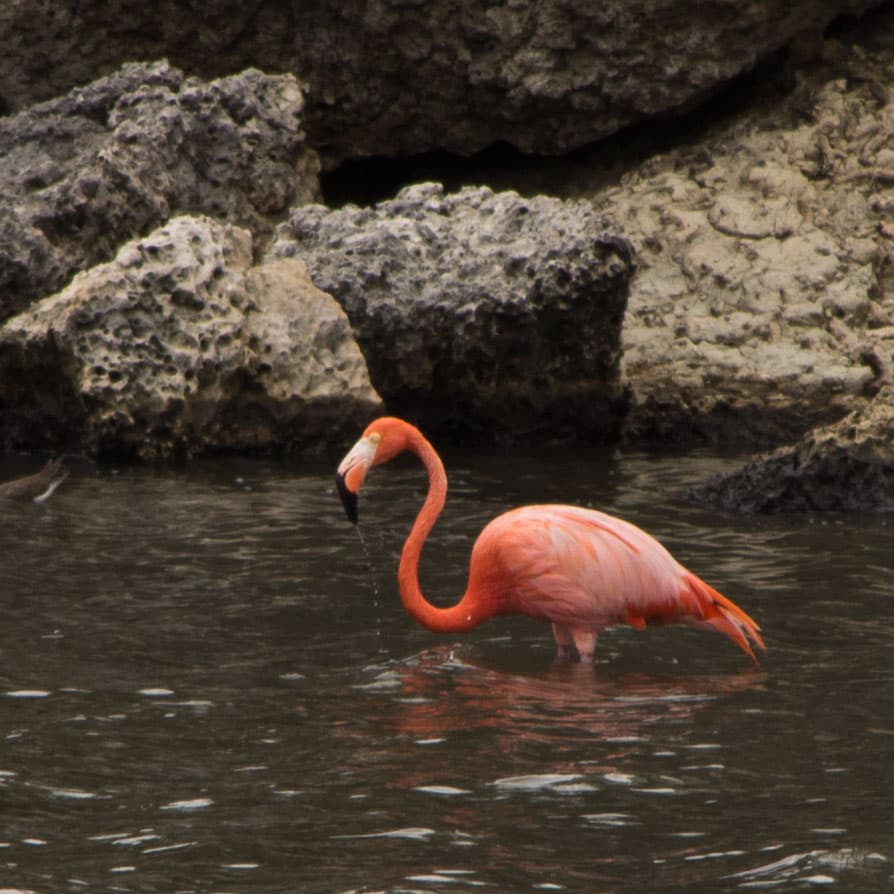
Adults stand roughly 1.2 to 1.4 m tall, with an exceptionally long neck and long pink legs. The plumage ranges from bright pink to a striking orange-red, the most vivid of any flamingo, while the wings reveal black flight feathers in flight. The large bill is bent sharply downward and is pale pink with a black tip, an adaptation for filter-feeding that no other bird group shares in quite the same way.
Behaviour
Caribbean Flamingos are intensely social and gather in flocks that can number in the thousands, feeding, flying and breeding together. They wade through shallow saline or brackish water, sweeping the head from side to side just below the surface.
Flocks perform synchronised group displays, with birds marching, head-flagging and wing-saluting in unison ahead of breeding. They are strong fliers and move widely between feeding and nesting sites, with their necks and legs extended in flight.
Diet and breeding
The bird feeds by holding its bent bill upside down in the water and pumping its fleshy tongue to filter out tiny food items through comb-like plates called lamellae. Its diet of brine shrimp, small molluscs, insect larvae and algae is rich in carotenoid pigments, and it is these pigments that produce the famous pink colour. Pairs build a low cone of mud as a nest and lay a single chalky white egg; both parents feed the grey-downed chick on a nutritious secretion called crop milk.
In Trinidad and Tobago
In Trinidad and Tobago the Caribbean Flamingo is best known as a non-breeding visitor, with birds appearing in the coastal wetlands and lagoons, including the Caroni Swamp and other mudflats, where they feed in the shallows. Numbers vary from year to year and the species does not maintain a regular breeding colony on the islands. Globally it is listed as Least Concern, but it depends on healthy, undisturbed coastal wetlands.