Bird
Bird
Yellow-headed Caracara
Milvago chimachima
The Yellow-headed Caracara is a medium-sized, opportunistic falcon relative found throughout Trinidad and Tobago in open country, agricultural land, and pastures, where it is commonly seen perched on fence posts, cattle, or grazing animals from which it picks ticks and parasites.
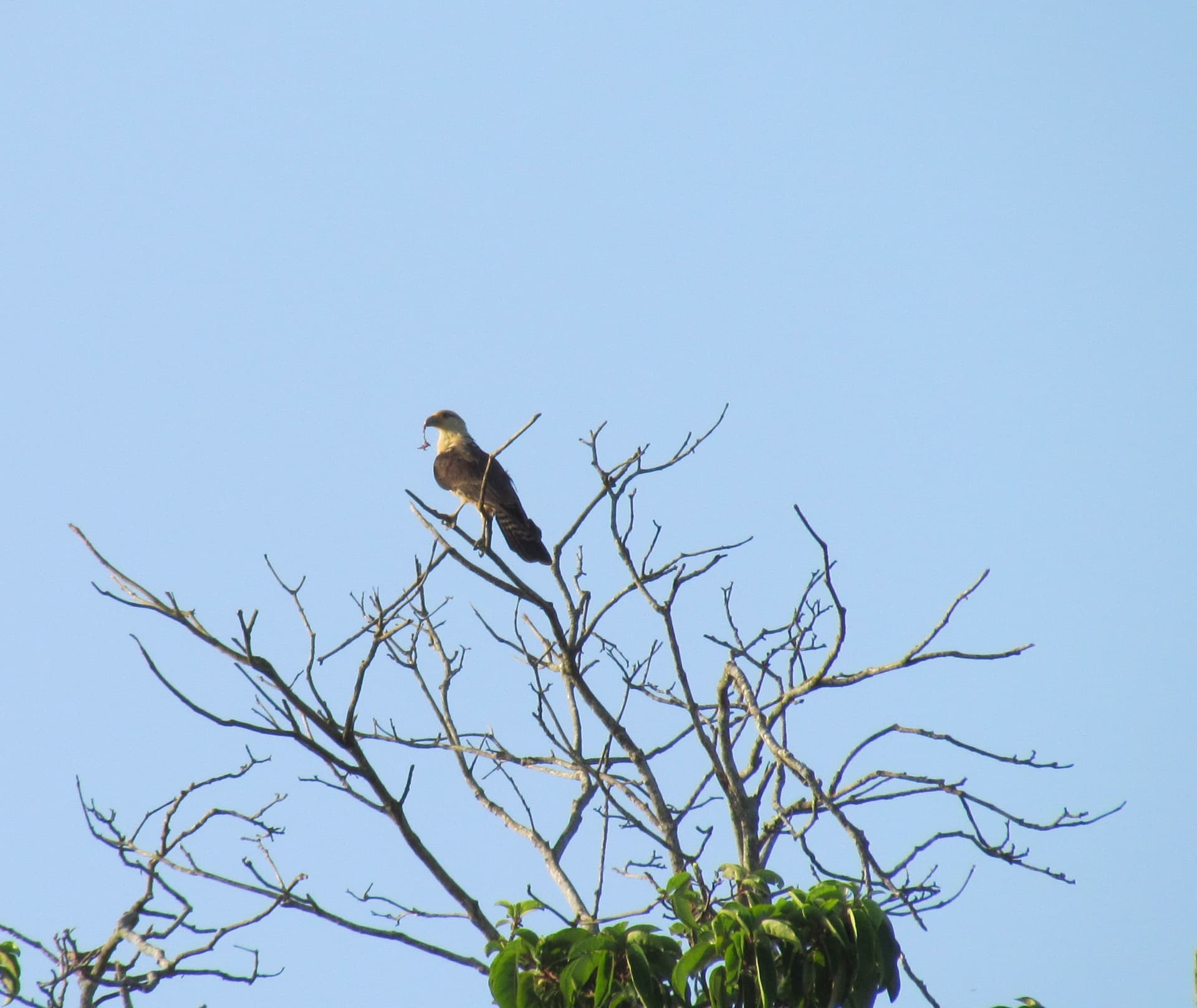
The Yellow-headed Caracara is a medium-sized, opportunistic falcon relative found throughout Trinidad and Tobago in open country, agricultural land, and pastures, where it is commonly seen perched on fence posts, cattle, or grazing animals from which it picks ticks and parasites. Its pale buff-yellow head and cream underparts, combined with dark brown wings and back and a streaked face, make it a distinctive and familiar bird of open landscapes on both islands. Unlike the powerful hunting falcons, it is primarily a scavenger and opportunist, exploiting a wide range of food sources.
Identification
The Yellow-headed Caracara measures 40 to 46 cm. The head and underparts are pale buff-cream to yellowish-white, with a dark brown streaked pattern through the eye. The back, wings, and tail are dark brown. The tail has fine dark barring and a dark subterminal band. The bare facial skin and cere are yellowish. The bill is hooked, typical of raptors. In flight, prominent pale buff wing patches on the primary bases are conspicuous. The flight style is buoyant and slightly floppy. Juveniles are more heavily streaked and browner on the head than adults.
Ecology
Yellow-headed Caracaras are highly opportunistic generalists, feeding on carrion, ticks picked from cattle and capybaras, insects, small vertebrates, fruit, and eggs. The habit of attending livestock to eat ticks and fly larvae constitutes a mutually beneficial relationship with cattle ranching. They are bold and inquisitive, not shy of humans, and readily exploit roadsides for road-killed animals. They also follow tractors and ploughs to catch displaced insects and small animals. Nests are built in trees, often in agricultural areas near human settlements.
Status in T&T
The Yellow-headed Caracara is a common year-round resident on both Trinidad and Tobago in open and agricultural habitats, pastures, and suburban areas. It has expanded its range with deforestation and the spread of cattle ranching. The species is fully protected under the Conservation of Wild Life Act and is not a game species. It is one of the few raptors that has actually benefited from land conversion from forest to agriculture.
Threats
- Decline of cattle ranching removing tick-feeding opportunities
- Pesticide-treated livestock reducing invertebrate food sources