Bird
Bird
Ruby-topaz Hummingbird
Chrysolampis mosquitus
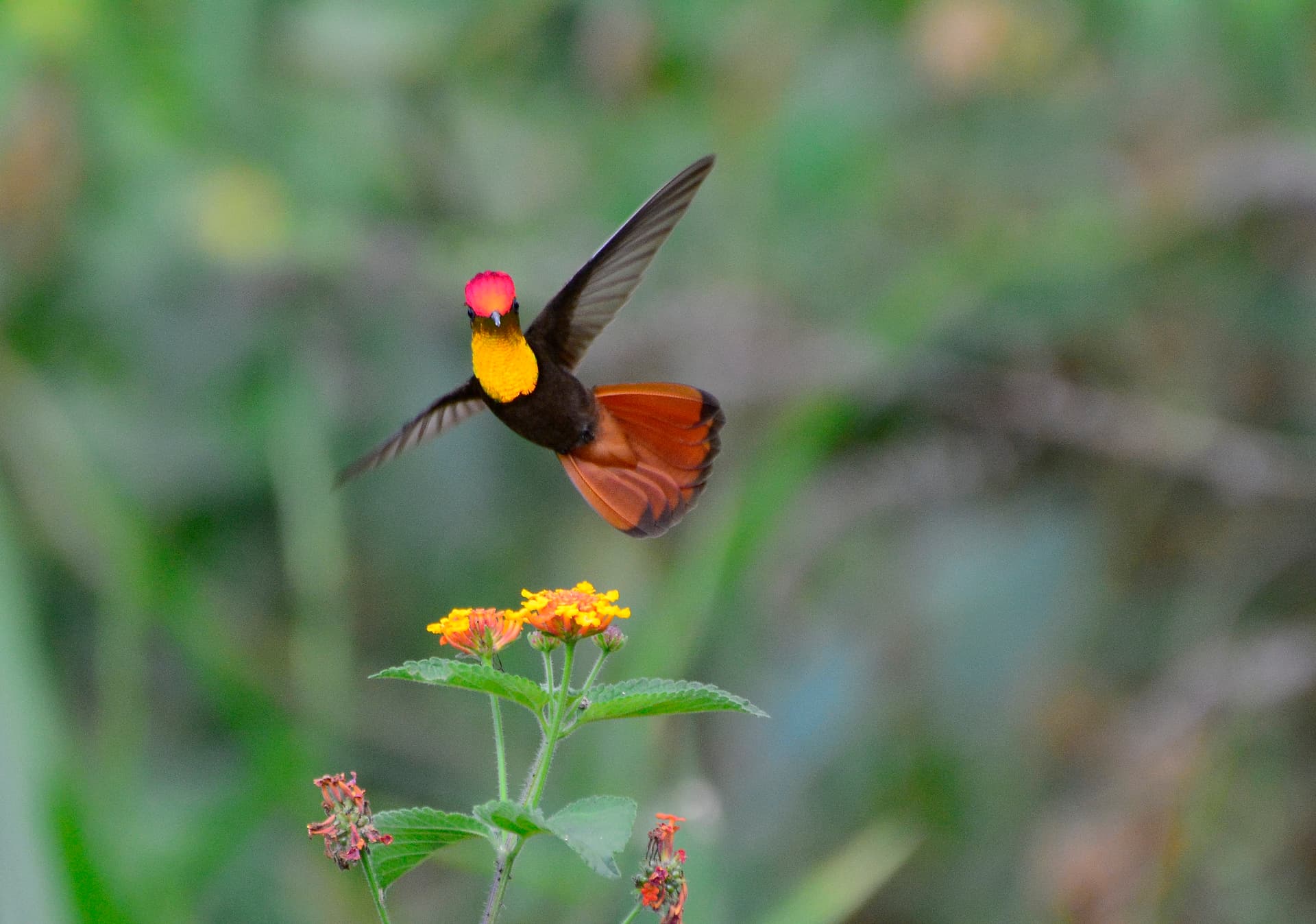
The Ruby-topaz Hummingbird is one of the most dazzlingly coloured birds in Trinidad and Tobago, the male combining a fiery ruby-red crown, brilliant golden-orange throat, and deep chestnut-brown body into an almost jewel-like combination that flashes brilliantly in sunlight.
The Ruby-topaz Hummingbird is one of the most dazzlingly coloured birds in Trinidad and Tobago, the male combining a fiery ruby-red crown, brilliant golden-orange throat, and deep chestnut-brown body into an almost jewel-like combination that flashes brilliantly in sunlight. Found on both islands in open scrub, gardens, and savanna habitats, it is one of the most commonly seen hummingbirds in residential areas and is often the first hummingbird species encountered by visitors to T&T outside of forested areas.
Identification
The Ruby-topaz Hummingbird is a small hummingbird measuring 8 to 9 cm. The male is unmistakable: a deep ruby-red crown and nape that glitters brilliantly when the light catches it, a vivid golden-orange to topaz-yellow gorget (throat patch), dark chestnut-brown body, and a rufous-orange tail. The female is far less conspicuous: bronze-green above, pale grey-white below, with a white spot behind the eye and a rufous-tinged tail. Both sexes have a short, straight, black bill. In flight the wings produce a distinctive rapid buzzing.
Ecology
Ruby-topaz Hummingbirds feed on nectar from a wide variety of flowers, including those of garden ornamentals, native shrubs, and flowering trees. They are aggressive and territorial at nectar sources, frequently chasing other hummingbirds regardless of size. Like all hummingbirds they also consume small insects and spiders for protein, especially during nesting. The female builds a tiny cup nest of plant fibres and spider silk, often attached to a thin branch or wire, and raises two chicks alone. The male plays no role in nesting or chick-rearing.
Status in T&T
The Ruby-topaz Hummingbird is found on both Trinidad and Tobago in open habitats: gardens, scrub, savanna edges, secondary growth, and disturbed areas. It is one of the most abundant hummingbirds in T&T's lowlands and urban gardens. The species is fully protected under the Conservation of Wild Life Act and is not a game species. It has benefited from the proliferation of flowering garden plants and is among the hummingbird species least threatened by habitat change in T&T.
Threats
- Garden pesticide use reducing nectar plant and insect availability
- Nest predation by introduced mammals