Bird
Bird
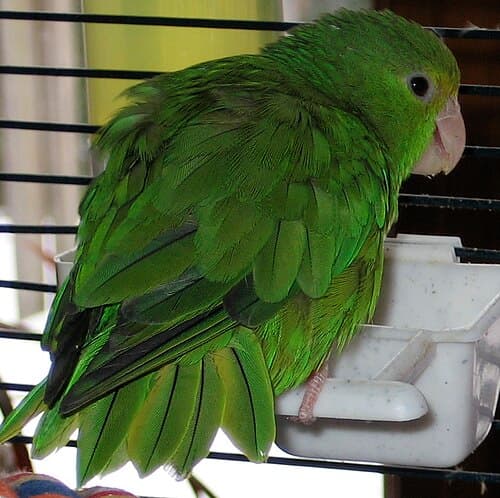
Green-rumped Parrotlet
Forpus passerinus
The Green-rumped Parrotlet is the smallest parrot found in Trinidad and Tobago, a diminutive, fast-flying, sociable bird of open country and gardens, its high-pitched, chattering calls giving away small flocks moving between feeding trees.
The Green-rumped Parrotlet is the smallest parrot found in Trinidad and Tobago, a diminutive, fast-flying, sociable bird of open country and gardens, its high-pitched, chattering calls giving away small flocks moving between feeding trees.
Identification
A tiny parrot around 12 to 13 cm long, predominantly bright green with paler underparts. Males show a blue patch on the wing coverts and rump area not present in females, which are uniformly green. Its very small size, short tail, and rapid, direct flight distinguish it easily from the larger parrots and macaws sharing its range.
Ecology
The Green-rumped Parrotlet feeds on small seeds, grass seeds, buds, and blossoms, foraging in small, tightly bonded flocks in open savanna, scrub, agricultural land, and gardens. It nests in cavities, including old woodpecker holes, fence post cavities, and other small hollows, and is unusual among parrots for readily using artificial nest sites, which has made it a well-studied model species for research on cooperative breeding and pair bonding in the wild.
Status in T&T
Common in open country, savanna, agricultural land, and gardens across both Trinidad and Tobago. It is not threatened and, owing to its small size, is somewhat less targeted for the pet trade than larger parrot species, though it is still sometimes kept and traded. It is protected under the Conservation of Wildlife Act, and, like other parrots, is subject to CITES trade restrictions.
Threats
- Some illegal capture for the pet trade, though less targeted than larger parrots