Bird
Bird
American Kestrel
Falco sparverius
The American Kestrel is the smallest and most colourful falcon in the Americas and one of the most familiar raptors of open country in Trinidad and Tobago, a sparrow-sized bird of prey commonly seen perched on telephone wires and fence posts across agricultural land and suburban areas, where it bobs its tail repeatedly in a characteristic nervous gesture.
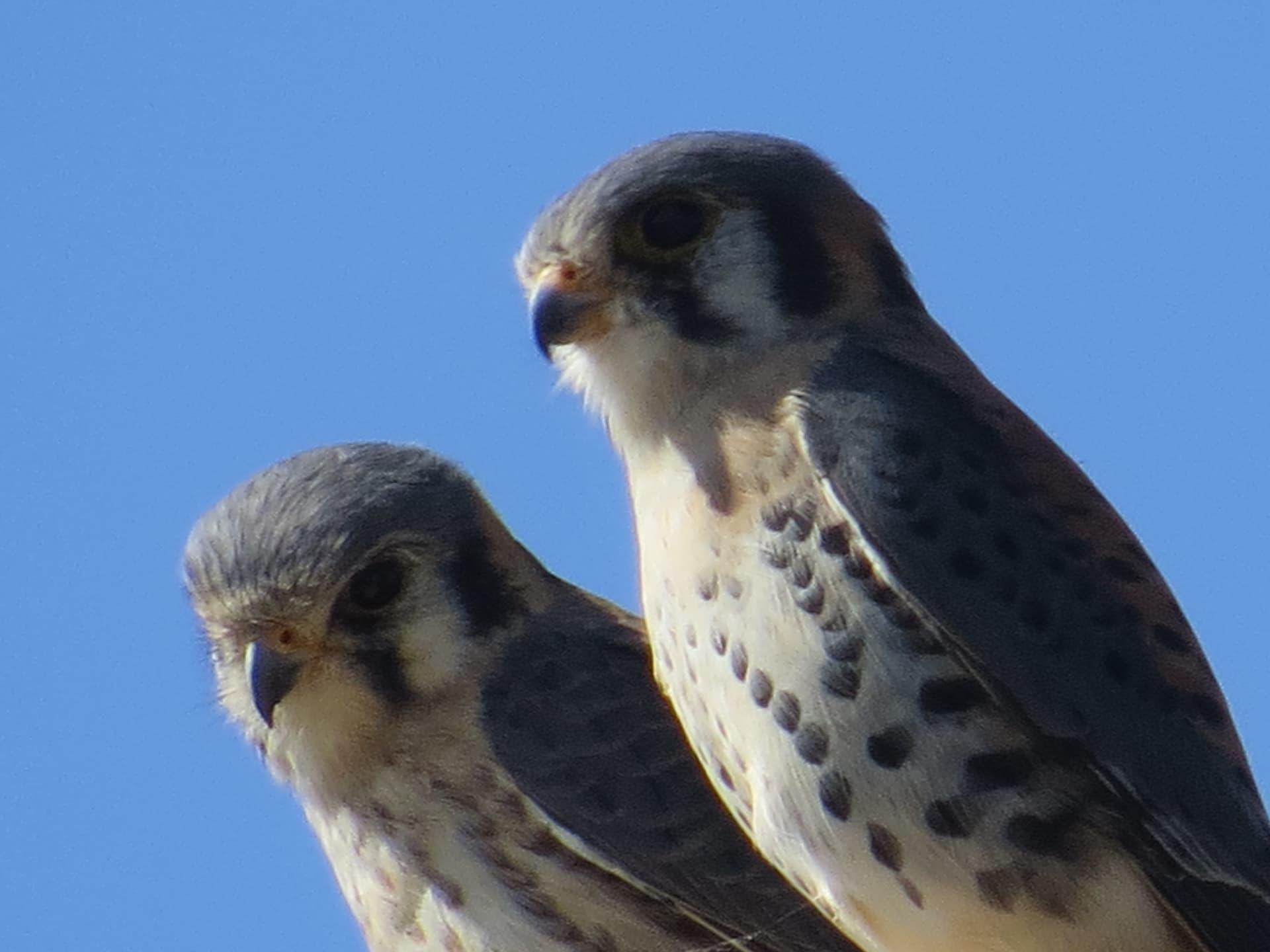
The American Kestrel is the smallest and most colourful falcon in the Americas and one of the most familiar raptors of open country in Trinidad and Tobago, a sparrow-sized bird of prey commonly seen perched on telephone wires and fence posts across agricultural land and suburban areas, where it bobs its tail repeatedly in a characteristic nervous gesture. The male is a jewel of a raptor, combining blue-grey wings, rufous back and tail, and bold black facial markings, while the female is streaked rufous-brown throughout. Both sexes hover over open ground to spot insect and small vertebrate prey below.
Identification
The American Kestrel measures 22 to 31 cm with a wingspan of 51 to 61 cm, roughly starling-sized. The male has blue-grey wings, a rufous back barred with black, a rufous tail with a black subterminal band, and a white face with two vertical black facial stripes (moustache and post-ocular stripe). The underparts are pale buff spotted with black. The female is larger, with rufous-brown wings, back, and tail all heavily barred with dark brown. Both sexes habitually bob or pump the tail when perched. In flight the kestrel hovers frequently, head into the wind, scanning the ground below.
Ecology
American Kestrels are generalist predators of open country, taking large insects (grasshoppers, beetles, dragonflies), lizards, small snakes, frogs, small birds, and small mammals. They hunt by hovering or watching from a prominent perch, dropping steeply to strike prey on the ground. In T&T they are most abundant in the dry season when grassy habitats offer concentrated prey. They nest in natural tree cavities, old woodpecker holes, crevices in buildings, or nest boxes. The pair shares incubation of typically 4 to 5 eggs.
Status in T&T
The American Kestrel is a common year-round resident on both Trinidad and Tobago in open grasslands, agricultural land, suburban areas, and the edges of savanna. The T&T population belongs to one of the island subspecies of the sparverius group. The species is fully protected under the Conservation of Wild Life Act and is not a game species. Though globally common, kestrel populations in parts of the Americas have declined due to grassland loss and pesticide reduction of insect prey.
Threats
- Pesticide reduction of insect prey base
- Loss of open grassland and savanna habitat
- Nest cavity loss from tree clearance