Bird
Bird
White-necked Jacobin
Florisuga mellivora
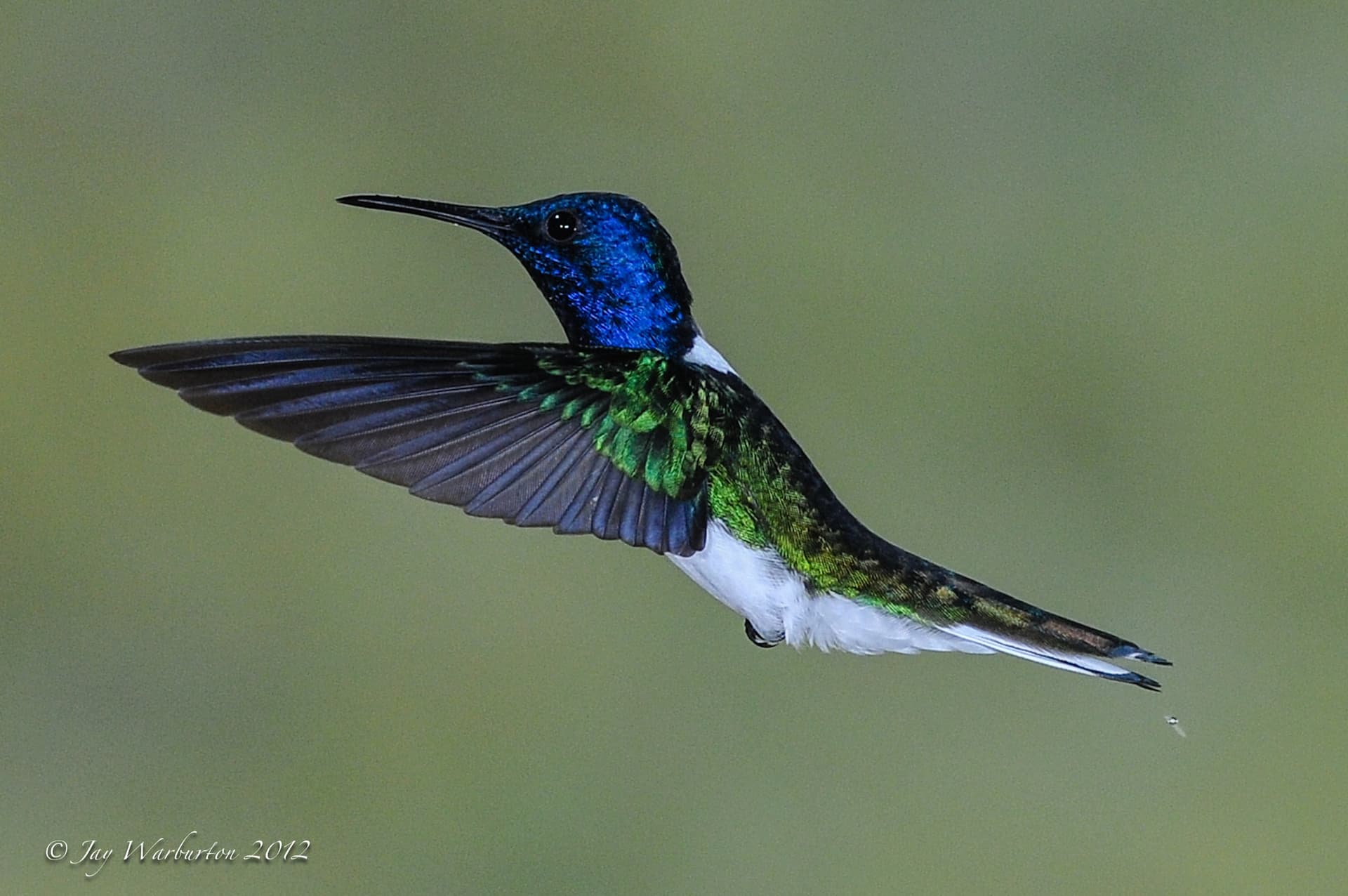
The White-necked Jacobin is one of the most striking hummingbirds of T&T's forests, the male a bold combination of deep iridescent blue head and breast, pure white belly and tail, and a distinctive white collar at the nape.
The White-necked Jacobin is one of the most striking hummingbirds of T&T's forests, the male a bold combination of deep iridescent blue head and breast, pure white belly and tail, and a distinctive white collar at the nape. Frequently seen at forest edges and flowering trees in the Northern Range and at sites like Asa Wright Nature Centre, it is a bold, fast, and conspicuous hummingbird that often dominates nectar sources and is one of the more reliably seen large hummingbirds at both forest and garden feeders on Trinidad.
Identification
The White-necked Jacobin measures 11 to 12 cm, one of the larger hummingbirds in T&T. The male is distinctive: deep iridescent blue-green on the head, throat, and upper breast, a white hindneck collar, vivid white belly and undertail, and white outer tail feathers with a broad blue-black terminal band. The bill is straight and medium length. The female is dusky green above and white-scaled green below; some females (about 20-30%) adopt a male-like plumage, a remarkable example of female mimicry of male colouration. Juveniles are similar to typical females.
Ecology
White-necked Jacobins are aggressive, dominant hummingbirds at nectar sources, regularly displacing smaller species. They feed on nectar from a wide variety of forest and garden flowers, particularly favouring large, tubular Heliconia and Erythrina flowers. They also hawk small insects in the air. Males perform rapid display flights above the forest canopy. The female builds a cup nest of plant fibres on a slender branch and raises two chicks alone. This species is a trap-line forager, visiting a series of flower patches in sequence along a regular route.
Status in T&T
The White-necked Jacobin is found on both Trinidad and Tobago, most commonly in forest edges, shaded gardens, and secondary growth near forest on both islands. It is one of the most frequently observed larger hummingbirds at forest-edge flower sources. The species is fully protected under the Conservation of Wild Life Act and is not a game species. Its tolerance of secondary and garden habitats makes it less sensitive to forest fragmentation than strictly interior forest hummingbirds.
Threats
- Forest fragmentation reducing flower diversity
- Pesticide reduction of flower and insect resources