Bird
Bird
Bat Falcon
Falco rufigularis
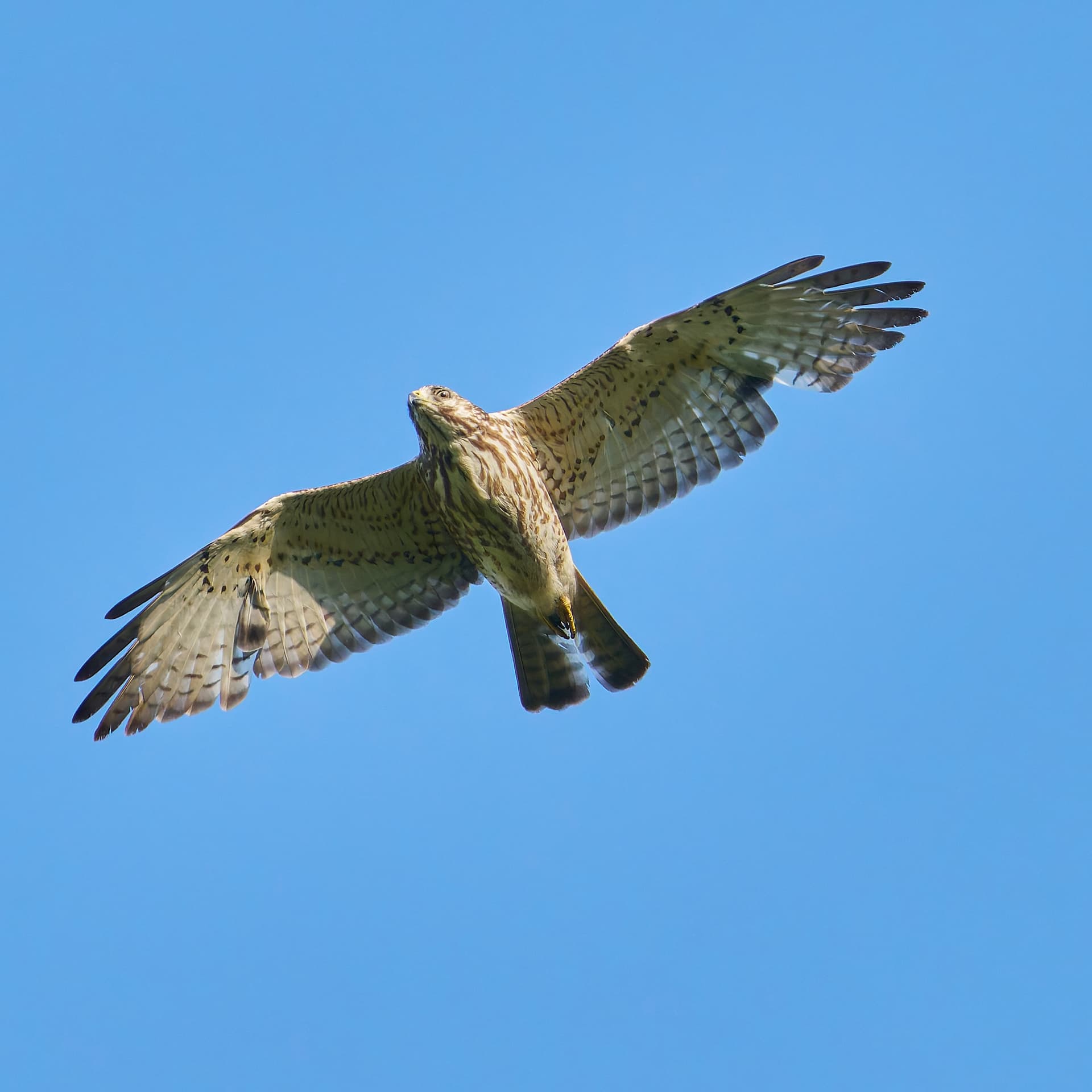
The Bat Falcon is a small, powerful, and handsomely marked forest falcon present on both Trinidad and Tobago, named for its habit of hunting bats at dusk but equally capable of taking swifts, swallows, and large insects at speed in open airspace above the canopy.
The Bat Falcon is a small, powerful, and handsomely marked forest falcon present on both Trinidad and Tobago, named for its habit of hunting bats at dusk but equally capable of taking swifts, swallows, and large insects at speed in open airspace above the canopy. Despite being considerably smaller than the Peregrine Falcon, it shares the characteristic pointed wings, rapid wingbeat, and aerial precision of the falcon family, and is one of the most exciting raptors for birdwatchers to encounter at T&T forest edges at dawn and dusk.
Identification
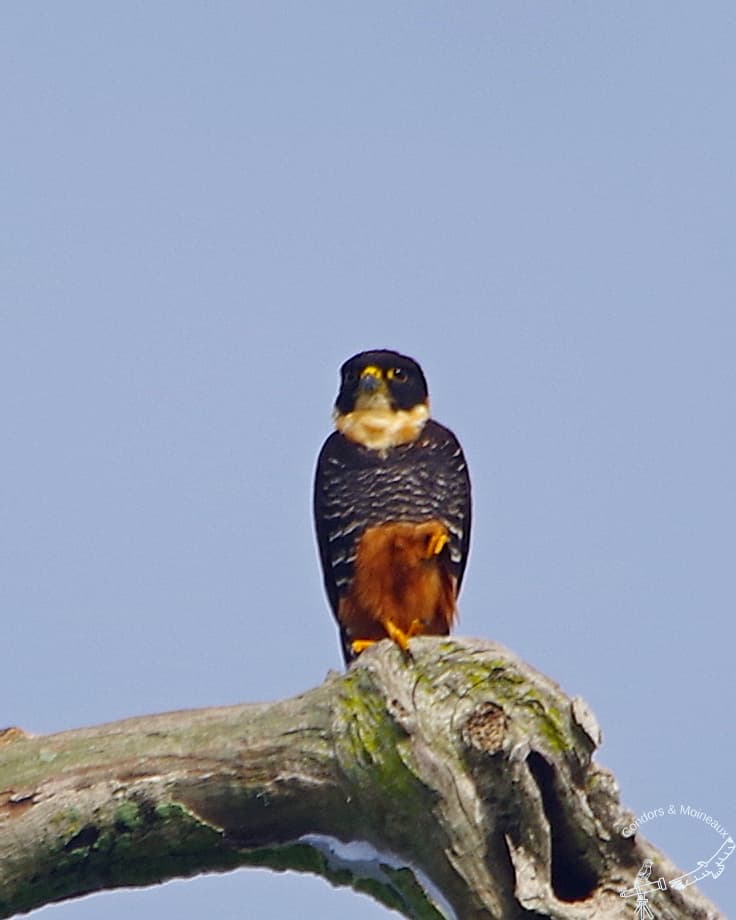
The Bat Falcon measures 23 to 30 cm, considerably smaller than the Peregrine Falcon. The upperparts are dark slate-black, the throat and upper breast white contrasting sharply with a narrow black moustachial stripe and dark crown. Below the white throat, a broad black breast band separates the white from a vivid rufous-orange lower breast and belly. The tail is narrowly barred black and white. The cere and orbital ring are yellow-orange. In flight the wings are long and pointed. Females are substantially larger than males, as in most raptors. The related Orange-breasted Falcon is larger and has a broader orange breast band.
Ecology
Bat Falcons are aerial hunters of the forest canopy and adjacent open airspace. They typically hunt from a high exposed perch at the top of a tall tree, sallying out to pursue and strike fast-flying prey. Primary prey includes bats taken at dusk as they emerge from roosts, swifts and swallows, large dragonflies and other insects, and small birds. The attack is a fast, level pursuit rather than the high stoop of the Peregrine. They are territorial and tend to occupy the same prominent perch trees year after year. Nesting uses natural tree cavities, typically high in a tall forest emergent.
Status in T&T
The Bat Falcon is found on both Trinidad and Tobago in forested areas, forest edges, and wherever tall emergent trees provide hunting perches above the canopy. It is uncommon but regular at sites such as Asa Wright Nature Centre and the forests of the Northern Range. The species is fully protected under the Conservation of Wild Life Act and is not a game species. Its dependence on large-diameter emergent trees for nesting makes it sensitive to the loss of old-growth forest structure.
Threats
- Loss of large emergent trees and old-growth forest structure
- Forest fragmentation reducing prey availability
- Bat population declines affecting food supply