Bird
Bird
Broad-winged Hawk
Buteo platypterus
The Broad-winged Hawk is a compact, forest-dwelling buteo that has one of the most dramatic migrations of any raptor in the Americas, with millions of birds concentrating at geographic bottlenecks during spring and autumn migration in what are called kettles, enormous spiralling columns of birds on thermals.
The Broad-winged Hawk is a compact, forest-dwelling buteo that has one of the most dramatic migrations of any raptor in the Americas, with millions of birds concentrating at geographic bottlenecks during spring and autumn migration in what are called kettles, enormous spiralling columns of birds on thermals. In Trinidad and Tobago the species occurs both as a breeding resident (a distinct sedentary subspecies) and as a passage migrant, giving the island a special dual status in the hawk's annual cycle. The resident T&T subspecies (*insulicola*) is largely non-migratory and inhabits the forested hills of both islands year-round.
Identification
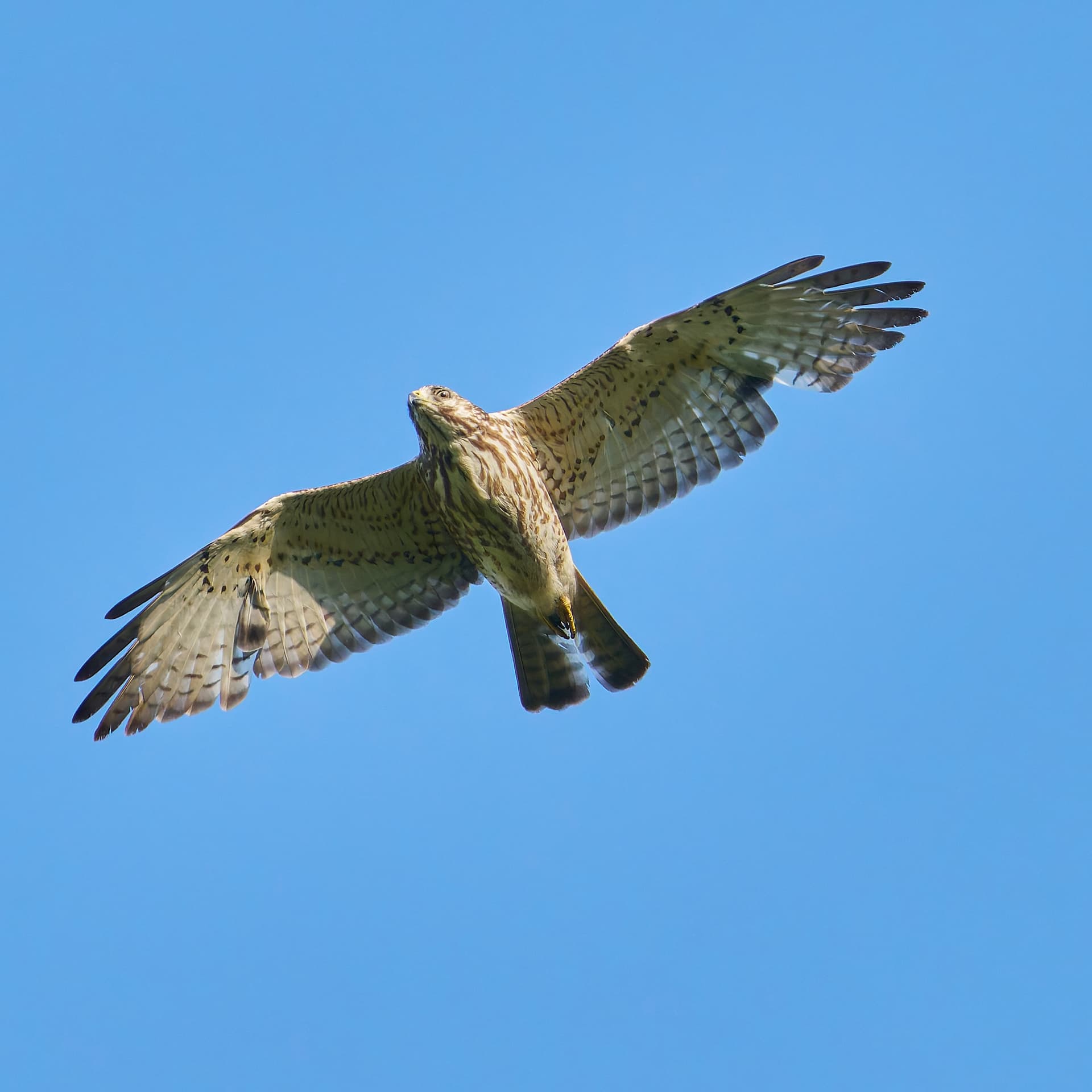
The Broad-winged Hawk measures 34 to 45 cm with a wingspan of 74 to 100 cm. The adult has dark brown upperparts, a rufous-barred breast and upper belly, and a boldly banded tail with broad black and white bands (typically 2 to 3 bands visible). The underwing in flight shows pale remiges with a dark border and dark wing tips. The wings are broad and the tail relatively short, giving a compact, stocky silhouette. Juveniles are streaked brown below. The sedentary T&T subspecies tends to be slightly different in tone from migratory North American birds passing through.
Ecology
Broad-winged Hawks are forest raptors, hunting from perches in the forest understorey and mid-canopy for small mammals, frogs, lizards, large insects, and occasionally small birds. They are relatively quiet and secretive compared to open-country raptors, perching motionless for long periods before dropping to take prey. The resident T&T population nests in forest, building a stick nest in a tall tree. Migratory North American birds arrive in T&T during September to November and March to April and may be seen at forest edges and ridge lines during peak passage.
Status in T&T
T&T supports both the resident endemic subspecies *insulicola* on Trinidad and Tobago and passage migrants from North American breeding populations. The species is found in forested hills and the Northern Range on Trinidad and in the Main Ridge area on Tobago. It is fully protected under the Conservation of Wild Life Act and is not a game species. The resident subspecies is dependent on the continued integrity of mature forest on both islands.
Threats
- Forest loss reducing habitat for resident subspecies
- Hunting during migration outside T&T
- Climate-driven shifts in migratory timing