Bird
Bird
Purple Honeycreeper
Cyanerpes caeruleus
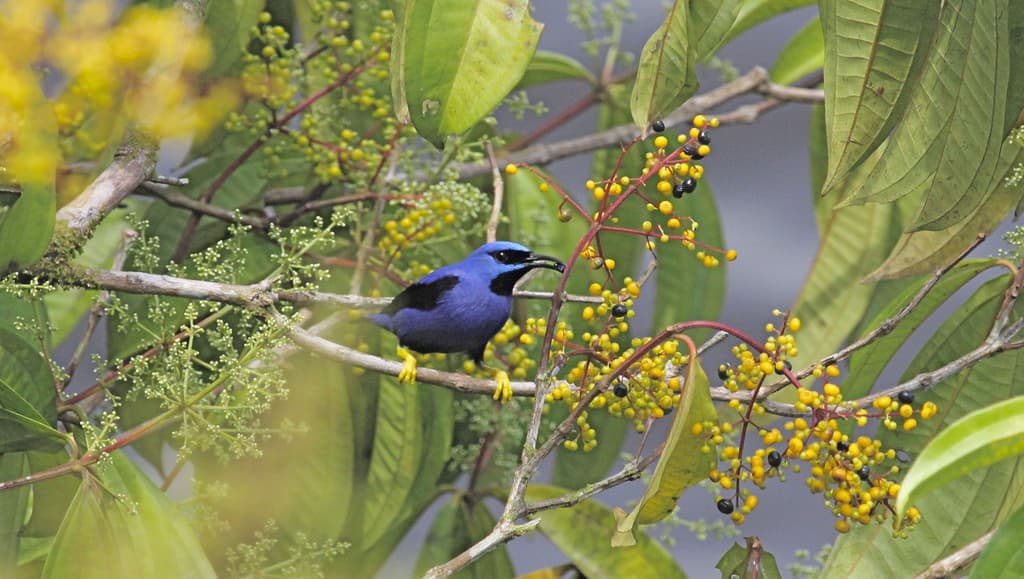
Photo: Shriram Rajagopalan · Asa Wright Nature Centre, Trinidad (CC BY 2.0)
The Purple Honeycreeper is one of the most vivid birds of Trinidad and Tobago's forest canopy, the male dressed in deep violet-purple plumage with contrasting black wings, back, and tail, and distinctive yellow legs that stand out against any branch.
The Purple Honeycreeper is one of the most vivid birds of Trinidad and Tobago's forest canopy, the male dressed in deep violet-purple plumage with contrasting black wings, back, and tail, and distinctive yellow legs that stand out against any branch. A specialist nectar feeder with a long, curved bill adapted for probing flowers, it is also a nimble forager for small fruits and insects in the forest upper storey and at garden flowering trees. Both Trinidad and Tobago support resident populations, and it is a frequently seen species wherever flowering trees attract bird activity.
Identification
The Purple Honeycreeper measures 11 to 12 cm. The male is striking: deep violet-purple over most of the body, with black wings, back, tail, and a narrow black mask through the eye and across the throat. The legs are bright yellow and conspicuous. The bill is long, decurved, and black, adapted for nectar probing. The female is completely different: olive-green above, pale streaked buff-green below, with a moustachial stripe, blue crown tinge, and similarly bright yellow-orange legs. Juveniles resemble the female. The related Red-legged Honeycreeper male is blue-green with red legs, while the female also differs significantly.
Ecology
Purple Honeycreepers feed primarily on nectar from a wide range of flowering trees and epiphytes, using the long decurved bill to access deep tubular flowers. They also take small berries and fruits, and hawk small insects and spiders in the forest canopy. They are important pollinators and, to a lesser extent, seed dispersers in T&T's forest ecosystems. Though not as strongly colonial as some honeycreepers, they often form loose mixed flocks with other small fruit-eating birds in the canopy. The cup nest is placed in a small tree or dense shrub.
Status in T&T
The Purple Honeycreeper is found on both Trinidad and Tobago in forest interior, forest edges, plantation gardens, and wherever large flowering trees occur. It is a common year-round resident on both islands. The species is fully protected under the Conservation of Wild Life Act and is not a game species. It is sensitive to loss of the large canopy flowering trees it depends on for nectar, making forest and large garden tree retention important for its welfare in T&T.
Threats
- Loss of large canopy flowering trees
- Forest fragmentation reducing foraging connectivity
- Garden pesticide reduction of insect component of diet