Bird
Bird
White-collared Swift
Streptoprocne zonaris
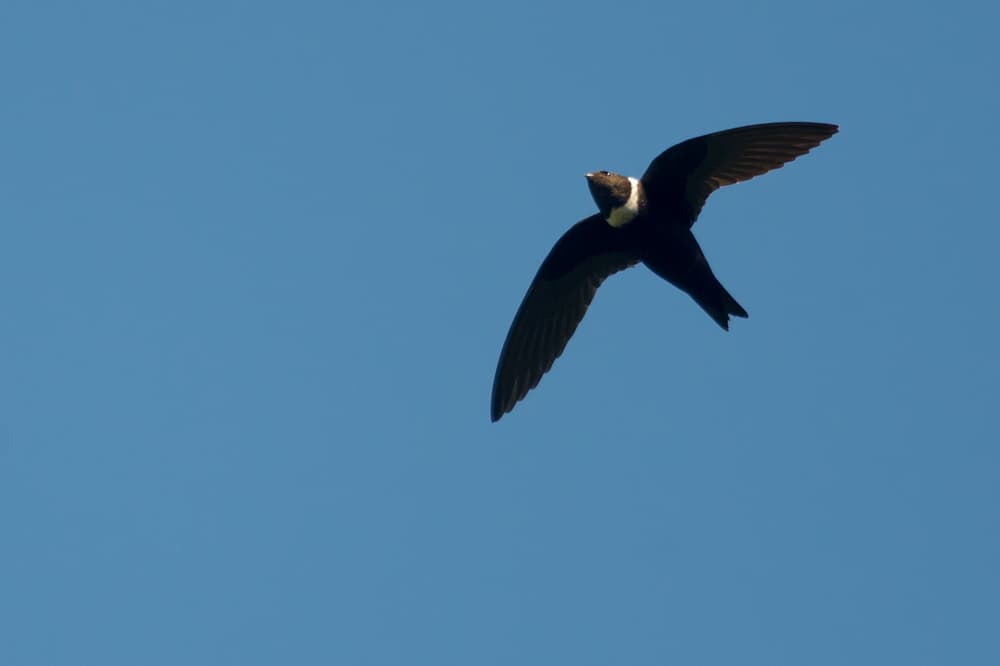
The White-collared Swift is the largest swift recorded in Trinidad and Tobago, an impressively fast, powerful flier often seen in noisy flocks sweeping over forested hills and ridges, particularly around waterfalls and cliffs used for roosting.
The White-collared Swift is the largest swift recorded in Trinidad and Tobago, an impressively fast, powerful flier often seen in noisy flocks sweeping over forested hills and ridges, particularly around waterfalls and cliffs used for roosting.
Identification
A large swift around 20 to 22 cm long, blackish overall with a broad, complete white collar encircling the neck, contrasting sharply with the dark body and readily visible even at distance or height. The wings are long and scythe-shaped, and the tail is slightly forked, adaptations for the sustained, high-speed flight typical of the species.
Ecology
An aerial insectivore, the White-collared Swift forages at considerable heights over forest, forest edge, and open country, often ranging widely in search of aerial insect swarms and covering large distances daily. It roosts and nests colonially on damp rock faces behind or beside waterfalls and on steep cliffs, building a nest of moss and plant material cemented with saliva to the rock surface, frequently in sites requiring flight through falling water to access.
Status in T&T
Found over forested hills, ridges, and waterfalls on both Trinidad and Tobago, with well-known roosting and nesting sites at several of Trinidad's Northern Range waterfalls. It is not threatened. It is protected under the Conservation of Wildlife Act and is not a game species.
Threats
- Disturbance of waterfall and cliff roosting and nesting sites