Bird
Bird
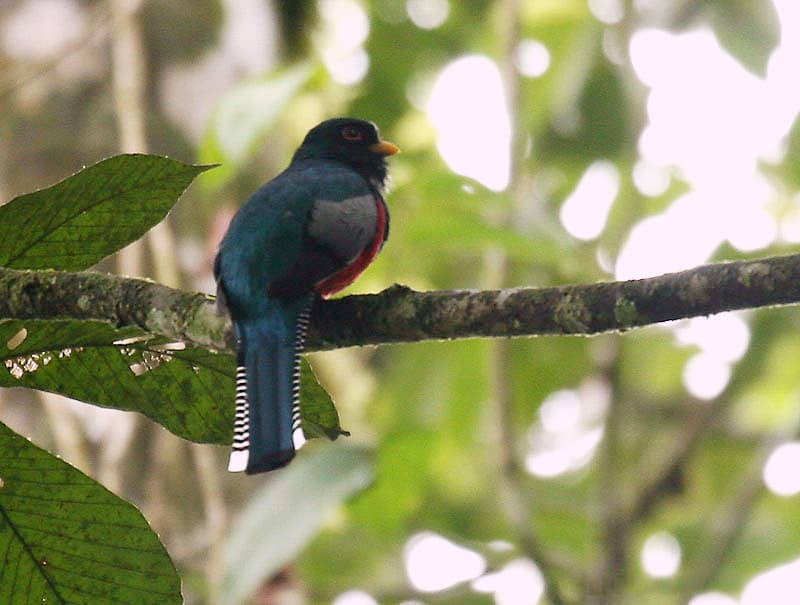
Collared Trogon
Trogon collaris
The Collared Trogon is a brilliantly coloured, quietly sedentary bird of Trinidad and Tobago's forest interior, the male's iridescent green upperparts and vivid red breast making it one of the most strikingly beautiful, if easily overlooked, birds of the forest understorey and mid-storey.
The Collared Trogon is a brilliantly coloured, quietly sedentary bird of Trinidad and Tobago's forest interior, the male's iridescent green upperparts and vivid red breast making it one of the most strikingly beautiful, if easily overlooked, birds of the forest understorey and mid-storey.
Identification
A medium-sized bird around 23 to 25 cm long. The male has an iridescent emerald-green head, back, and breast band separated from a vivid red belly by a narrow white collar, from which the common name derives, and a finely barred black-and-white undertail pattern. The female is duller, with a grey-brown breast and head replacing the male's green, but retains the red belly and barred undertail. Both sexes perch upright and remarkably still for long periods, relying on camouflage rather than movement.
Ecology
The Collared Trogon feeds on fruit and large insects, sallying briefly from a still perch to snatch prey or fruit before returning to the same or a nearby perch, a foraging style requiring patience and stillness rather than active movement through foliage. It nests in a cavity, often a rotten stub or an active or abandoned arboreal termite or wasp nest, hollowed out by the pair. It is usually detected by its soft, repeated, low-pitched call rather than by sight, given its habit of remaining motionless in dense mid-storey foliage.
Status in T&T
Found in forest interior on both Trinidad and Tobago, from lowland to montane forest, generally requiring intact forest structure. It is not threatened. It is protected under the Conservation of Wildlife Act and is not a game species.
Threats
- Forest clearance and fragmentation reducing intact forest structure