Bird
Bird
White Bellbird
Procnias alba
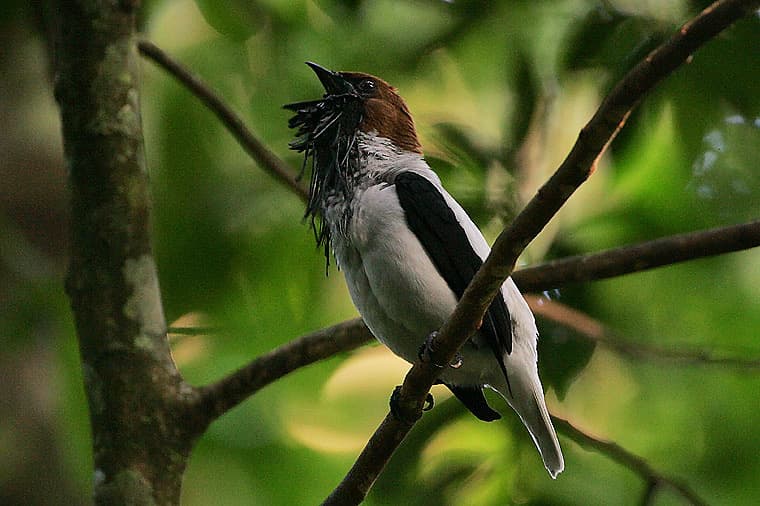
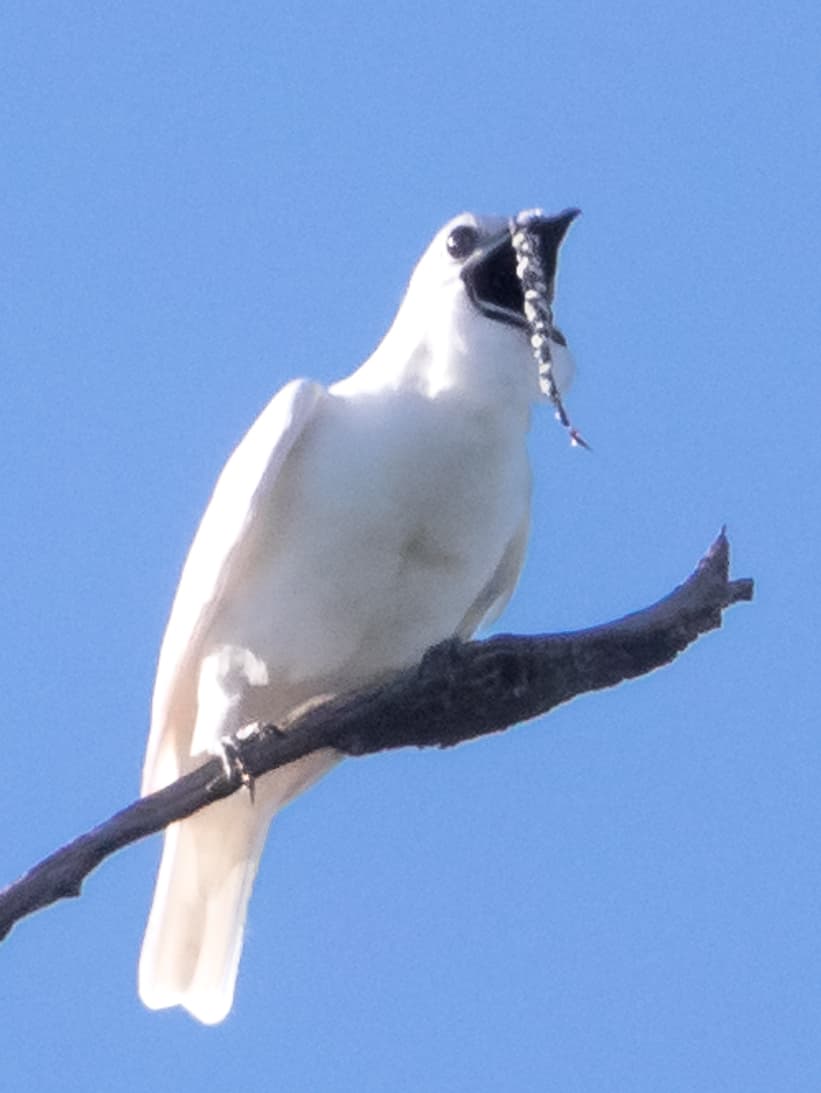
Photo: Christoph Moning · Parauapebas, Para, Brazil (CC BY 4.0)
The White Bellbird holds the record for the loudest bird call on Earth, a single, ear-splitting metallic clang delivered by the male at close range that has been measured at over 125 decibels, comparable to a chainsaw held at arm's length.
The White Bellbird holds the record for the loudest bird call on Earth, a single, ear-splitting metallic clang delivered by the male at close range that has been measured at over 125 decibels, comparable to a chainsaw held at arm's length. Found in Trinidad's Northern Range forests alongside its close relative the Bearded Bellbird, the male's all-white plumage and single dangling black wattle make it a strikingly bizarre figure on his display perch.
Identification
The White Bellbird is 27 to 30 cm long. Adult males are entirely snow white with a single long, black, worm-like wattle dangling from the base of the bill that is erected and swung forward during calling. The bill is broad and slightly hooked, the legs pale. Females are entirely different: olive-green above, heavily streaked yellow-green and dark below, resembling other female cotingas. Immature males pass through several intermediate plumages before achieving full adult dress. The contrast between the spectral white male and the cryptic female is one of the most extreme examples of sexual dimorphism among T&T birds.
World Record Call
The male White Bellbird produces the loudest bird call ever recorded, a single explosive metallic "BONK" that has been measured at 125.4 dB at a distance of one metre from the calling bird. To produce this extraordinary sound, the male compresses his chest dramatically and opens his bill to an angle of nearly 180 degrees, forcing air through the modified syrinx. Females that approach a displaying male are subjected to this call at point-blank range, a form of sensory coercion that has fascinated researchers studying mate choice. Males call from exposed perches in the forest canopy, rotating to face different directions during calling bouts.
Status in T&T
The White Bellbird is found in Trinidad in the higher forests of the Northern Range, typically above 400 m, and is less frequently recorded than the Bearded Bellbird. It is absent from Tobago. The species is fully protected under the Conservation of Wild Life Act and is not a game species. As a frugivore and seed disperser of the montane forest, its conservation depends on maintaining the intact forest cover of Trinidad's Northern Range highlands.
Threats
- Northern Range montane forest loss
- Forest fragmentation