Bird
Bird
Bearded Bellbird
Procnias averano
The Bearded Bellbird is one of the most acoustically extraordinary birds in the world and a flagship species of Trinidad's Northern Range forests.
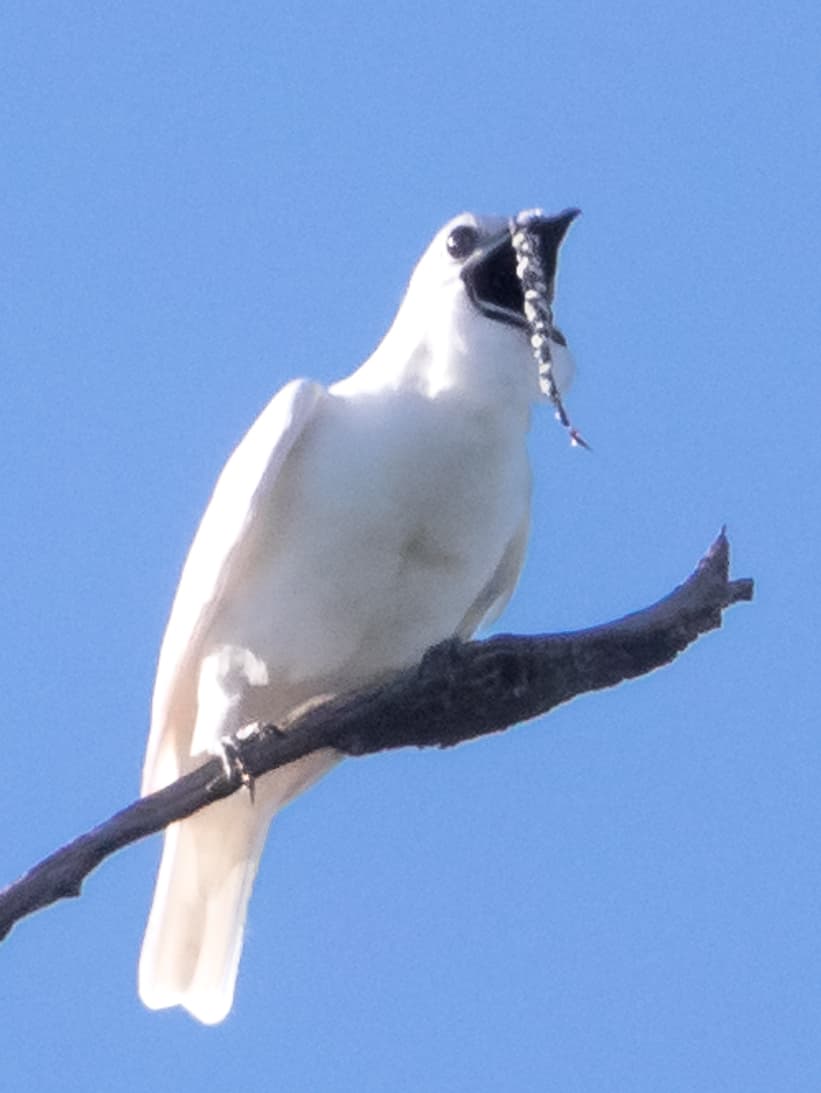
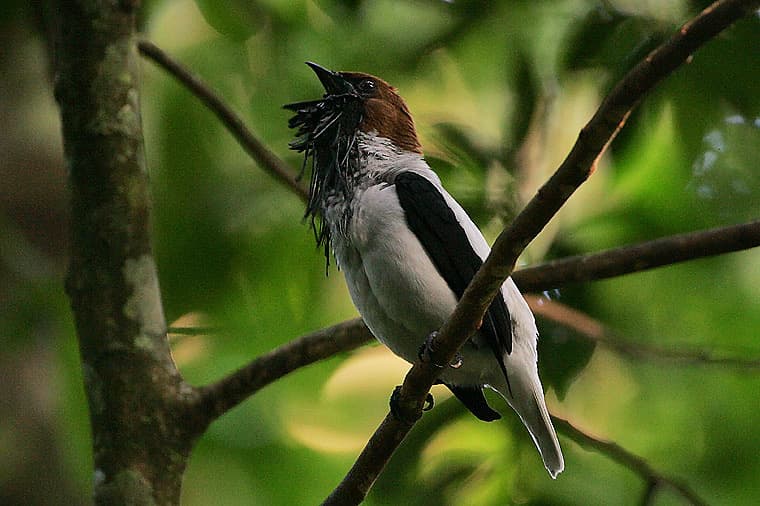
The Bearded Bellbird is one of the most acoustically extraordinary birds in the world and a flagship species of Trinidad's Northern Range forests. The male's bonk call, a single explosive metallic clang that carries over a kilometre through dense forest, is among the loudest sounds produced by any bird relative to its body size and is one of the defining soundscapes of T&T's highland interior. A member of the cotinga family, the Bearded Bellbird is strongly sexually dimorphic: males are stunning in white and black with a distinctive beard of wattles, while females are cryptically streaked green.
Identification
Male Bearded Bellbirds are 27 to 29 cm long and unmistakable: the plumage is white with a chestnut-brown head, the wings and back are black with white speckling, and the throat bears a remarkable dangling beard of black wiry wattles that gives the species its name. The bill is broad and slightly hooked. Females are entirely different in appearance, with olive-green and yellowish plumage heavily streaked with black, resembling other cotingas. Immature males pass through several intermediate plumages before attaining full adult dress.
Ecology and Display
Bearded Bellbirds are frugivores of the forest canopy and subcanopy, feeding on a range of berries and small fruits, particularly nutmeg family species (Myristicaceae) whose seeds they disperse. Males hold traditional display perches, returning to the same exposed branch year after year to produce their extraordinary call. The call is delivered with a violent full-body snap and is audible at extraordinary distances. Females visit display perches to assess males and mate, then nest and raise chicks entirely alone. Nests are simple, flimsy cups placed in the canopy.
Status in T&T
The Bearded Bellbird is found in Trinidad in the Northern Range and associated forested hills, typically above 300 m. It is absent from Tobago. The species is fully protected under the Conservation of Wild Life Act and is not a game species. It is considered a prime birdwatching target at Asa Wright Nature Centre and along the Blanchisseuse Road. Forest loss and fragmentation in the Northern Range represent the primary long-term threats to the species in T&T.
Threats
- Northern Range forest loss
- Forest fragmentation
- Disturbance of display perches