Bird
Bird
Troupial
Icterus icterus
Photo: Felix Uribe · Arauca, Colombia (CC BY-SA 2.0)
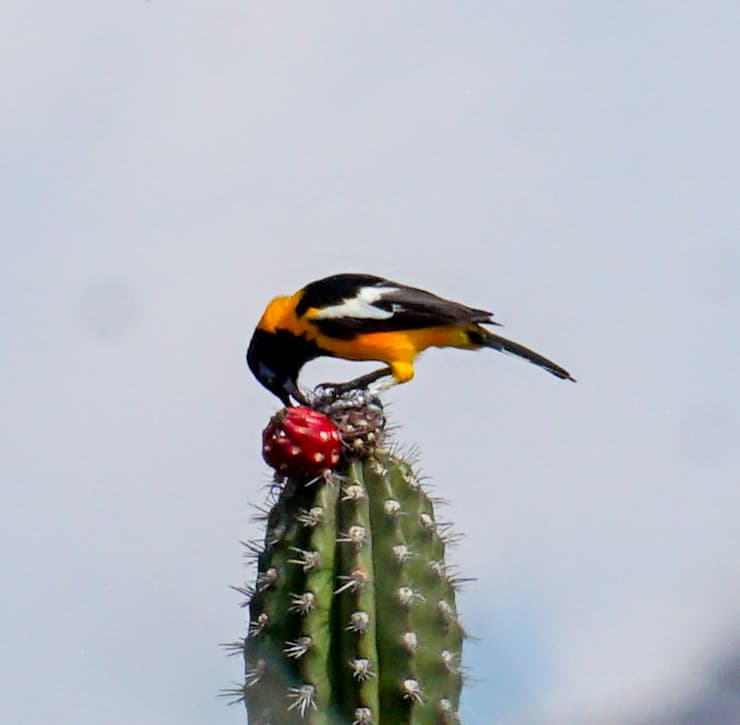
The Troupial is the largest oriole in South America and one of the most striking birds found in Trinidad and Tobago, combining vivid orange-and-black plumage with a long blue bare facial patch around the eye that distinguishes it immediately from every other icterid in the region.
The Troupial is the largest oriole in South America and one of the most striking birds found in Trinidad and Tobago, combining vivid orange-and-black plumage with a long blue bare facial patch around the eye that distinguishes it immediately from every other icterid in the region. Present on both islands, it is a bold, conspicuous bird of gardens, open woodland, and savanna edges, known for its loud, melodious song and its unusual habit of usurping the nests of other species rather than building its own.
Identification
The Troupial measures 22 to 25 cm, making it noticeably larger than the Yellow Oriole. The plumage is vivid: bright orange-yellow on the head, neck, and underparts, contrasting with glossy black wings and tail. A distinctive elongated bare blue orbital patch surrounds the yellow eye on the black face, a feature unique among Caribbean icterids. The bill is long, pointed, and pale bluish-grey at the base. In flight, large white patches on the black wings are visible. Juveniles are dull brownish with less contrasting pattern.
Ecology
Troupials are unusual among orioles in that they do not build their own nests. Instead, they usurp the nests of other species, particularly the large hanging basket nests of oropendolas and caciques, or open nests of other birds, sometimes evicting the rightful owners or waiting for a nest to be abandoned. They may also nest in tree cavities. Diet includes large insects, small lizards, frogs, eggs of other birds, nectar, and fruits. Their loud, rich whistled song carries over long distances and is one of the most musical bird songs heard in T&T.
Status in T&T
The Troupial is found on both Trinidad and Tobago in open woodland, gardens, savanna edges, and scrub. It is a year-round resident on both islands, though more common on Trinidad. The species is fully protected under the Conservation of Wild Life Act and is not a game species. It has historically been kept as a cage bird across the Caribbean because of its song, and illegal trapping remains a concern regionally.
Threats
- Illegal cage bird trapping
- Nest site competition from deforestation
- Garden pesticide reduction of insect prey