Bird
Bird
Tropical Mockingbird
Mimus gilvus
The Tropical Mockingbird is a bold, vocal, grey-and-white bird of open country and gardens across Trinidad and Tobago, well known for its habit of perching conspicuously on fence posts, wires, and rooftops while delivering long, varied, often mimicked phrases of song.
The Tropical Mockingbird is a bold, vocal, grey-and-white bird of open country and gardens across Trinidad and Tobago, well known for its habit of perching conspicuously on fence posts, wires, and rooftops while delivering long, varied, often mimicked phrases of song.
Identification
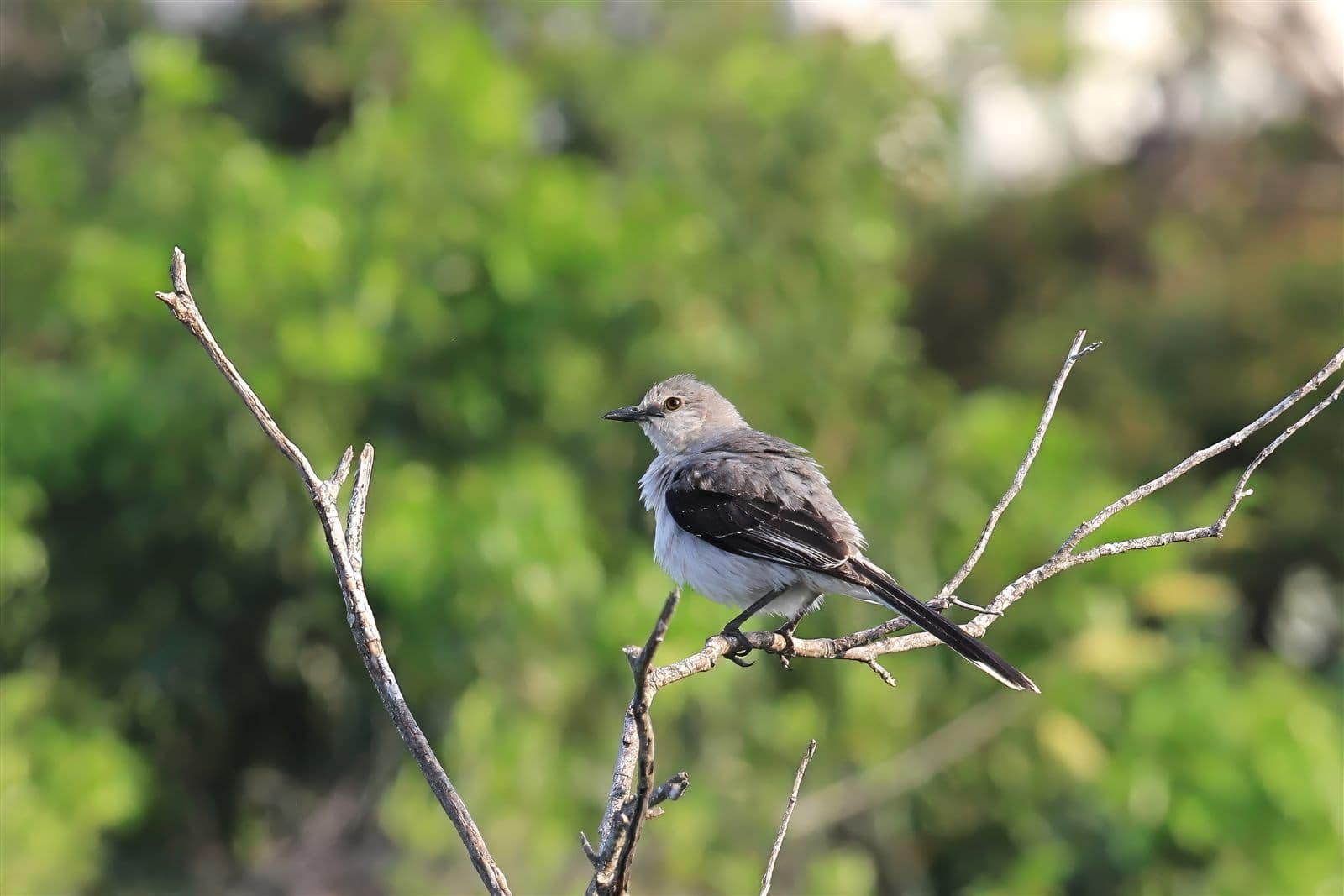
A slender, long-tailed bird around 25 cm long, pale grey above and whitish below, with a long black tail edged in white and a bold white wing patch visible in flight. The eye is pale yellow, and the bill is slim and slightly downcurved. Its upright posture and habit of frequently flicking and fanning the tail while foraging on open ground are distinctive field characteristics.
Ecology
An opportunistic omnivore, the Tropical Mockingbird feeds on insects, small lizards, fruit, and seeds, foraging mostly on the ground in open, short-grass habitats such as lawns, savannas, roadsides, and agricultural land. It is highly vocal, with a loud, varied song that frequently incorporates mimicked phrases and calls of other bird species, sung persistently from an exposed perch, sometimes even at night in urban settings under artificial light. Pairs are strongly territorial and will aggressively mob potential nest predators, including much larger birds.
Status in T&T
Common and conspicuous across both Trinidad and Tobago in gardens, savannas, agricultural land, and urban areas, thriving especially well in human-altered open landscapes. It is not threatened and has likely expanded with the spread of cleared, open habitat. It is protected under the Conservation of Wildlife Act and is not a game species.
Threats
- No significant threats; well adapted to human-altered landscapes