Bird
Bird
Great Kiskadee
Pitangus sulphuratus
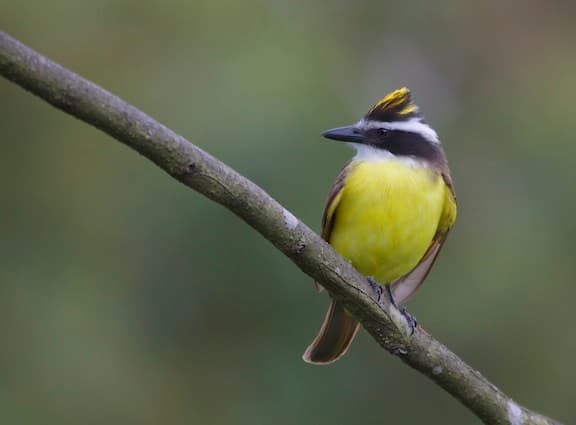
The Great Kiskadee is arguably the most familiar bird in Trinidad and Tobago, a loud, bold, brilliantly coloured flycatcher whose name is an onomatopoeia of its own call: a ringing "kis-ka-dee" that rings out from gardens, roadsides, forest edges, and waterways from early morning to dusk.
The Great Kiskadee is arguably the most familiar bird in Trinidad and Tobago, a loud, bold, brilliantly coloured flycatcher whose name is an onomatopoeia of its own call: a ringing "kis-ka-dee" that rings out from gardens, roadsides, forest edges, and waterways from early morning to dusk. With its vivid yellow breast, bold black-and-white head, and fearless temperament, the kiskadee is a defining presence in T&T's everyday landscape.
Identification
The Great Kiskadee is a robust flycatcher measuring 22 to 25 cm. The head is boldly patterned black and white, with a broad black mask, a white supercilium, and a white throat. The crown conceals a semi-hidden yellow patch, seldom visible unless the bird is agitated. The breast and underparts are deep, saturated yellow. The back and wings are rufous-brown. The bill is heavy, broad, and slightly hooked for its family. Sexes are identical. The species is easily separated from related flycatchers by its larger size, stronger bill, and combination of rufous wings with yellow underparts.
Ecology
The Great Kiskadee is a dietary generalist of exceptional flexibility. It hunts insects from prominent perches by sallying to catch them in flight or on the ground; it also takes small lizards, frogs, berries, and small fish by diving feet-first into shallow water in the manner of a kingfisher. This versatility makes it equally at home in forest edges, gardens, wetland margins, mangrove borders, and urban parks. Highly territorial and aggressive, kiskadees will mob and drive off much larger birds, including raptors, that approach their nests. The nest is a large, conspicuous domed structure of grass and other fibres.
Status in T&T
The Great Kiskadee is found on both Trinidad and Tobago and is one of the most abundant landbirds on both islands. It is fully protected under the Conservation of Wild Life Act and is not a game species. Its adaptability to modified and urban habitats means its population is stable and not threatened by the level of habitat change that affects forest-dependent species. The kiskadee's confident familiarity with humans and tolerance of settled environments make it one of T&T's most-photographed and most-recognised birds.
Threats
- Pesticide use reducing insect prey
- Nest predation by introduced mammals