Bird
Bird
Tropical Kingbird
Tyrannus melancholicus
The Tropical Kingbird is one of the most abundant and familiar birds in Trinidad and Tobago, a boldly confident flycatcher that perches prominently on wires, treetops, and fence posts in gardens, agricultural land, and forest edges across both islands.
The Tropical Kingbird is one of the most abundant and familiar birds in Trinidad and Tobago, a boldly confident flycatcher that perches prominently on wires, treetops, and fence posts in gardens, agricultural land, and forest edges across both islands. Like other kingbirds it aggressively defends its territory against birds far larger than itself, earning its name through regularly chasing hawks, vultures, and other raptors that stray too close to its nest. Its loud, rattling "pip-pip-pip-pipiteerrr" call is one of the most characteristic sounds of T&T's open country at dawn.
Identification
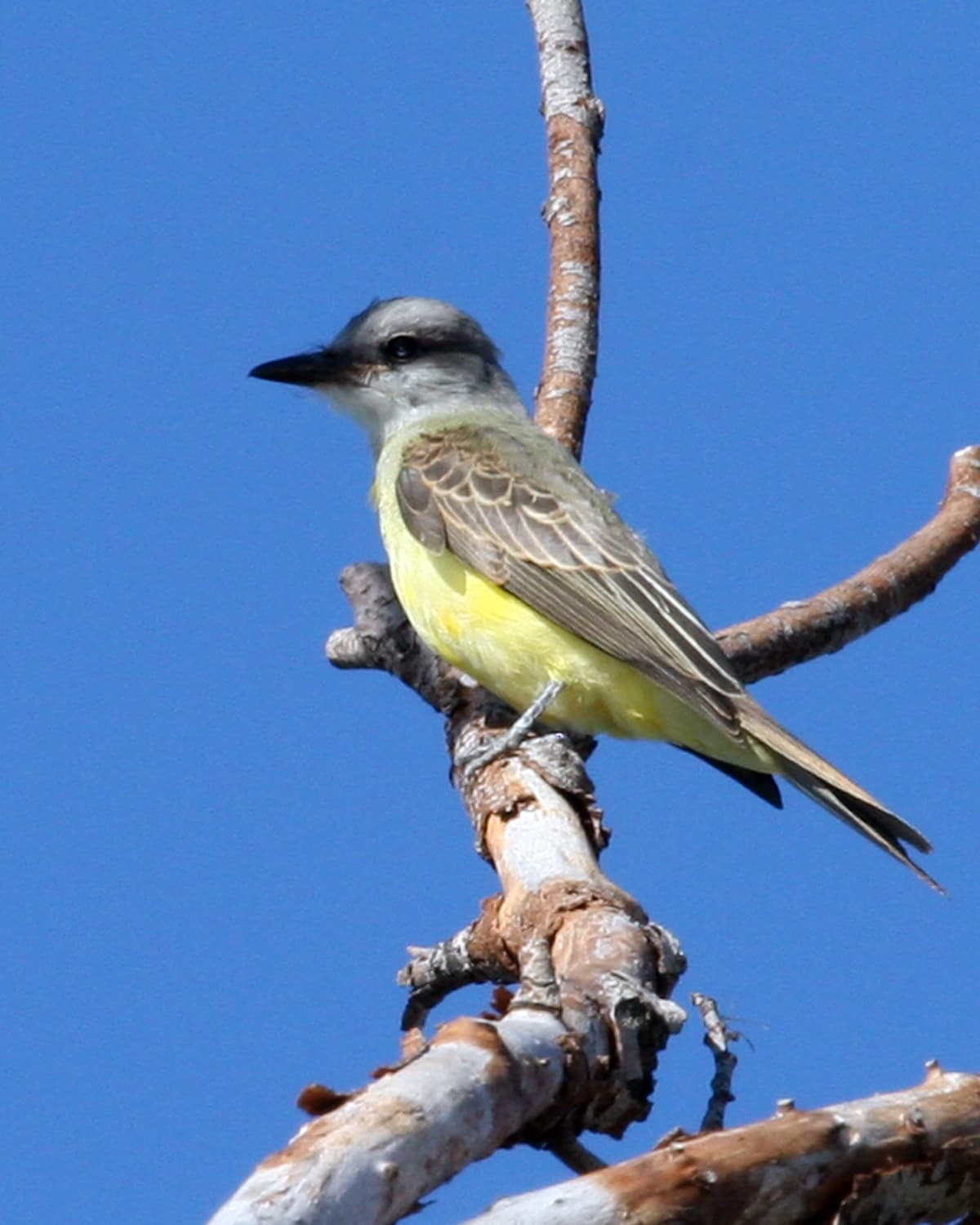
The Tropical Kingbird measures 20 to 23 cm. The upperparts are grey-olive, the head grey with a slight darker mask through the eye. The throat and chest are pale grey-white, transitioning to a bright sulphur-yellow belly and undertail. A concealed orange-red crown patch is rarely visible. The bill is fairly long, slightly hooked, and blackish. The tail is slightly notched or forked. The species is very similar to the Couch's Kingbird of North America but is effectively the only common large flycatcher in open habitats in T&T; the related Gray Kingbird has a longer bill and lacks yellow on the underparts.
Ecology
Tropical Kingbirds are aerial insect hunters, sallying from a prominent perch to catch large flying insects in the air, returning to the same perch or a nearby one. They also take berries and small fruits, particularly in the non-breeding season. Pairs are strongly territorial, with the male frequently engaging in spectacular aerial pursuits of hawks, vultures, and other perceived threats. The nest is an open cup placed high in a tree or on a telephone pole; both sexes build and share incubation of typically 2 to 3 eggs. The species is a year-round resident in T&T.
Status in T&T
The Tropical Kingbird is found throughout Trinidad and Tobago in any open or semi-open habitat: gardens, parks, agricultural land, forest edges, and roadsides. It is one of the most numerous landbirds on both islands. The species is fully protected under the Conservation of Wild Life Act and is not a game species. It has benefited from deforestation and urbanisation creating the open habitats it prefers, and is among the species least threatened by habitat change in T&T.
Threats
- Pesticide reduction of flying insect prey
- Nest predation by introduced mammals