Bird
Bird
Trinidad Piping-guan
Pipile pipile
Photo: William Stephens · Trinidad and Tobago (CC BY 4.0)
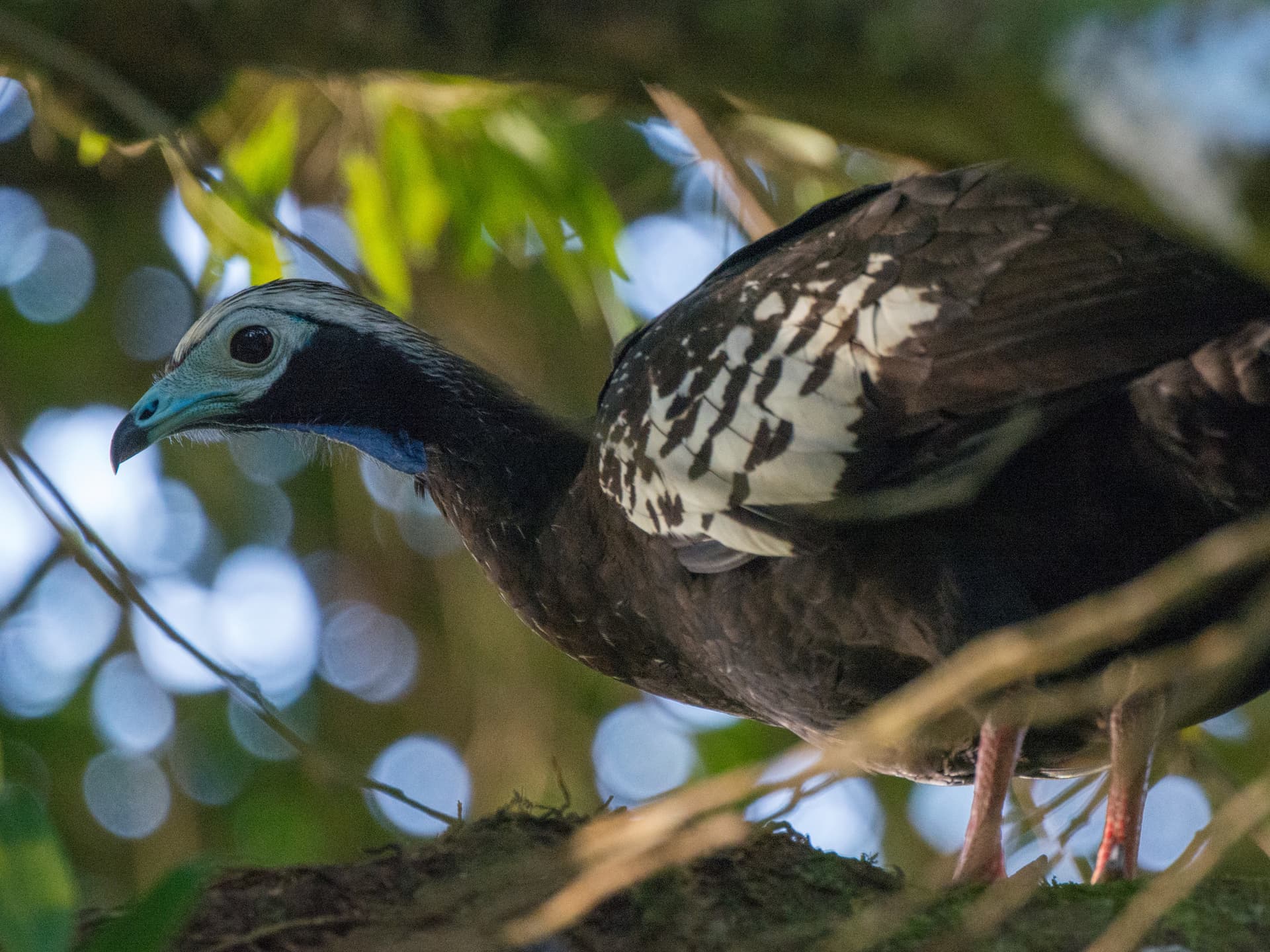
The Trinidad Piping-guan, known locally as the 'Pawi', is a large turkey-like forest bird found nowhere else on Earth but Trinidad.
The Trinidad Piping-guan, known locally as the 'Pawi', is a large turkey-like forest bird found nowhere else on Earth but Trinidad. A member of the guan and curassow family, it is a striking, glossy-black canopy dweller and one of the island's most iconic wildlife species.
Appearance
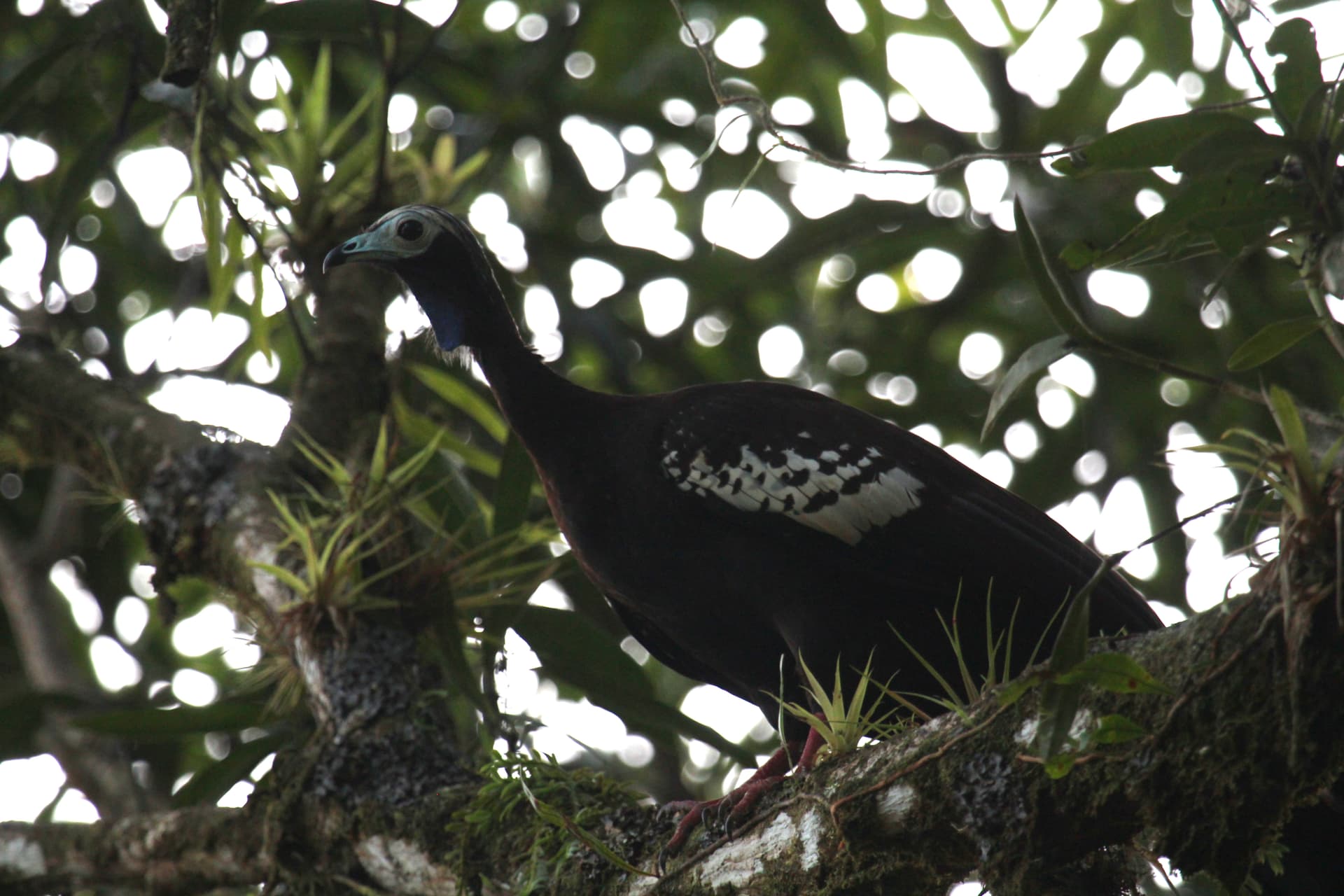
It is a big, heavy-bodied bird up to about 60 to 69 cm long, glossy black overall with bold white streaking on the wing coverts and a white-tipped crest. The bare face is pale blue, and a long, vivid azure-blue dewlap of bare skin hangs from the throat, set off by bright red legs. The combination of black plumage, white wing patches and blue facial skin makes it unmistakable in its forest home.
Behaviour
The Pawi is an arboreal bird that spends most of its time high in the canopy, clambering along branches and only rarely coming to the ground. It is usually seen singly or in pairs and is most active in the early morning and late afternoon. Its presence is often betrayed by sound: a piping series of rising whistles, which gives the bird its name, and a loud mechanical wing-rattle produced in flight.
It is shy and easily disturbed, retreating quickly when it detects people.
Diet and breeding
It feeds mainly on fruits and berries gathered in the canopy, supplemented by flowers, young leaves and buds, which makes it an important disperser of forest tree seeds. Breeding centres on the wet season; the female typically lays around three large white eggs and incubates them alone, with the young able to clamber about soon after hatching. As a large frugivore it plays a meaningful ecological role in regenerating the forests it depends on.
In Trinidad and Tobago
The Pawi is endemic to Trinidad, where it was once widespread but is now largely confined to remote parts of the Northern Range, with a tiny population variously estimated at well under a few hundred birds. It is listed by the IUCN as Critically Endangered, driven chiefly by past illegal hunting and habitat loss, and it is a designated Environmentally Sensitive Species (ESS) and the focus of dedicated recovery efforts in Trinidad and Tobago.