Bird
Bird
Crested Oropendola
Psarocolius decumanus
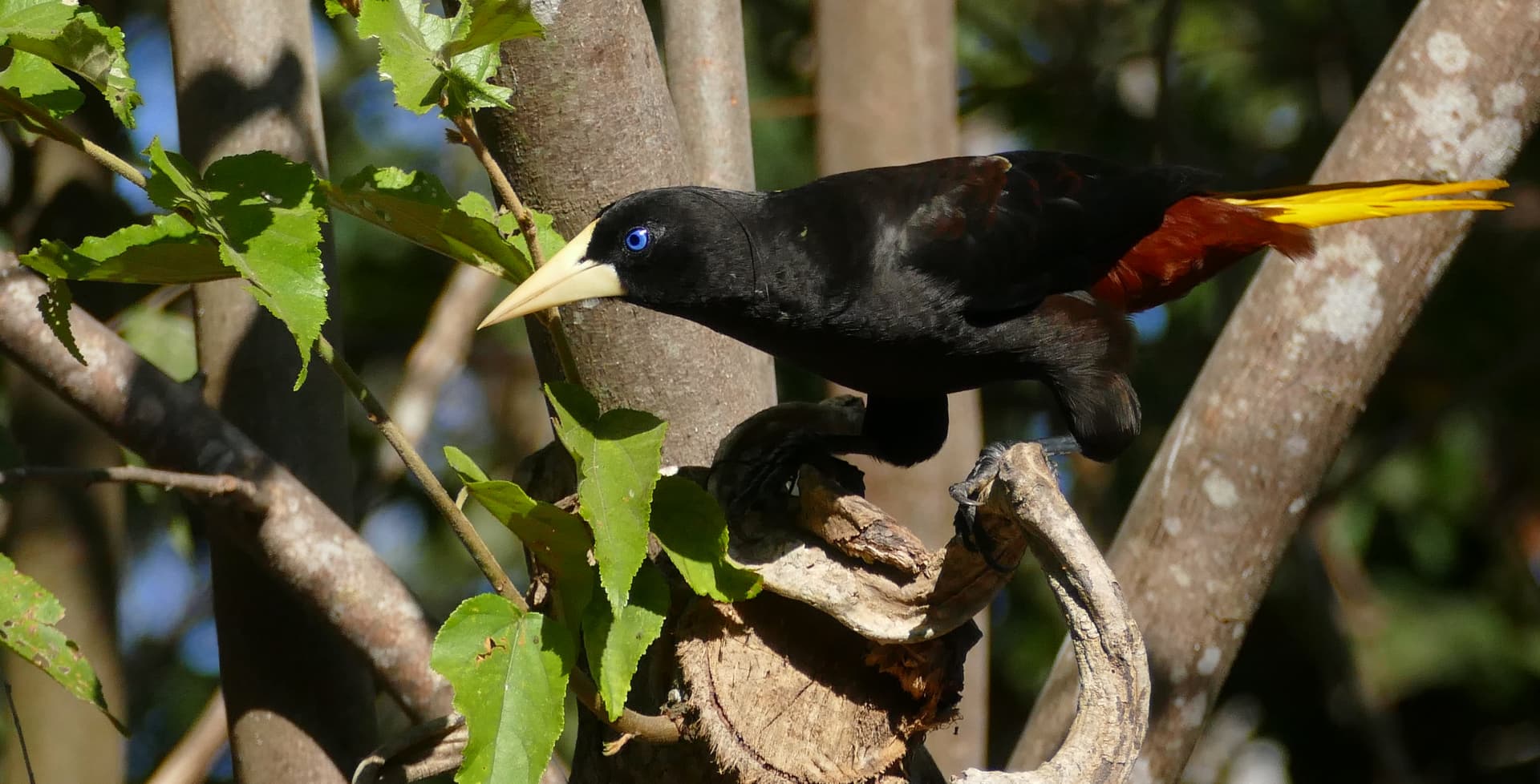
The Crested Oropendola, known across Trinidad and Tobago as the cornbird or yellowtail, is a large, glossy black icterid famous for the swaying colonies of long woven nests that hang like baskets from tall trees.
The Crested Oropendola, known across Trinidad and Tobago as the cornbird or yellowtail, is a large, glossy black icterid famous for the swaying colonies of long woven nests that hang like baskets from tall trees. Its bubbling, gurgling song and bright yellow tail make it one of the most recognisable birds of the local countryside.
Appearance
Males are large at about 46 cm long and around 300 g, while females are noticeably smaller at roughly 37 cm and 180 g. The plumage is mainly black with a chestnut rump and a striking bright yellow tail broken only by two dark central feathers. A pale, ivory-coloured pointed bill, a narrow crest of fine feathers and pale blue eyes complete the distinctive look.
Behaviour
Crested Oropendolas are colonial and highly social, gathering in noisy groups in the tops of tall isolated trees. Males perform an elaborate forward-bowing display, tumbling forward on the branch while delivering a loud liquid, gurgling song.
They forage actively through the canopy, often in mixed flocks, and are conspicuous as they fly between feeding areas and the colony with a strong, direct flight.
Diet and breeding
The diet is broad and includes fruit, nectar, large insects and other small animals, and they will visit cultivated areas, which helped earn the local name cornbird. The species is a colonial breeder in which females weave remarkable pendulous nests over a metre long from strips of bark, palm and grass fibres, hung high in a tree. A single dominant male mates with most of the 15 to 30 females in a colony, and each female lays two blotched blue-grey eggs that hatch in about 15 to 19 days. Colonies are sometimes placed near wasp nests, which may help deter predators.
In Trinidad and Tobago
The Crested Oropendola is a common and widespread resident on Trinidad, found in forests, forest edges, plantations and well-treed settled areas, and it also occurs on Tobago. Its hanging colonies are a familiar sight in the local landscape. The species is listed as Least Concern.