Mammal
Mammal
Brazilian Tree Porcupine
Coendou prehensilis
The Brazilian Tree Porcupine is a large, nocturnal, tree-dwelling rodent found in the forests of Trinidad.
The Brazilian Tree Porcupine is a large, nocturnal, tree-dwelling rodent found in the forests of Trinidad. Equipped with a long muscular prehensile tail and a coat of defensive quills, it spends most of its life high in the canopy, descending only occasionally to forage. It is one of the island's more rarely seen mammals, betraying its presence mainly through nocturnal activity in fruiting trees.
Identification
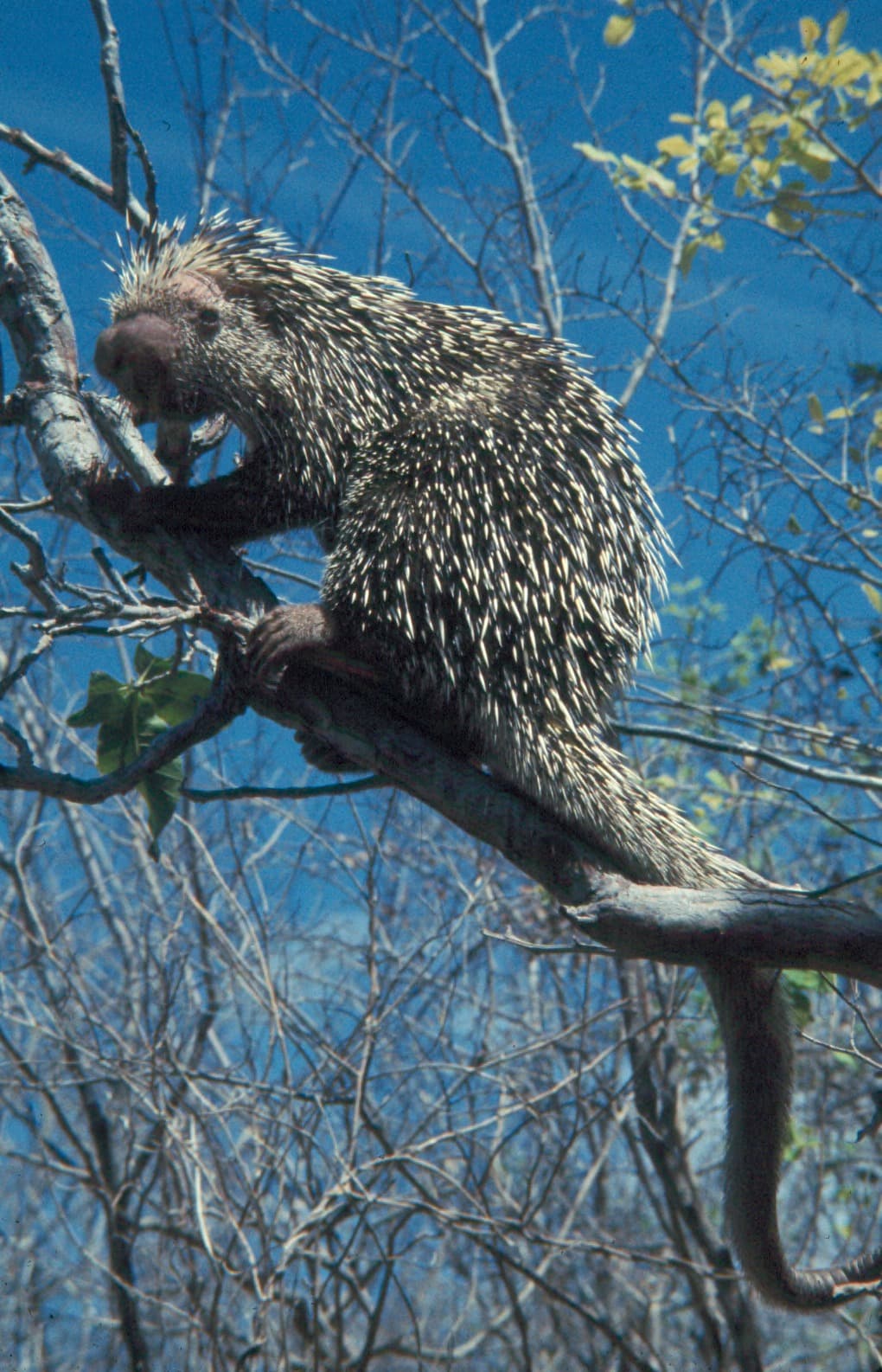
An adult Brazilian Tree Porcupine reaches roughly a metre in total length, of which the tail accounts for nearly half (about 330 to 485 mm). The body is covered in short, thick, whitish or yellowish spines mixed among darker coarse hair, while the underside is paler.
The most distinctive feature is the long, spineless prehensile tail, which curls around branches to grip them securely. Adults typically weigh in the region of 4 kg, making this a heavy-bodied arboreal rodent.
Ecology
This porcupine is primarily arboreal and nocturnal, resting by day in a hollow tree cavity or a well-shaded part of the canopy, often 6 to 10 metres above the ground. At night it moves through the trees using its prehensile tail and clawed feet, descending to the forest floor only to forage.
Its diet is largely vegetarian and includes leaves, fruit, seeds, and bark, and it will also raid nearby farms, plantations, and gardens for crops. Animals are usually solitary or found in pairs, and females generally give birth to a single well-developed young.
Status in T&T
In Trinidad and Tobago the Brazilian Tree Porcupine occurs on Trinidad, reflecting the island's continental South American fauna, and is not recorded as a natural resident of Tobago. Globally the species is listed as Least Concern by the IUCN, owing to its wide distribution across northern South America.
No specific national conservation listing has been confirmed for this species in Trinidad and Tobago. Its forest habitat is nonetheless shared with the country's protected areas, and like other arboreal mammals it depends on continuous canopy cover.