Bird
Bird
Streaked Flycatcher
Myiodynastes maculatus
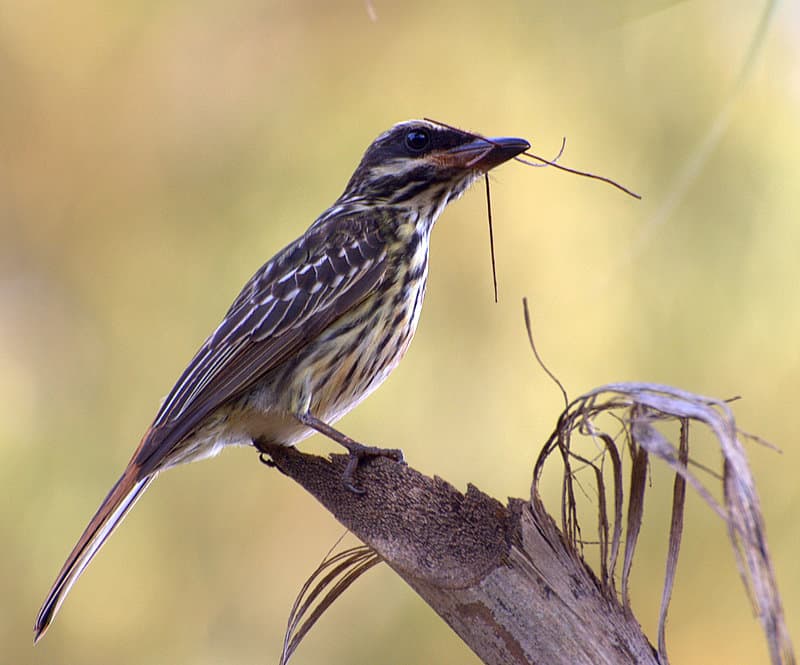
The Streaked Flycatcher is a boldly patterned bird of Tobago's forest edge, its heavily streaked underparts setting it apart from the plainer-bellied kingbirds and kiskadees sharing its habitat, and its presence often signalled by loud, distinctive calls from the canopy.
The Streaked Flycatcher is a boldly patterned bird of Tobago's forest edge, its heavily streaked underparts setting it apart from the plainer-bellied kingbirds and kiskadees sharing its habitat, and its presence often signalled by loud, distinctive calls from the canopy.
Identification
A medium-sized flycatcher around 20 to 22 cm long, brown above with a bold, dark facial mask and a distinctive rufous panel visible on the wings and tail in flight, and heavily streaked yellowish-white underparts, a pattern unlike the plain yellow bellies of the Great Kiskadee and kingbirds. A partially concealed yellow crown patch is present in some individuals.
Ecology
The Streaked Flycatcher feeds on large insects and fruit, foraging at forest edge and in the canopy, often sallying from an exposed perch to catch flying prey. Some populations in the wider range are migratory, moving seasonally between breeding and non-breeding areas within South America. It builds a nest in a natural cavity or old woodpecker hole, distinguishing its nesting habits from the open cup nests of many related flycatchers.
Status in T&T
Found in forest edge and semi-open woodland on Tobago. It is not threatened. It is protected under the Conservation of Wildlife Act and is not a game species.
Threats
- Forest edge clearance reducing foraging habitat