Bird
Bird
Squirrel Cuckoo
Piaya cayana
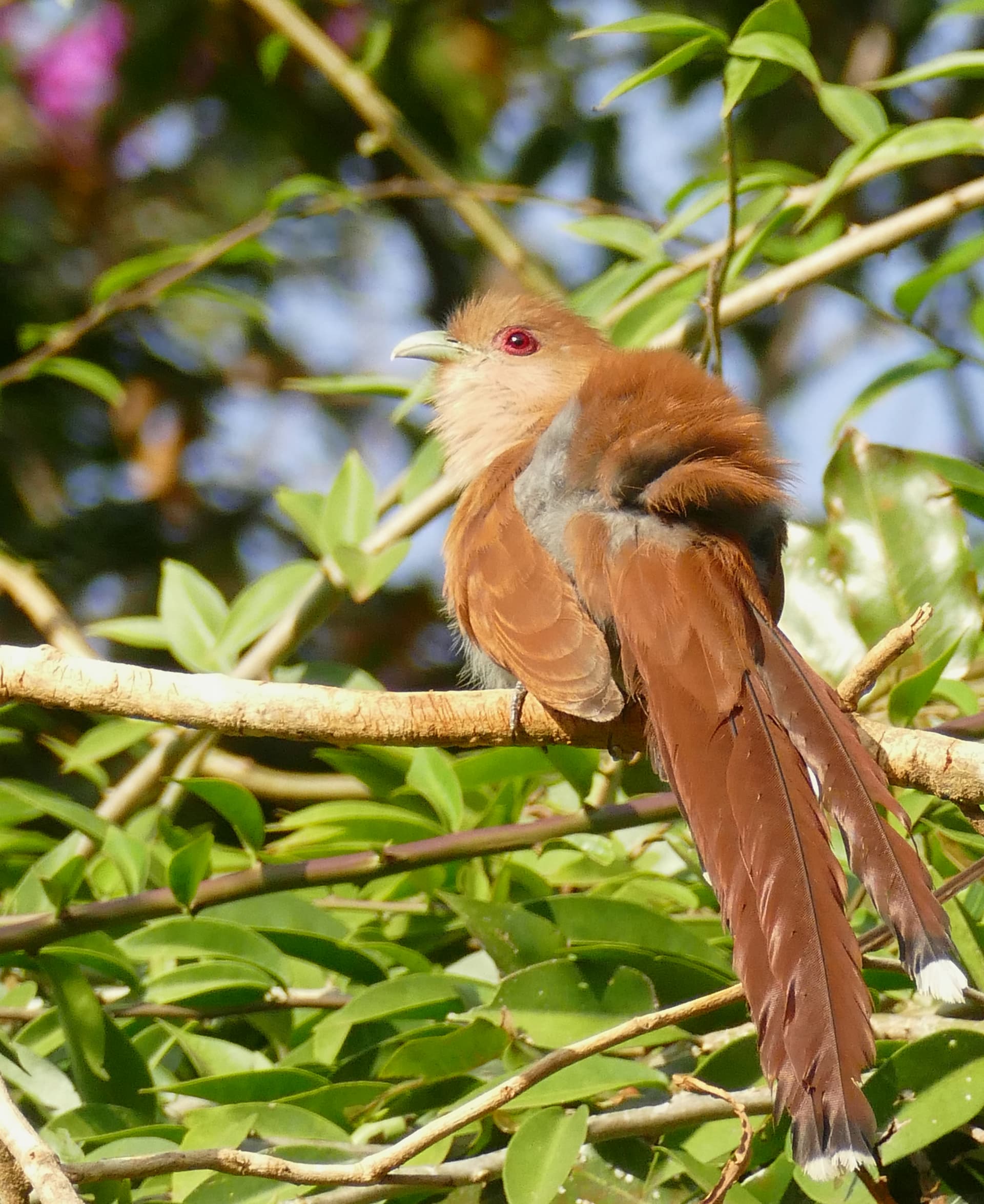
Photo: Francesco Veronesi · Darien, Panama (CC BY-SA 2.0)
The Squirrel Cuckoo is one of the most elegant and agile birds of Trinidad's forests, a large, richly coloured cuckoo that moves through the canopy and subcanopy with a bounding, squirrel-like agility that immediately explains its name.
The Squirrel Cuckoo is one of the most elegant and agile birds of Trinidad's forests, a large, richly coloured cuckoo that moves through the canopy and subcanopy with a bounding, squirrel-like agility that immediately explains its name. Its warm chestnut upperparts, pale grey breast, and long, boldly patterned tail make it a striking sight when it emerges briefly in an open gap or perches on a sunlit branch before melting back into the forest.
Identification
The Squirrel Cuckoo is a large cuckoo measuring 40 to 50 cm, much of that in the long, graduated tail. The upperparts, head, and breast are warm chestnut, becoming paler grey-buff on the lower breast and belly. The long tail is chestnut above and has bold black-and-white banding on the underside, visible when the bird fans the tail. The bill is yellow-green and slightly curved; the eye is red with a bare red eye-ring. The species is non-parasitic and raises its own young.
Ecology
Squirrel Cuckoos move through forest canopy, edges, and secondary growth in long bounding leaps between branches, running and hopping along large limbs in a manner more like a squirrel than a typical perching bird. They feed on large insects and caterpillars, including hairy species that other birds avoid, as well as small lizards and frogs. They are solitary outside the breeding season. Nests are loose, open cup structures in a tree or shrub, typically at moderate height, where both sexes share incubation and chick-rearing duties.
Status in T&T
The Squirrel Cuckoo is a resident of Trinidad, found in forest interiors, forest edges, and advanced secondary growth particularly in the Northern Range and central forests. It is absent from Tobago. The species is fully protected under the Conservation of Wild Life Act and is not a game species. Its dependence on forest habitat with a structurally complex canopy means it is sensitive to deforestation and simplification of forest structure.
Threats
- Forest loss and fragmentation
- Simplification of canopy structure