Mammal
Mammal
Southern Tamandua
Tamandua tetradactyla
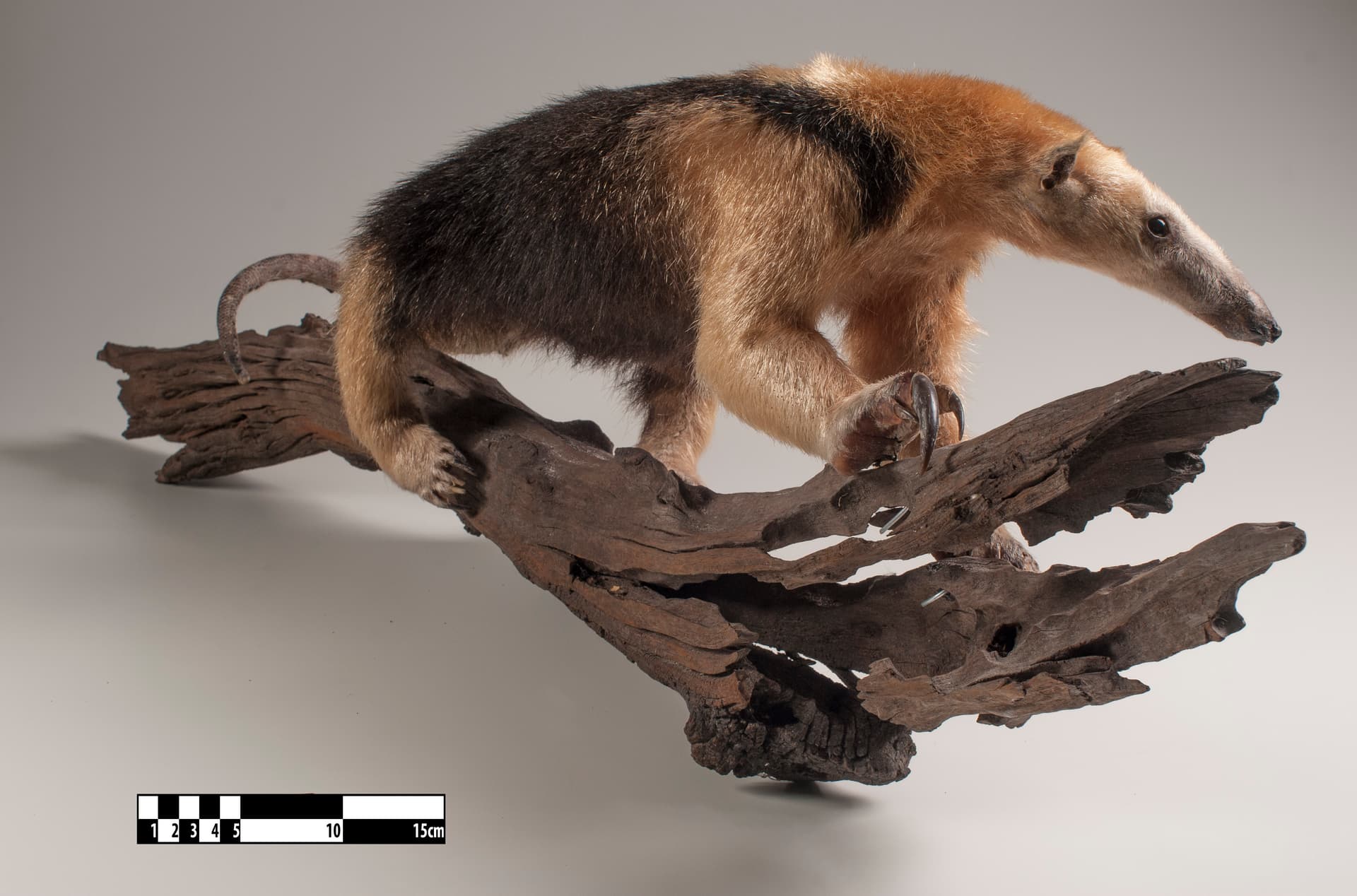
The Southern Tamandua is a tree-climbing 'lesser anteater', a tan-and-black mammal with a long tubular snout, no teeth, and a prehensile tail it uses like a fifth limb.
The Southern Tamandua is a tree-climbing 'lesser anteater', a tan-and-black mammal with a long tubular snout, no teeth, and a prehensile tail it uses like a fifth limb. Smaller and far more arboreal than the giant anteater, it is one of Trinidad's most distinctive forest residents, often given the local name 'matapel' or simply anteater.
Appearance
Head and body length runs roughly 34 to 88 cm, with a naked prehensile tail of similar length and a weight commonly between 3.5 and 7 kg. The coat is short and coarse, typically blond or tan with a bold black 'vest' wrapping the shoulders, back and flanks, though some individuals are almost uniformly pale. The snout is long, narrow and slightly down-curved, ending in a tiny mouth from which a sticky worm-like tongue extends; the eyes and ears are small.
Behaviour
It is a solitary, mainly nocturnal animal that moves slowly and deliberately through the canopy and along the ground, gripping branches with its prehensile tail and powerful curved foreclaws. Those same claws are a formidable defence: when cornered it rears back on its hind legs and tail, spreads its forelimbs and slashes, and can release a strong musky odour from an anal gland. It shelters by day in hollow trees, burrows or dense tangles of vines and epiphytes.
Tamanduas are most common near streams and rivers where vine-rich vegetation supports abundant insect prey.
Diet and breeding
The diet is almost entirely ants and termites, especially arboreal species, located by a keen sense of smell and extracted by tearing open nests with the foreclaws and lapping up insects with the long sticky tongue. It deliberately avoids ants with strong chemical defences, such as army ants and leaf-cutter ants, and will also take some bees and honey. A single young is usually born after a gestation of around 4 to 5 months; the infant rides on the mother's back and is later parked on a branch while she forages. A notable quirk is that, lacking teeth, it relies on a muscular stomach to grind its food.
In Trinidad and Tobago
The Southern Tamandua is native to Trinidad, where it occurs in forests, secondary growth and plantation edges across much of the island, but it is absent from Tobago. It plays a useful ecological role as a controller of ant and termite populations. Globally the species is listed by the IUCN as Least Concern given its wide range, though road kills and habitat clearance are local pressures.