Fish
Fish
Southern Stingray
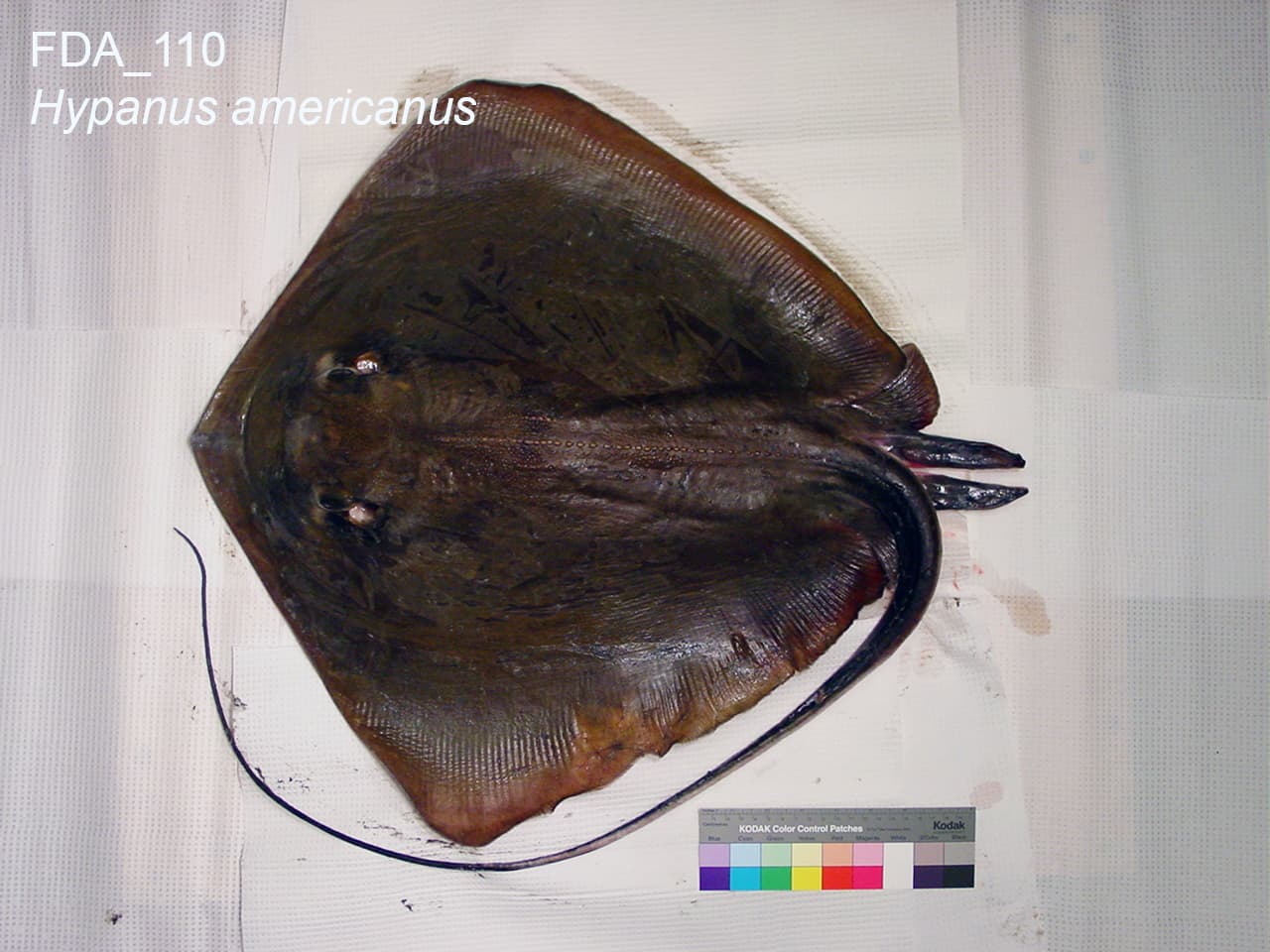
Hypanus americanus
The southern stingray is a large, diamond-shaped ray of warm western Atlantic shallows, perfectly built for life on the seabed.
The southern stingray is a large, diamond-shaped ray of warm western Atlantic shallows, perfectly built for life on the seabed. Its flattened body and earth-toned upper surface let it bury in sand with only the eyes and breathing spiracles exposed. A bottom specialist, it shapes the sediment of seagrass meadows and sandy flats as it forages. The species is now placed in the genus Hypanus, having long been known as Dasyatis americana.
Appearance
The body is a flat, angular disc, brown to olive-grey above and pale below, with the snout forming a gentle point. The tail is long and whip-like and carries one or more serrated venomous spines used only in defence. Large females can span well over a metre across the disc, noticeably bigger than males.
Behaviour
Southern stingrays are largely nocturnal and spend much of the day resting partly buried in sand. The eyes sit on top of the head while water for breathing is drawn in through the spiracles behind them, allowing the ray to lie hidden without inhaling sediment.
To feed they flap the disc and jet water from the mouth to excavate buried prey, leaving distinctive feeding pits that other fishes often exploit. They are usually solitary but tolerate close company at rich feeding grounds.
Diet and breeding
The diet is dominated by benthic invertebrates: crabs, shrimp, worms, clams and small bony fishes crushed by flattened plate-like teeth. Reproduction is aplacental viviparous, the developing young being nourished inside the female by a nutrient-rich uterine secretion before live birth of a small litter. A notable trait is its ecological role as a sediment turner, recycling nutrients and creating foraging opportunities across sandy and seagrass habitats.
In Trinidad and Tobago
Around Trinidad and Tobago the southern stingray occurs on sandy bottoms, seagrass beds and reef margins in coastal waters, and is taken in artisanal and small-scale fisheries. Anglers and bathers should respect the tail spine, which can inflict a painful wound if the animal is trodden on or handled. The species is assessed as Near Threatened by the IUCN, reflecting fishing pressure across its range.