Fish
Fish
Lionfish (Invasive)
Pterois volitans
The Lionfish is a strikingly beautiful but ecologically destructive invasive predator that has spread throughout the Caribbean, including Trinidad and Tobago waters, since escaping the aquarium trade in Florida in the 1980s and 90s.
The Lionfish is a strikingly beautiful but ecologically destructive invasive predator that has spread throughout the Caribbean, including Trinidad and Tobago waters, since escaping the aquarium trade in Florida in the 1980s and 90s. Venomous spines and a voracious appetite make it one of the most serious marine invasive species threats to native reef fish populations in the Atlantic basin.
Identification
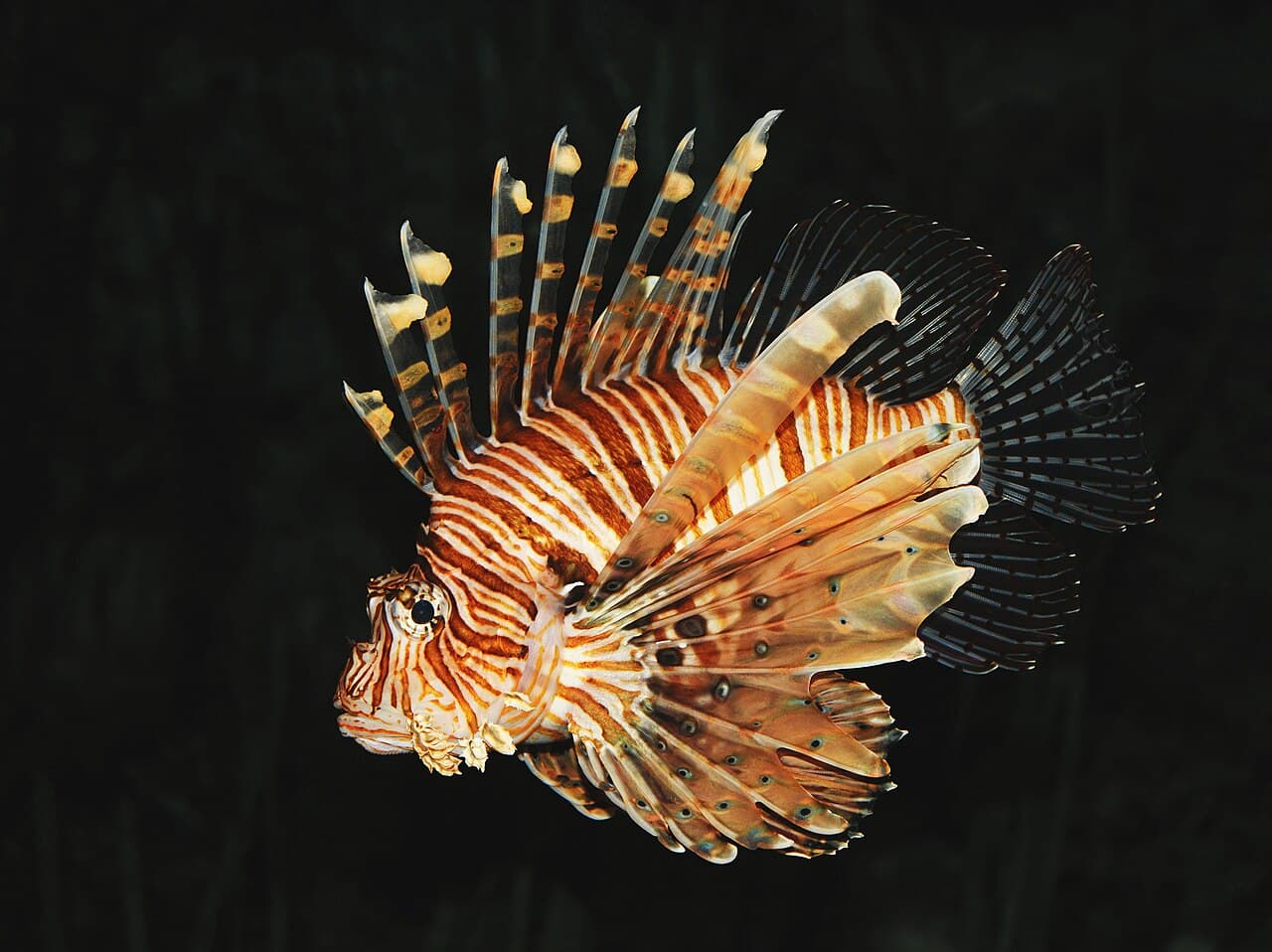
Unmistakable, with bold reddish-brown and white banding across the body and elaborate, fan-like pectoral fins spread wide to corner prey against reef structure, plus long, venomous dorsal, pelvic, and anal spines used purely for defence. Adults reach around 30 to 40 cm.
Ecology
A voracious ambush predator of small reef fish and invertebrates, cornering prey with its spread pectoral fins before striking with a sudden gape. Caribbean and Atlantic reef fish have no evolutionary history with lionfish and largely fail to recognise it as a predator, allowing it to hunt with unusual efficiency, while no native predator reliably recognises it as prey. Combined with an extremely high reproductive rate (females can spawn tens of thousands of eggs every few days year-round), this has allowed lionfish populations to explode rapidly once established on a reef. Venomous spines cause an intensely painful but rarely life-threatening sting to people.
In Trinidad and Tobago
Established on Tobago's reefs and increasingly recorded around Trinidad, where it preys heavily on juvenile native reef fish, with documented impacts on local reef fish recruitment. Local culling programmes and "eat the invader" campaigns promoting lionfish as a sustainable seafood choice, along with organised lionfish derbies, are used to suppress numbers, since complete eradication is not considered achievable once a population is established.