Bird
Bird
Southern Lapwing
Vanellus chilensis
The Southern Lapwing is a large, boldly patterned plover and one of the most vocal and conspicuous birds of open grasslands, savannas, and wetland margins in Trinidad and Tobago.
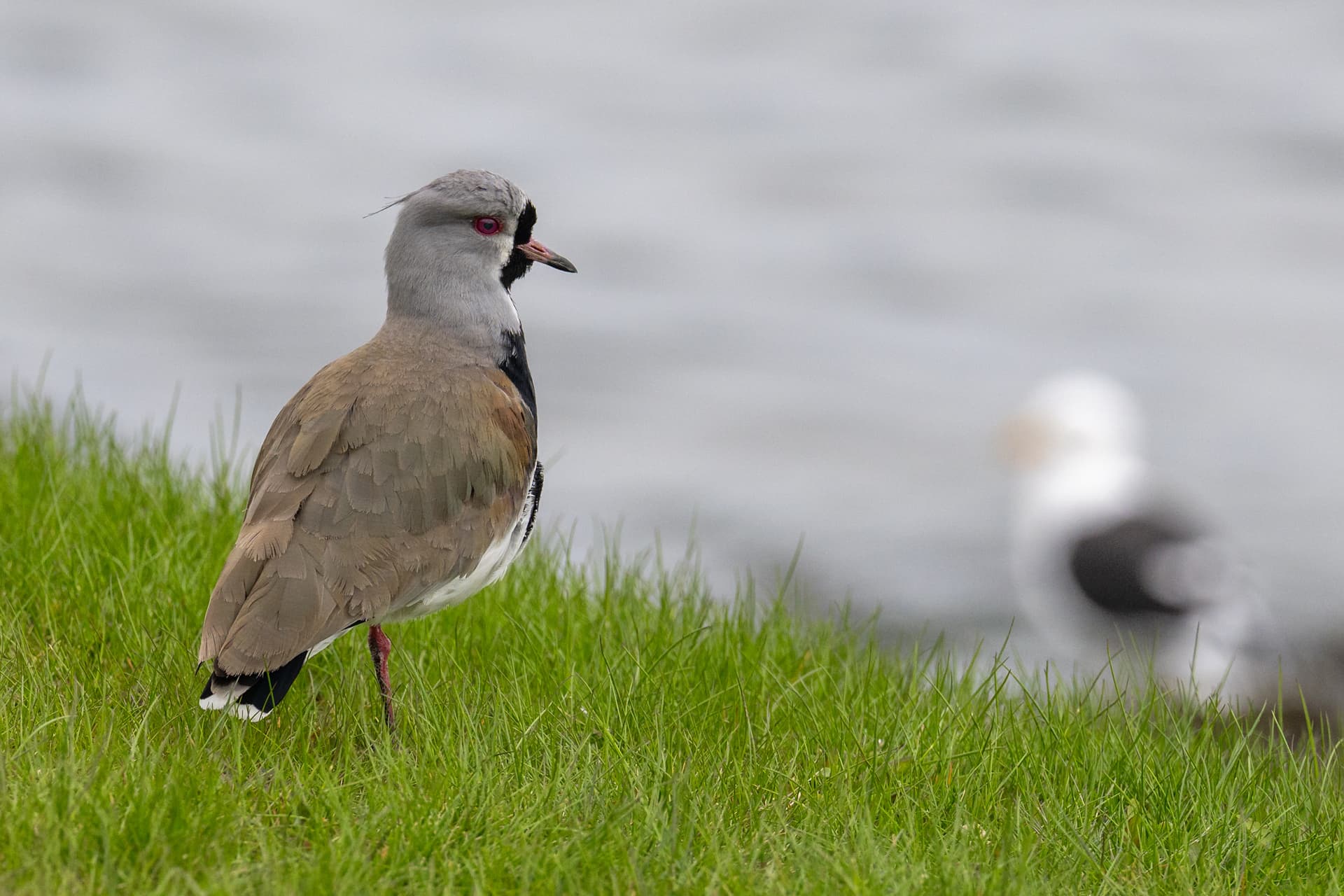
The Southern Lapwing is a large, boldly patterned plover and one of the most vocal and conspicuous birds of open grasslands, savannas, and wetland margins in Trinidad and Tobago. Highly territorial, it defends its nest with a loud, penetrating call and will mob potential predators including dogs, livestock, and humans far larger than itself, often alerting other species to danger in the process. Its striking black-and-white head pattern, pinkish-grey body, and long red-based bill make it easy to identify even at a distance.
Identification
The Southern Lapwing measures 32 to 38 cm, stocky and upright with long pinkish-red legs. The head is distinctively patterned with a black forecrown, white face sides, black throat and breast-band, and grey hindcrown with a wispy backward-pointing crest. The body is pinkish-grey above and white below. The bill is red at the base and black at the tip. A small red wattle sits above the bill. In flight, broad white wing patches contrast with the dark flight feathers and body. Juveniles lack the bold head pattern of adults and are more streaked and brown.
Ecology
Southern Lapwings are ground-dwelling birds of open habitats, feeding by walking and probing for invertebrates including earthworms, beetles, and grasshoppers, as well as seeds and plant material. They are highly territorial year-round, not just during breeding, and a pair will vigorously chase any intruder from their territory. The nest is a simple scrape on the ground, often in short grass or bare earth, with 3 to 4 cryptically marked eggs. Chicks are precocial and able to run within hours of hatching. The species has expanded across T&T as grassland and agricultural areas have increased.
Status in T&T
The Southern Lapwing is found on both Trinidad and Tobago in open grasslands, savannas, pastures, agricultural fields, and the grassy margins of wetlands. It has become more common over recent decades as deforestation has created suitable open habitat. The species is fully protected under the Conservation of Wild Life Act and is not a game species. Its loud alarm calls make it a useful sentinel species for other ground-nesting birds in the same habitat.
Threats
- Ground nest destruction by agricultural machinery
- Predation by introduced mammals
- Pesticide reduction of invertebrate prey