Bird
Bird
Anhinga (Snake Bird)
Anhinga anhinga
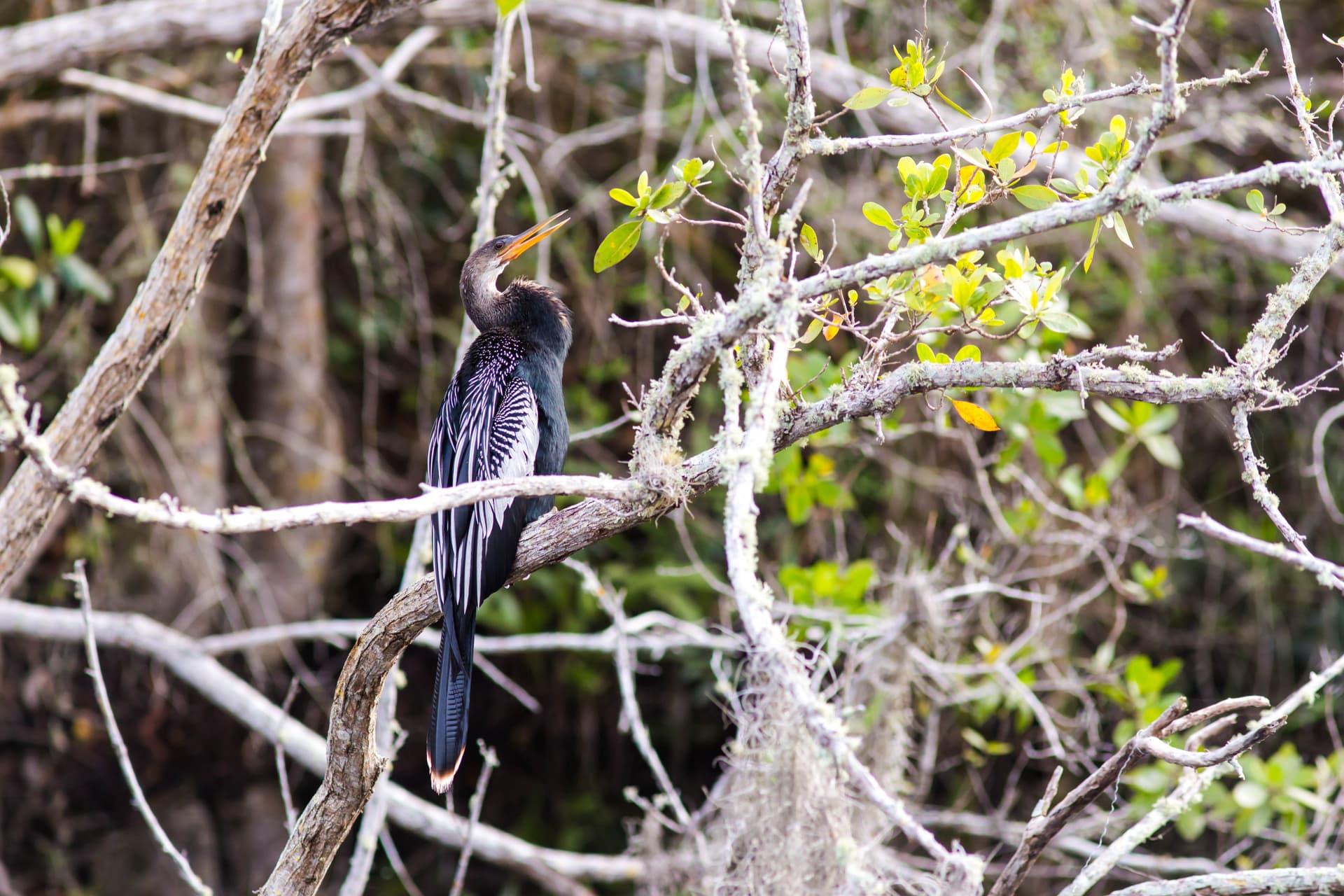
Photo: Brandon Moore · Big Cypress National Preserve, Florida (CC BY-SA 4.0)
The Anhinga, known locally in Trinidad and Tobago as the Snake Bird, is one of the most distinctive waterbirds of T&T's freshwater and coastal wetlands.
The Anhinga, known locally in Trinidad and Tobago as the Snake Bird, is one of the most distinctive waterbirds of T&T's freshwater and coastal wetlands. Unlike most waterbirds, the anhinga lacks waterproofing oils in its feathers, which allows it to dive and pursue fish with far less buoyancy but means it must spend long periods perched with wings spread wide to dry. The sight of an anhinga standing in this heraldic sun-drying pose on a wetland snag is one of the characteristic images of T&T's swamp edges.
Identification
The Anhinga is a large, slender waterbird measuring 75 to 95 cm with a wingspan of 114 to 128 cm. The plumage is black and dark greenish with silver-white spots and streaks on the wings and back. The neck is long and sinuous, the bill long and sharply pointed. The tail is long and fan-shaped with a pale terminal band. Males have black-and-dark-green plumage with a small orange-yellow bare face patch; females have a pale buffy-rufous head and neck contrasting sharply with the dark body. In flight, the anhinga holds its neck outstretched in a characteristic S-curve shape.
Ecology
Anhingas are pursuit divers, swimming underwater and spearing fish with a rapid thrust of the neck, using a hinge-like mechanism in the neck vertebrae that stores tension before releasing in an explosive forward jab. Because the feathers are not waterproofed they become saturated during diving, reducing buoyancy and improving underwater manoeuvrability. After each diving session, the bird must haul out and spread its wings to dry in the sun, a behaviour that makes it conspicuous and easy to observe. Anhingas nest colonially, often mixed with herons and cormorants, building stick platforms in trees over or near water.
Status in T&T
The Anhinga is found on both Trinidad and Tobago in freshwater swamps, rivers, reservoirs, and some coastal wetlands. Key sites include the Caroni and Nariva swamps and mangrove-lined river mouths. The species is fully protected under the Conservation of Wild Life Act and is not a game species. Its sensitivity to wetland pollution and disturbance of nesting colonies makes wetland conservation critical for its long-term status in T&T.
Threats
- Wetland pollution
- Disturbance of nesting colonies
- Wetland drainage and conversion