Bird
Bird
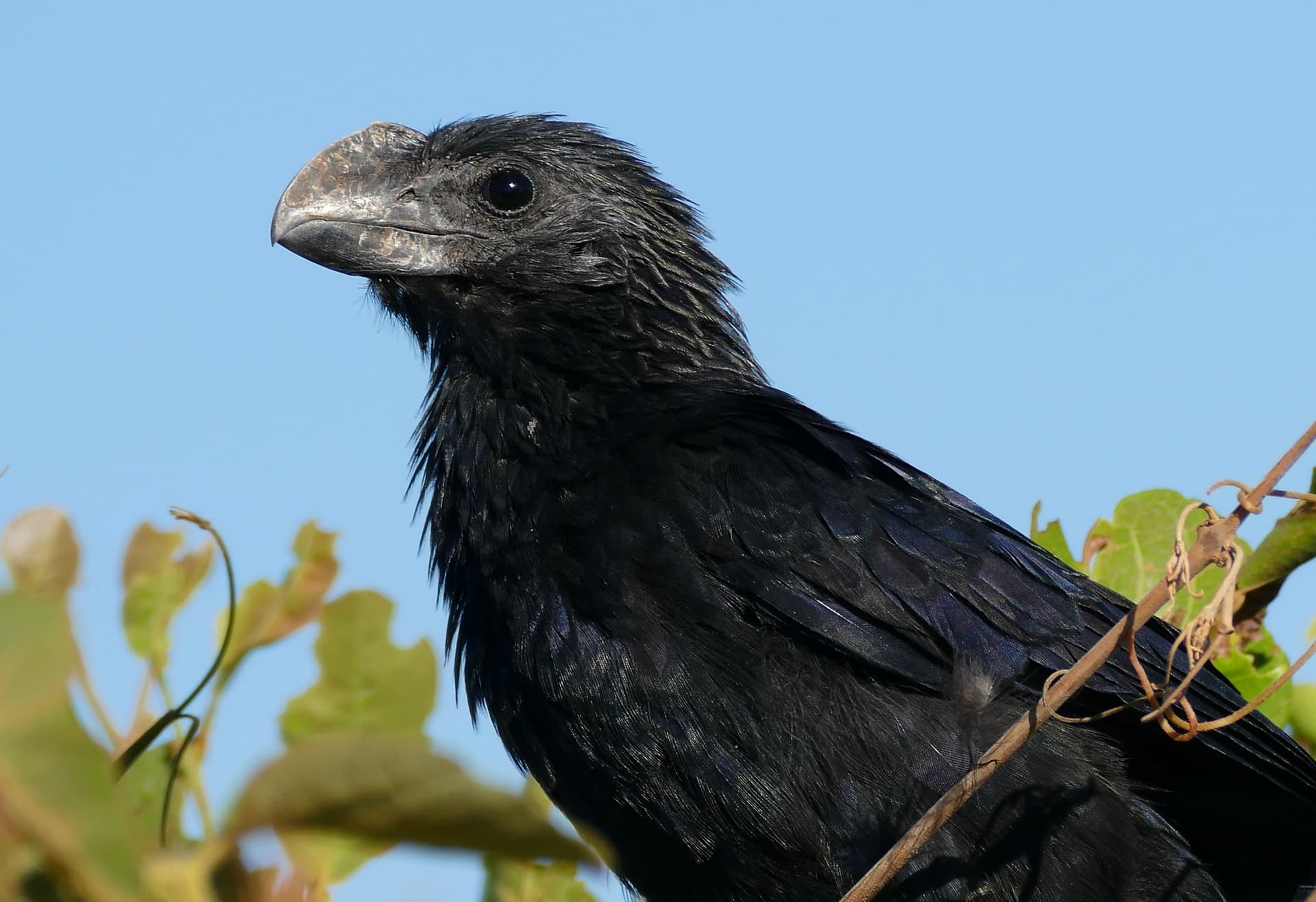
Smooth-billed Ani
Crotophaga ani
Photo: Giles Laurent · Encontro das Aguas State Park, Mato Grosso, Brazil (CC BY-SA 4.0)
The Smooth-billed Ani is one of the most conspicuous and socially remarkable birds of Trinidad and Tobago's open country, a glossy black cuckoo that lives in tight, noisy groups and practises one of the most unusual cooperative breeding systems in the avian world.
The Smooth-billed Ani is one of the most conspicuous and socially remarkable birds of Trinidad and Tobago's open country, a glossy black cuckoo that lives in tight, noisy groups and practises one of the most unusual cooperative breeding systems in the avian world. Familiar in farmland, scrub, roadsides, and gardens across both islands, the ani is immediately recognisable by its all-black plumage, compressed, ridge-topped bill that looks like a small keel, and the floppy, tail-heavy flight of a group moving between bushes.
Identification
The Smooth-billed Ani is 30 to 36 cm long with a long, loose-jointed tail and an unmistakable bill: large, strongly laterally compressed, with a prominent arched ridge along the culmen that gives it a prehistoric, toothed appearance. The plumage is entirely iridescent black with a bronzy-purple sheen on the body feathers. The eye is dark brown. Groups move in a characteristic floppy, undulating flight, with birds gliding and flapping in loose succession. The call is a whining, rising "wee-OO" and a range of liquid clucks and whistles.
Cooperative Breeding
Smooth-billed Anis live in year-round groups of two to five breeding pairs that share a single large nest, with all group members contributing to nest building, incubation, and chick feeding. All females in the group lay in the communal nest, and eggs laid earlier by dominant females tend to be buried by later arrivals, creating a complex hierarchy of reproductive success within the group. Despite this competition, cooperative defence of the nest against predators is effective, and the cooperative system provides advantages in harsh conditions. Anis are ground foragers, following large animals and agricultural machinery to catch insects, lizards, and frogs disturbed from the grass.
Status in T&T
The Smooth-billed Ani is abundant throughout Trinidad and Tobago in open and semi-open habitats: agricultural land, roadsides, gardens, scrub, and forest edges. It is fully protected under the Conservation of Wild Life Act and is not a game species. Its tolerance of disturbed and modified habitats means it is one of T&T's most numerous birds and is not threatened by the level of land-use change that affects forest species.
Threats
- Agricultural intensification reducing insect prey
- Nest predation by introduced mongooses and rats