Mammal
Mammal
Small Indian Mongoose
Herpestes auropunctatus
The Small Indian Mongoose is a slender, ferret-like carnivore that has become one of Trinidad and Tobago's most familiar mammals, often glimpsed darting across roads and field edges by day.
The Small Indian Mongoose is a slender, ferret-like carnivore that has become one of Trinidad and Tobago's most familiar mammals, often glimpsed darting across roads and field edges by day. Although it looks at home in the local landscape, it is not native at all; it was deliberately introduced from Asia and is now one of the world's most damaging invasive species.
Appearance
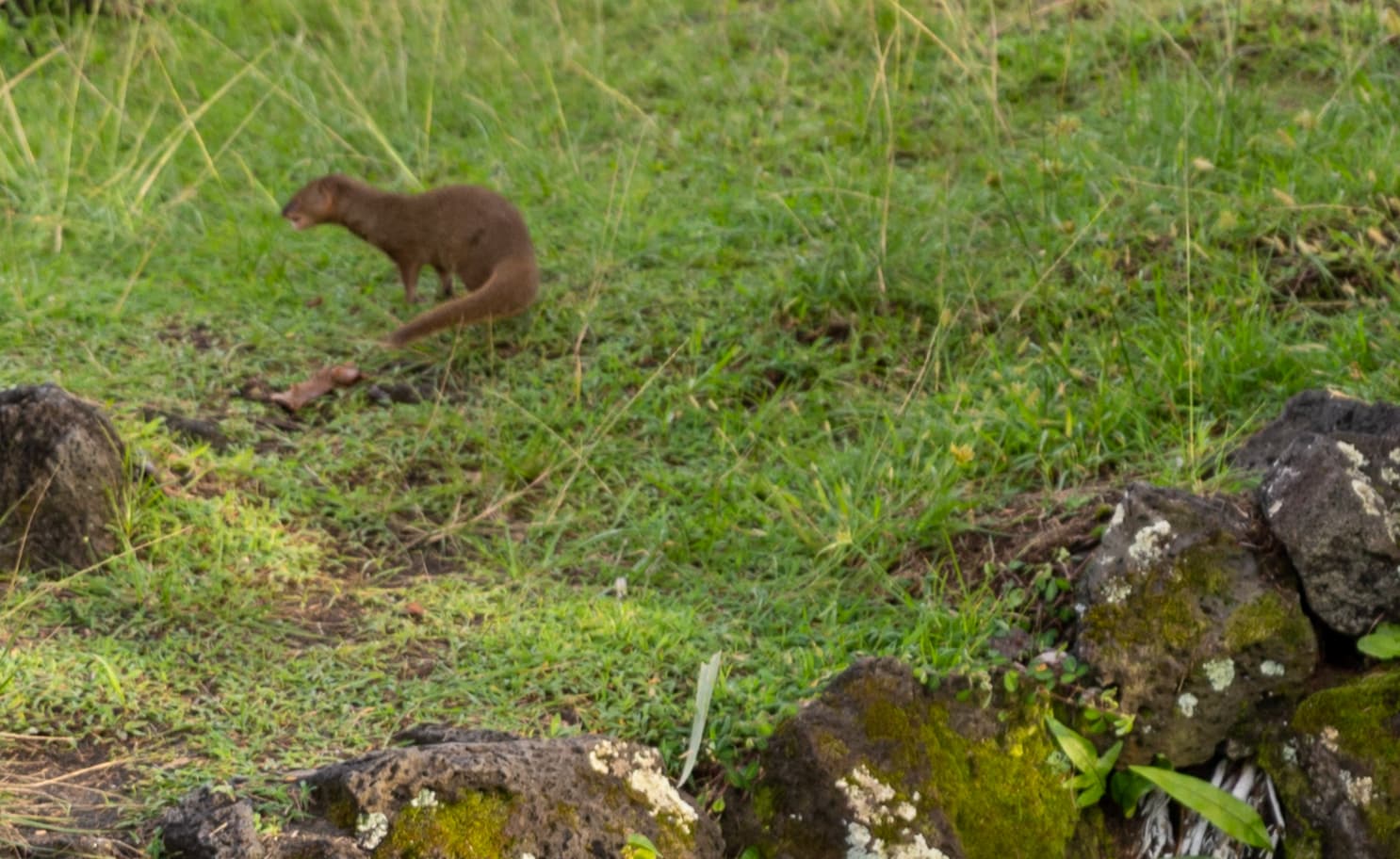
It is a small, low-slung carnivore with a long body, short legs and a tapering tail nearly as long as the body, the whole animal measuring roughly 50 to 65 cm including the tail. The fur is grizzled grey-brown with a faint golden speckling, giving rise to the older name golden mongoose. The head is pointed with small rounded ears and sharp eyes, built for a fast, agile predator.
Behaviour
The Small Indian Mongoose is active by day, hunting on the ground through scrub, cane fields, gardens and forest edges with quick, restless movements. It is bold and curious, sheltering in burrows, rock piles and dense vegetation.
It is largely solitary and territorial, and is a notably fast and determined hunter, famous in folklore for tackling snakes.
Diet and breeding
It is an opportunistic generalist, eating insects, small mammals, birds and their eggs, lizards, snakes, frogs, crabs and fruit. This broad appetite is exactly what makes it so destructive where it does not belong. Females can breed two to three times a year, producing litters of two to four young, which lets populations build quickly. A famous but real danger is that on several islands the mongoose acts as a reservoir for rabies and leptospirosis.
In Trinidad and Tobago
The mongoose was introduced to the Caribbean, including Trinidad and Tobago, in the late nineteenth century to control rats and snakes in sugarcane estates, but it quickly turned on native wildlife instead. As a ground predator it preys heavily on ground-nesting birds, lizards, snakes, frogs and sea turtle eggs, and across the region it has been linked to the decline and extinction of several native reptiles and amphibians. It is listed among the world's 100 worst invasive species, and locally it is regarded as a pest rather than a species in need of protection.