Mammal
Mammal
Silky Anteater
Cyclopes didactylus
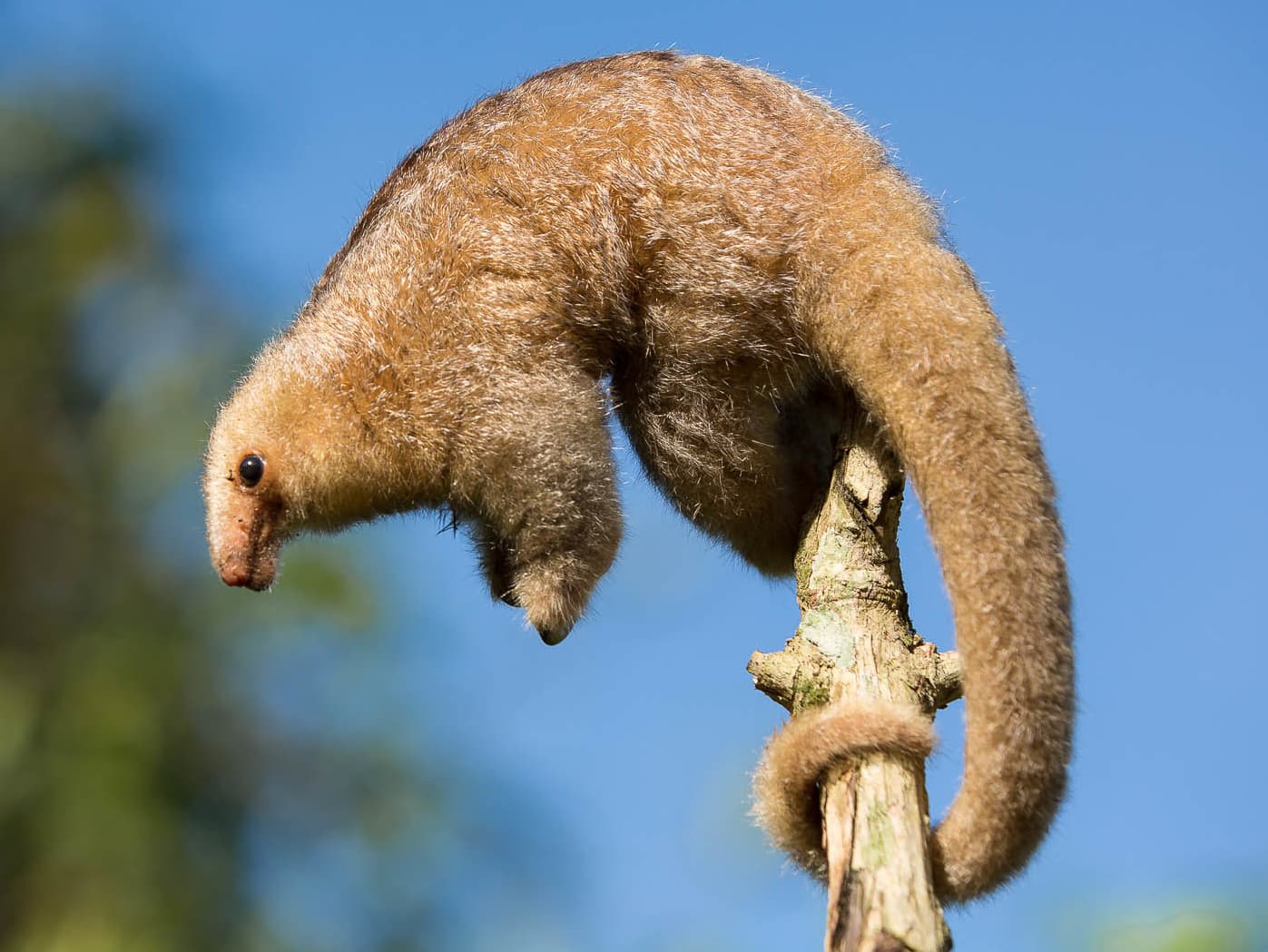
The Silky Anteater is the smallest of the world's anteaters, a secretive, golden-furred mammal that lives high in the forest canopy.
The Silky Anteater is the smallest of the world's anteaters, a secretive, golden-furred mammal that lives high in the forest canopy. In Trinidad it is closely associated with mangrove swamps and tall forest, where its cryptic, nocturnal habits make it one of the island's least frequently seen mammals.
Identification
This is a tiny anteater, with a body roughly 16 to 21 cm long and a prehensile tail of similar length, weighing only about 160 to 250 grams. Its dense, silky fur ranges from golden to silvery-grey, and it has two large curved claws on each front foot used to grip branches and tear open ant nests. The long, naked, grasping tail anchors the animal as it forages, leaving the limbs free.
Ecology
The Silky Anteater is strictly nocturnal and almost entirely arboreal, sheltering by day curled in tree foliage and foraging at night through the canopy. Its diet is made up almost exclusively of ants, which it laps up with a long sticky tongue after opening nests with its claws.
In Trinidad it occupies mangrove forest as well as evergreen and secondary forest, and is often linked with silk cotton (Ceiba) trees. It is solitary and slow-moving, relying on camouflage rather than speed to avoid predators.
Status in T&T
The species is recorded from Trinidad but not from Tobago, and the Trinidad population is referred to the genus Cyclopes. A density study in the Caroni Swamp Ramsar site estimated roughly 4.6 to 5.5 individuals per square kilometre, showing that protected mangrove is important habitat. Globally the Silky Anteater is listed as Least Concern by the IUCN, and in Trinidad and Tobago it is a protected animal rather than a game species, so it may not legally be hunted.