Bird
Bird
Scarlet Macaw
Ara macao
The Scarlet Macaw is one of the largest and most flamboyant parrots in the Americas, a metre-long bird draped in vivid red, yellow and blue plumage.
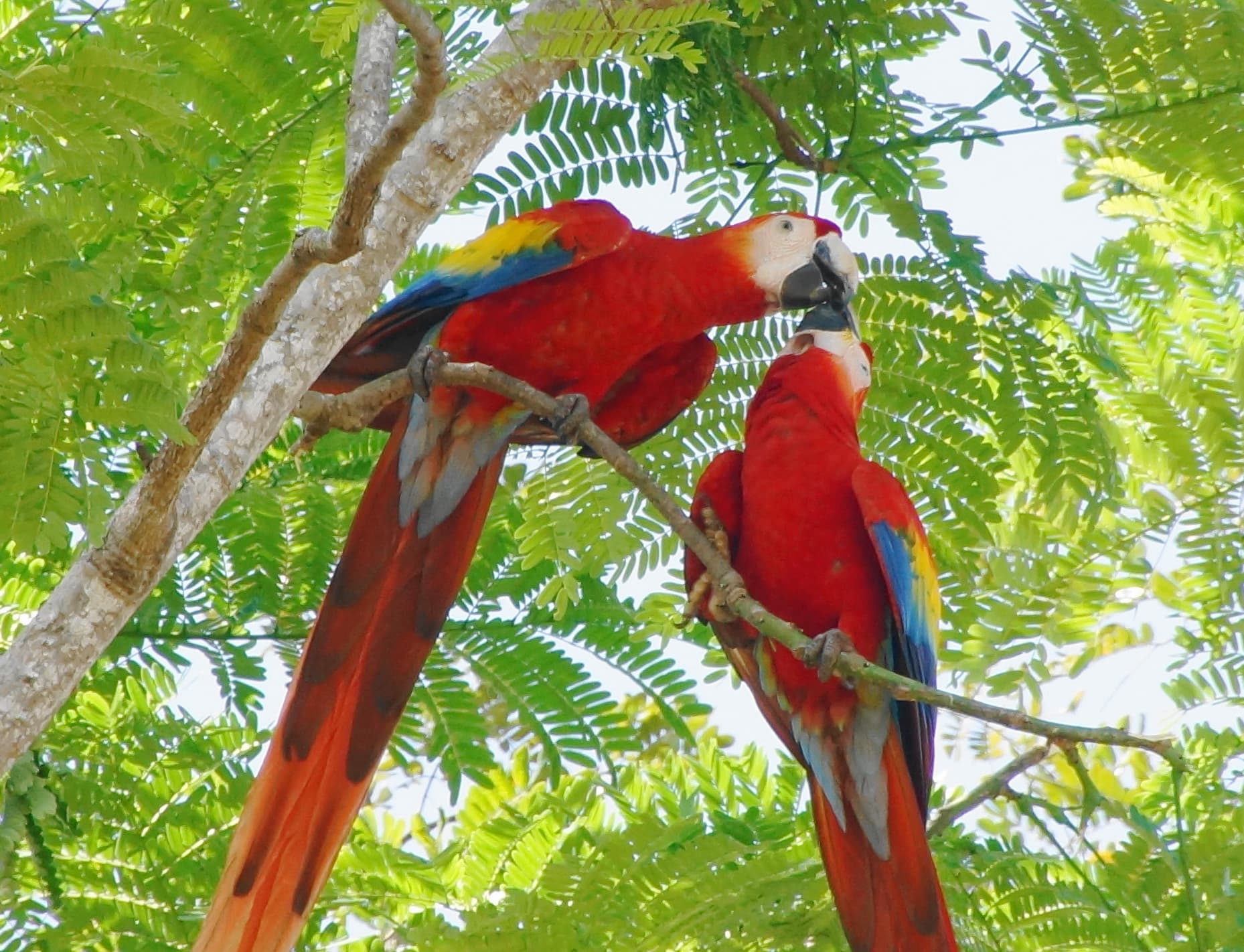
The Scarlet Macaw is one of the largest and most flamboyant parrots in the Americas, a metre-long bird draped in vivid red, yellow and blue plumage. Its raucous, far-carrying squawks and its habit of flying in pairs or small flocks make it one of the most recognisable birds of the Neotropical lowlands.
Appearance
Adults reach about 81 to 96 cm in total length, much of it a sweeping tapered tail. The body is brilliant scarlet, the wings show bands of bright yellow and blue, and the rump and lower back are blue. A large pale facial patch of bare skin surrounds the eye, marked with tiny lines of feathers, and the powerful hooked bill is pale above and dark below. Males and females look alike, and the heavy beak is strong enough to crack the hardest nuts and seeds.
Behaviour
Scarlet Macaws are highly social and are usually seen in pairs, family groups or larger flocks that gather to feed and roost. They are strong, direct fliers and communicate constantly with loud, harsh calls.
Like many large parrots they form long-term pair bonds, and pairs stay close together in flight, often appearing to fly wingtip to wingtip. They are intelligent, long-lived and curious, traits that unfortunately also make them prized in the cage-bird trade.
Diet and breeding
The diet is dominated by fruits, nuts, seeds and flowers, and the strong bill lets them open seeds too hard for most other birds. In several parts of their range they visit exposed riverbank clay licks, eating mineral-rich soil that is thought to help neutralise toxins in unripe seeds. They nest in cavities high in large trees, where the female lays a small clutch of white eggs and both parents help rear the chicks, which are slow to mature; wild birds can live several decades.
In Trinidad and Tobago
Historically the Scarlet Macaw was recorded in Trinidad but disappeared from the island, a loss tied to habitat clearance and capture for the pet trade, mirroring the better-known decline of the Blue and Gold Macaw. In recent years escaped and released birds have established small free-flying groups in parts of the island, so sightings do occur, but these are not a secure natural population. Globally the species is listed as Least Concern, though it is protected under CITES Appendix I against international commercial trade.