Bird
Bird
Rufous-tailed Jacamar
Galbula ruficauda
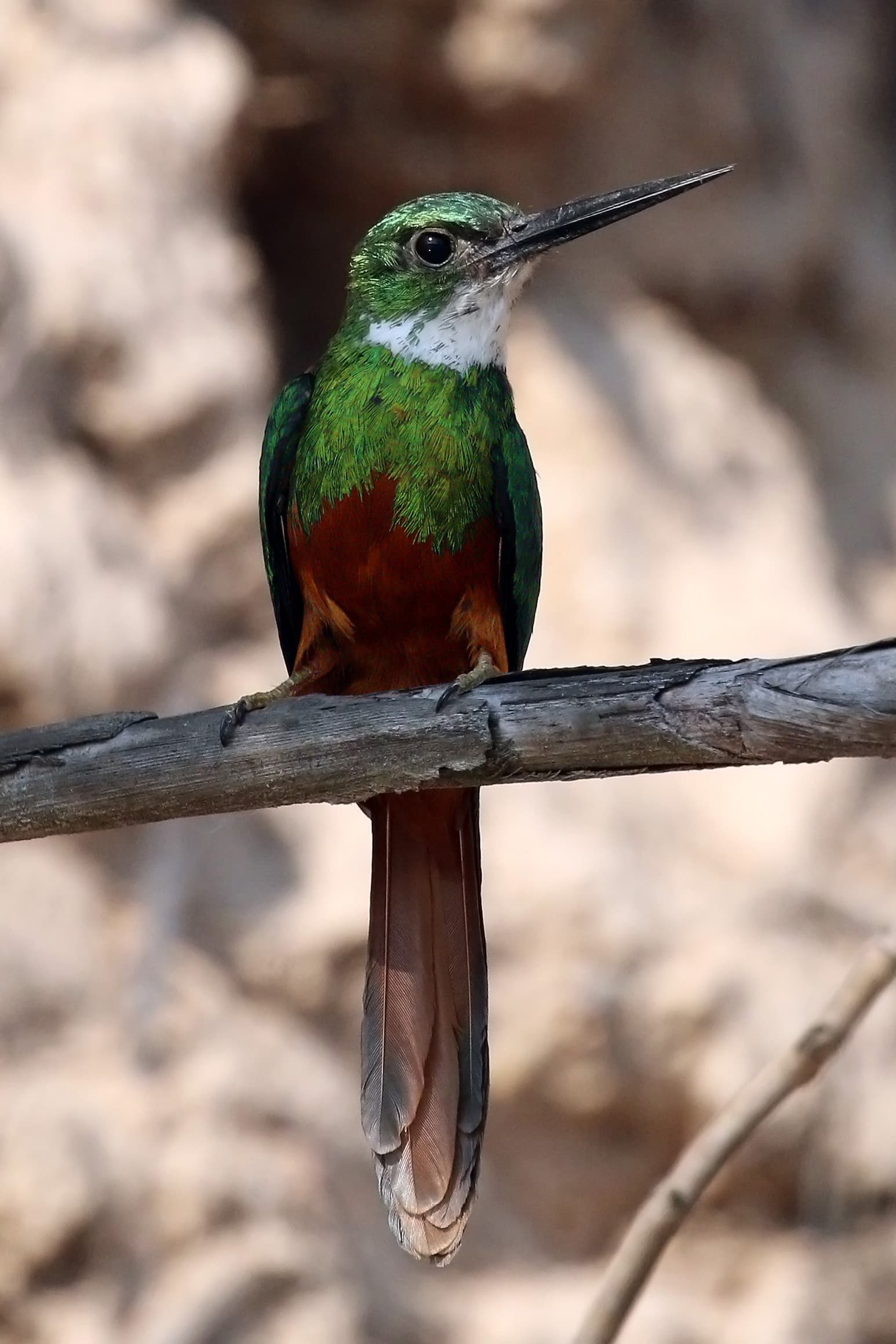
The Rufous-tailed Jacamar is one of the jewels of Trinidad and Tobago's forest edges and sunlit clearings, a strikingly beautiful bird that resembles a large, iridescent hummingbird perched on an open branch.
The Rufous-tailed Jacamar is one of the jewels of Trinidad and Tobago's forest edges and sunlit clearings, a strikingly beautiful bird that resembles a large, iridescent hummingbird perched on an open branch. With its glittering green and gold upperparts, rufous-orange belly and tail, and long, pointed bill adapted for catching large insects in mid-air, the jacamar brings a flash of the South American jungle to T&T's woodland margins and is a favourite subject for both birdwatchers and wildlife photographers.
Identification
The Rufous-tailed Jacamar measures 23 to 25 cm, much of that in the long, needle-like bill and elongated tail. The upperparts, head, and upper breast are brilliantly iridescent green-gold with a bronze-green sheen that changes in different light. The lower breast and belly are warm rufous-orange, and the rufous-orange tail is long and graduated. Males have a white throat; females have a pale buff throat. The long bill is black and slightly decurved. When perched, the bird holds its bill tilted slightly upward in a characteristic posture.
Ecology
Rufous-tailed Jacamars are aerial insectivores, hunting from exposed perches on forest edges, clearings, and roadsides by sallying out to catch large, often iridescent insects in mid-air, including dragonflies, beetles, butterflies, and moths. Prey is brought back to the perch and beaten vigorously against the branch before being swallowed. Like kingfishers to which they are related, jacamars nest in burrows excavated in earthen banks or termite mounds, with both sexes sharing incubation and chick-rearing duties. They are most often seen perched quietly on an exposed branch at the edge of a sunlit clearing, scanning for passing insects.
Status in T&T
The Rufous-tailed Jacamar is found on both Trinidad and Tobago, favouring forest edges, sunlit clearings, roadsides through forest, and the margins of plantations. It is fully protected under the Conservation of Wild Life Act and is not a game species. The species is a popular birdwatching target at forest edge sites across Trinidad and at the Main Ridge Forest Reserve on Tobago. Its tolerance of edge habitat gives it some resilience to forest fragmentation, but loss of adjacent forest interior reduces nesting and foraging resources.
Threats
- Forest edge loss from deforestation
- Pesticide use reducing large insect prey