Bird
Bird
Rufescent Tiger Heron
Tigrisoma lineatum
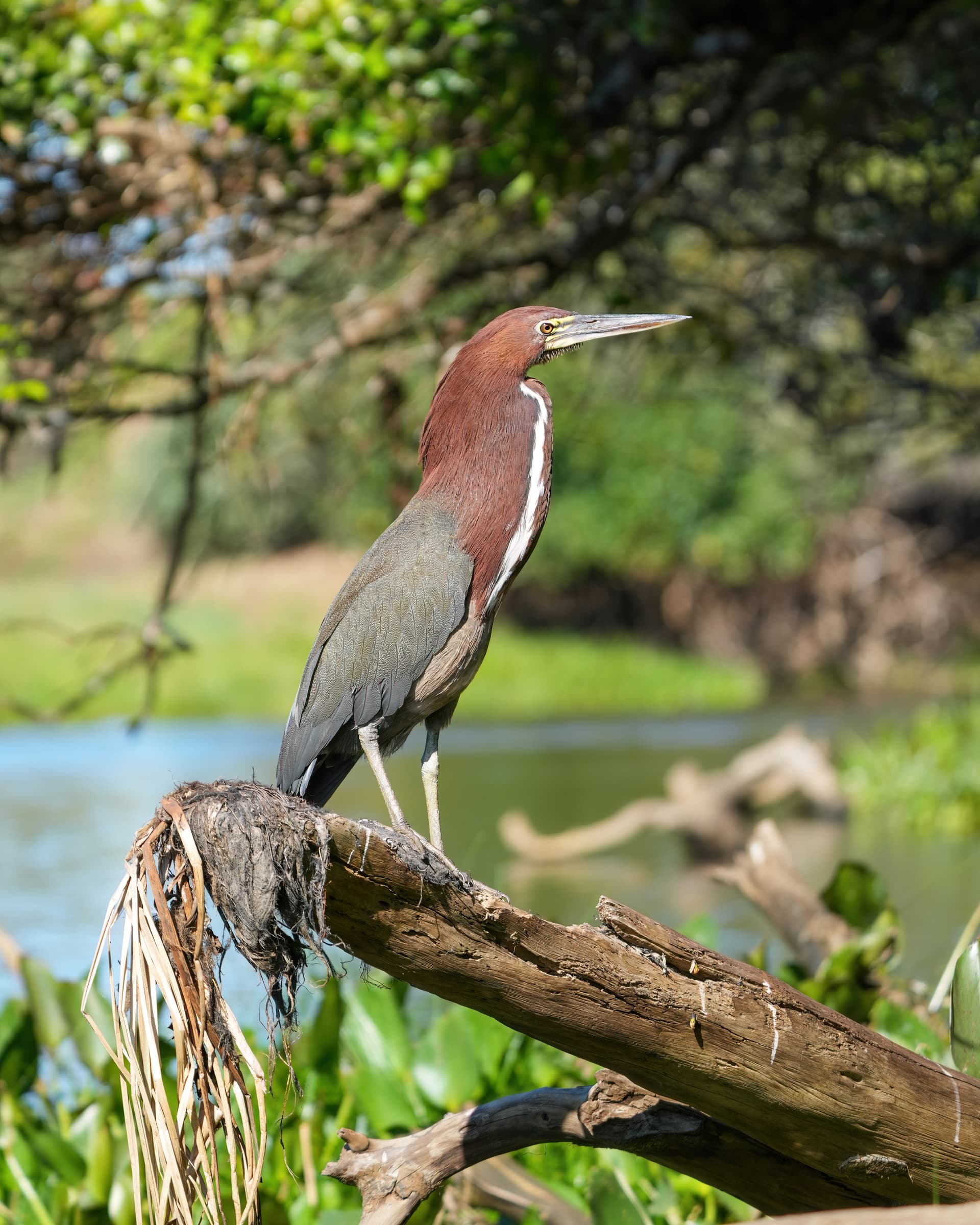
The Rufescent Tiger Heron is a large, strikingly patterned, and notoriously secretive heron of Trinidad's forested rivers and shaded freshwater margins, named for the intricate rufous and black tiger-like barring of the juvenile plumage and the rich chestnut colouration of the adult.
The Rufescent Tiger Heron is a large, strikingly patterned, and notoriously secretive heron of Trinidad's forested rivers and shaded freshwater margins, named for the intricate rufous and black tiger-like barring of the juvenile plumage and the rich chestnut colouration of the adult. Found standing motionless for long periods at the water's edge in dense, shaded vegetation, it is a master of camouflage and patience, striking at fish and frogs with explosive speed. A sighting of this solitary heron on a forest river in T&T is one of the standout wildlife moments for visiting naturalists.
Identification
The Rufescent Tiger Heron is a large heron measuring 66 to 76 cm. The adult has a rich rufous-chestnut head, neck, and upper breast, finely vermiculated with black giving a tiger-striped effect, a grey-brown back and wings, and a pale whitish stripe down the centre of the foreneck. The bill is long, dagger-like, and yellowish-green. The juvenile is spectacularly different: heavily barred and mottled rufous, black, and white throughout, with a strongly tiger-patterned plumage that gives the species its common name. Juveniles take several years to attain full adult plumage through a series of intermediate stages.
Ecology
Rufescent Tiger Herons are highly solitary birds of shaded forest streams, river margins, forest pools, and swamp edges. They feed by standing absolutely motionless at the water's edge for extended periods, then striking at fish, frogs, large insects, and crustaceans with rapid bill thrusts. When alarmed they adopt an upright, bill-pointing posture and remain completely still, blending into riverside vegetation with remarkable effectiveness. They are territorial, occupying long stretches of river bank. Nesting is poorly documented in T&T; the nest is a large platform of sticks placed over or near water.
Status in T&T
The Rufescent Tiger Heron is found on Trinidad in forested river systems, particularly in the Northern Range and on wooded streams draining into the Nariva and Caroni catchments. It does not occur on Tobago. The species is fully protected under the Conservation of Wild Life Act and is not a game species. Its dependence on shaded forest streams makes it sensitive to deforestation in river catchments, sedimentation, and stream channelisation.
Threats
- Deforestation of river catchments removing shaded stream habitat
- River sedimentation from agricultural run-off
- Stream channelisation destroying foraging habitat