Bird
Bird
Red-legged Honeycreeper
Cyanerpes cyaneus
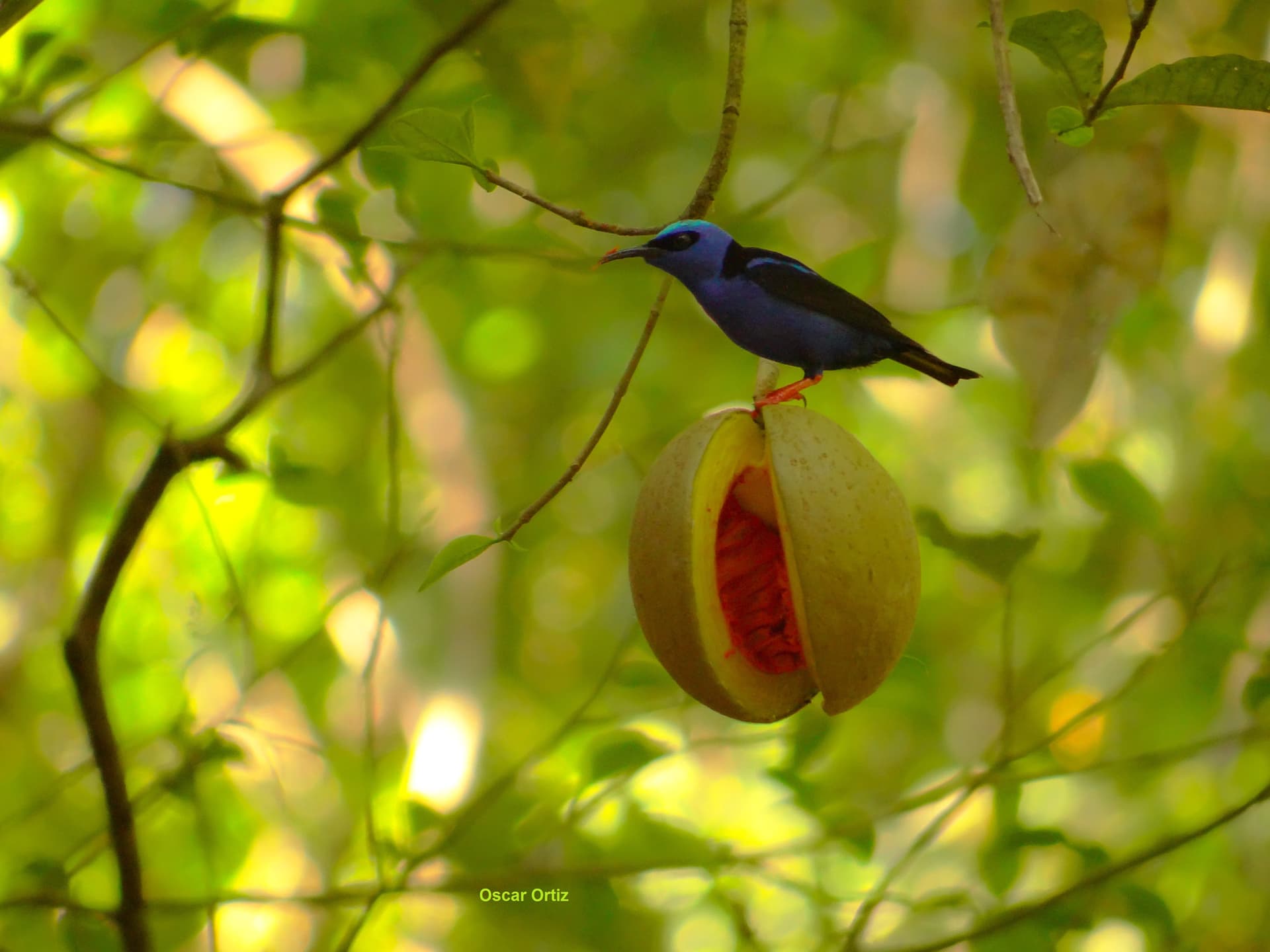
The Red-legged Honeycreeper is a small, jewel-like bird of Trinidad and Tobago's forest edge and gardens, the breeding male a striking combination of violet-blue body, black wings, and vivid red legs, in sharp contrast to the plain green female.
The Red-legged Honeycreeper is a small, jewel-like bird of Trinidad and Tobago's forest edge and gardens, the breeding male a striking combination of violet-blue body, black wings, and vivid red legs, in sharp contrast to the plain green female.
Identification
A small bird around 11 to 12 cm long. The breeding male is deep violet-blue overall with a black crown, wings, and tail, and unusually bright red-orange legs, one of the few brightly coloured leg patterns among small passerines. Non-breeding males resemble females, which are entirely green with faintly paler streaking below, but males in any plumage retain the diagnostic red legs, a reliable identification feature year-round.
Ecology
The Red-legged Honeycreeper feeds on nectar, small fruit, and insects, using its slightly downcurved bill to probe flowers and pierce soft fruit, and often forages actively in the forest canopy, forest edge, and garden trees, sometimes joining mixed-species flocks with tanagers and other honeycreepers. It plays a role in pollinating some flowering trees. Nests are small, well-hidden cups built by the female, typically placed in a fork of a tree or shrub.
Status in T&T
Common in forest edge, gardens, and semi-open woodland with flowering and fruiting trees across both Trinidad and Tobago. It is not threatened. It is protected under the Conservation of Wildlife Act and is not a game species.
Threats
- No major threats; adapts well to garden and forest-edge habitat