Mammal
Mammal
Red Brocket Deer
Mazama americana
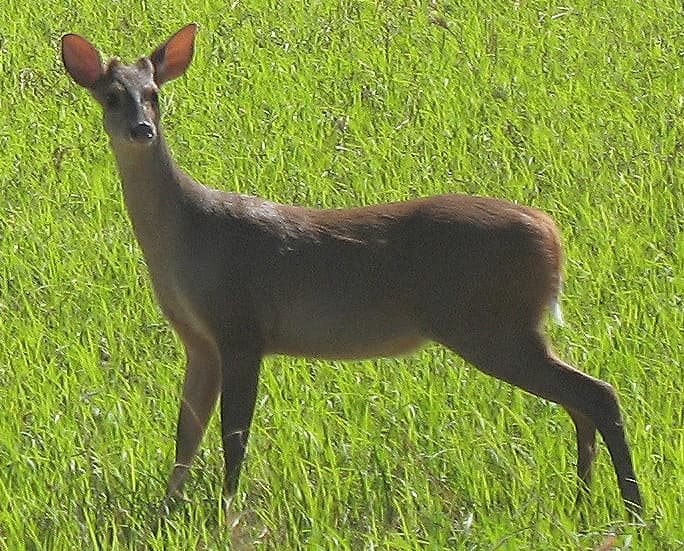
The Red Brocket Deer is the only wild deer in Trinidad and Tobago, known locally simply as 'deer'.
The Red Brocket Deer is the only wild deer in Trinidad and Tobago, known locally simply as 'deer'. A small, russet-coated forest cervid, it is the most prized game animal in the country and may be hunted only during a regulated open season under State licensing. The Trinidad population is the endemic subspecies Mazama americana trinitatis.
Identification
The Red Brocket Deer is a small, compact cervid with a rich reddish-brown to chestnut coat, a darker face and legs, and paler underparts. Adults typically stand around 65 to 80 cm at the shoulder and weigh roughly 24 to 48 kg, with a rounded, hunched body shape adapted to slipping through dense undergrowth.
Unlike the branching antlers of temperate deer, males carry short, simple, unbranched spike antlers, the feature that gives 'brocket' deer their name. Females lack antlers, and fawns are born with rows of white spots that fade as they mature.
Ecology
Brocket deer are shy, largely solitary browsers of dense forest, mountain slopes, plantations, and forest-edge savanna, where thick cover lets them hide from danger. They feed on a varied diet of fallen fruit, leaves, shoots, fungi, and other plant material, and they help disperse seeds through the forest.
They are most active around dawn and dusk and freeze or bolt into vegetation when alarmed rather than running in the open. In Trinidad the main natural predator is the ocelot, while fawns and adults are also taken by large raptors, snakes, and human hunters.
Status in T&T
The deer is the most prized game animal in Trinidad and Tobago and may be taken only during the regulated open hunting season under the Conservation of Wild Life Act (Chapter 67:01), which requires a State Game Licence and prohibits the taking, sale, or possession of wild meat in the closed season. A hunting moratorium has been used as a management tool to allow populations to recover, and density studies have monitored deer at several Trinidad sites.
Deer are listed as a game species for Trinidad only, and their presence in Tobago is uncertain and possibly extirpated. Globally the IUCN currently lists Mazama americana as Data Deficient because the species represents an unresolved complex still being clarified by genetic study, leaving the conservation status of the endemic Trinidad subspecies poorly defined.