Mammal
Mammal
Nine-banded Armadillo
Dasypus novemcinctus
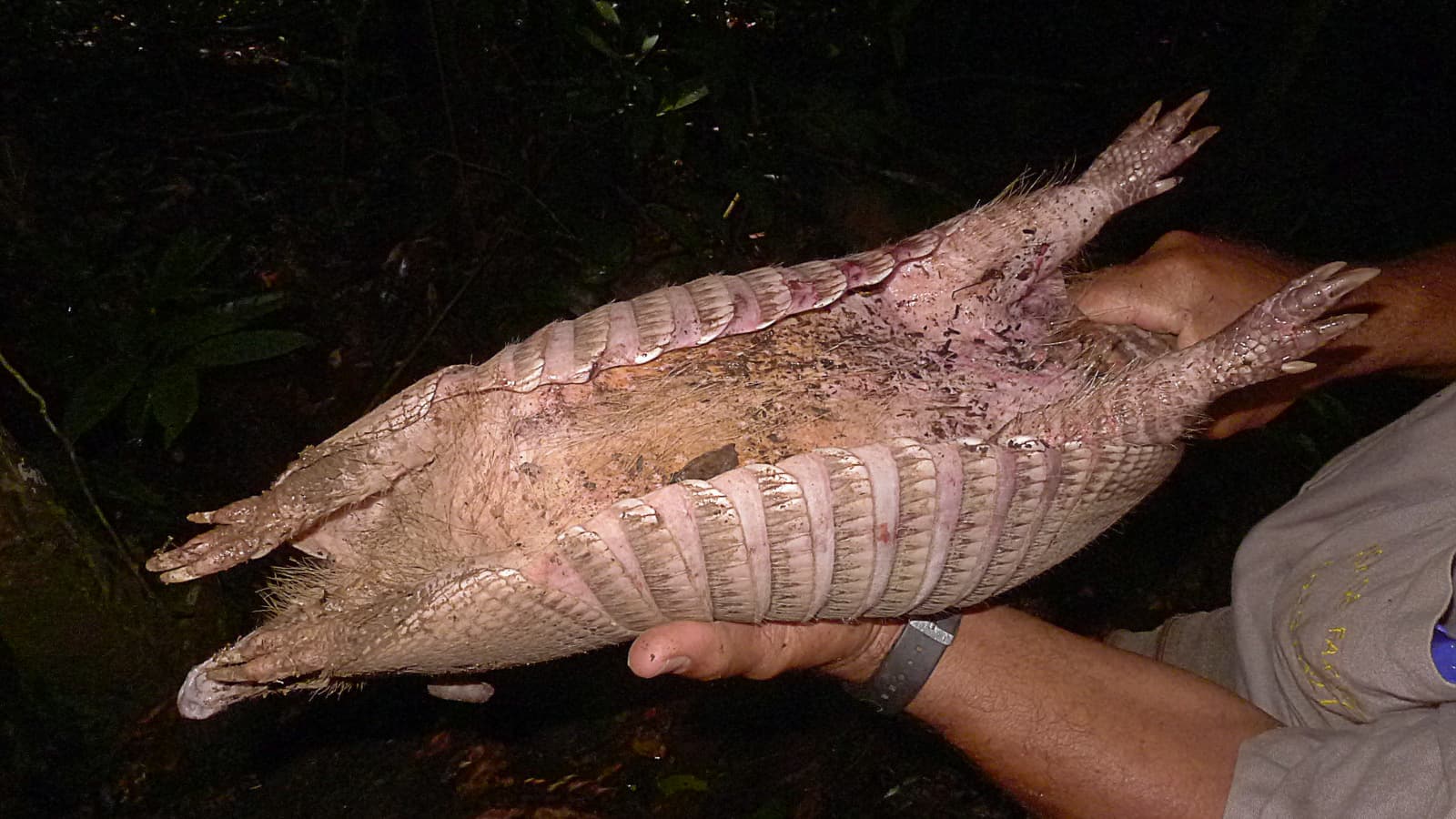
Known locally as the tatou (or tattoo), the Nine-banded Armadillo is a nocturnal, armoured mammal found throughout the forests and scrublands of both Trinidad and Tobago.
Known locally as the tatou (or tattoo), the Nine-banded Armadillo is a nocturnal, armoured mammal found throughout the forests and scrublands of both Trinidad and Tobago. It is one of the most heavily hunted wild mammals in the islands, prized as bush meat and managed as a regulated game animal under national wildlife law.
Identification
The Nine-banded Armadillo is unmistakable, with a body encased in a tough, leathery armour of bony plates covered by horny skin. Between the rigid front and rear shields sit a series of flexible bands (typically eight or nine) that allow the animal to flex its body. It has a long, tapering scaly tail, a pointed snout, large ears, and powerful clawed forefeet built for digging. Adults usually measure roughly 60 to 105 cm in total length including the tail.
Ecology
This species is solitary and mainly nocturnal, spending the day in self-excavated burrows and emerging at night to forage. It feeds chiefly on ants, termites, beetles, grubs and other invertebrates, rooting through leaf litter and soil with its snout and claws, and will also take small vertebrates, eggs and some plant matter.
The Nine-banded Armadillo occupies a wide range of habitats, from mature and secondary rainforest to dry scrub, savanna and forest edges. Females characteristically give birth to identical quadruplets developed from a single fertilised egg, a reproductive trait unusual among mammals.
Status in T&T
Globally the species is listed as Least Concern by the IUCN, reflecting its very broad range and adaptability across the Americas. In Trinidad and Tobago it occurs on both islands and is classed as a game animal under the Conservation of Wild Life Act, meaning it may be hunted legally only during an open season and only by holders of a State Game Licence. A close season (broadly from around 1 April to 30 September) protects the animals during their main breeding period, and continued hunting pressure for bush meat is the principal local conservation concern.