Bird
Bird
Purple Gallinule
Porphyrio martinicus
The Purple Gallinule is one of the most strikingly coloured waterbirds of Trinidad and Tobago's freshwater wetlands.
The Purple Gallinule is one of the most strikingly coloured waterbirds of Trinidad and Tobago's freshwater wetlands. Known locally as the blue waterfowl, it combines iridescent purple-blue plumage with bright yellow legs and oversized toes that let it stride across floating swamp vegetation. It is a resident breeder found on both islands, wherever lily-covered freshwater marshes persist.
Identification
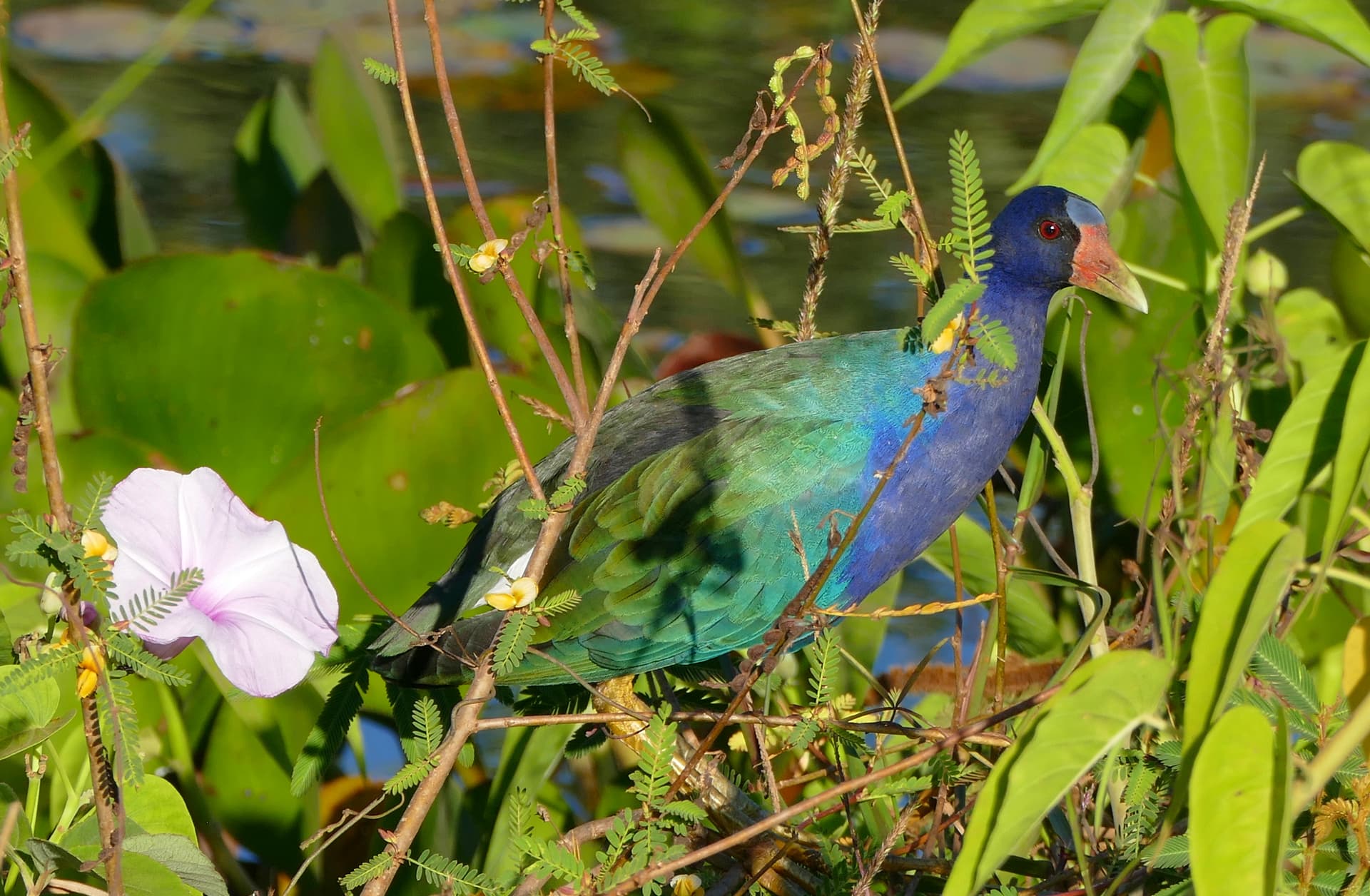
Adults have a deep purplish-blue head, neck, and underparts that shade to bronzy-green on the back and wings, with a white undertail that flicks conspicuously as the bird walks. The bill is bright red with a yellow tip, topped by a pale blue frontal shield on the forehead.
The long, slender legs are bright yellow and end in remarkably long, unwebbed toes. This medium-sized rail measures roughly 26 to 37 cm in length. Immature birds are duller, buffy-brown overall with olive-toned wings and lacking the vivid adult colours.
Ecology
Those elongated toes spread the bird's weight so it can walk steadily across lily pads and mats of floating plants without sinking, a hallmark of how it forages. It is an omnivore, taking the flowers, fruits, and seeds of water lilies and other aquatic plants alongside insects, snails, frogs, small fish, and occasionally the eggs and nestlings of other birds.
It favours dense stands of emergent and floating vegetation in freshwater marshes, which provide both feeding cover and nesting sites. Nests are platforms woven among reeds or floating plants just above the waterline.
Status in T&T
The Purple Gallinule is a resident breeder in Trinidad and Tobago, present year-round on both islands. It is regularly recorded at freshwater and brackish wetlands including the Caroni Swamp, Nariva Swamp, and the Pointe-a-Pierre Wildfowl Trust.
Globally the species is listed as Least Concern by the IUCN, reflecting its wide range and stable population. Locally its fortunes are tied to the health of freshwater marshes, so protecting wetland vegetation is key to keeping the species common.