Bird
Bird
Piratic Flycatcher
Legatus leucophaius
The Piratic Flycatcher earns its name from a remarkable nesting strategy: rather than building its own nest, it aggressively harasses other birds, particularly oropendolas and caciques, until they abandon an active nest, which the flycatcher then takes over for its own use.
The Piratic Flycatcher earns its name from a remarkable nesting strategy: rather than building its own nest, it aggressively harasses other birds, particularly oropendolas and caciques, until they abandon an active nest, which the flycatcher then takes over for its own use.
Identification
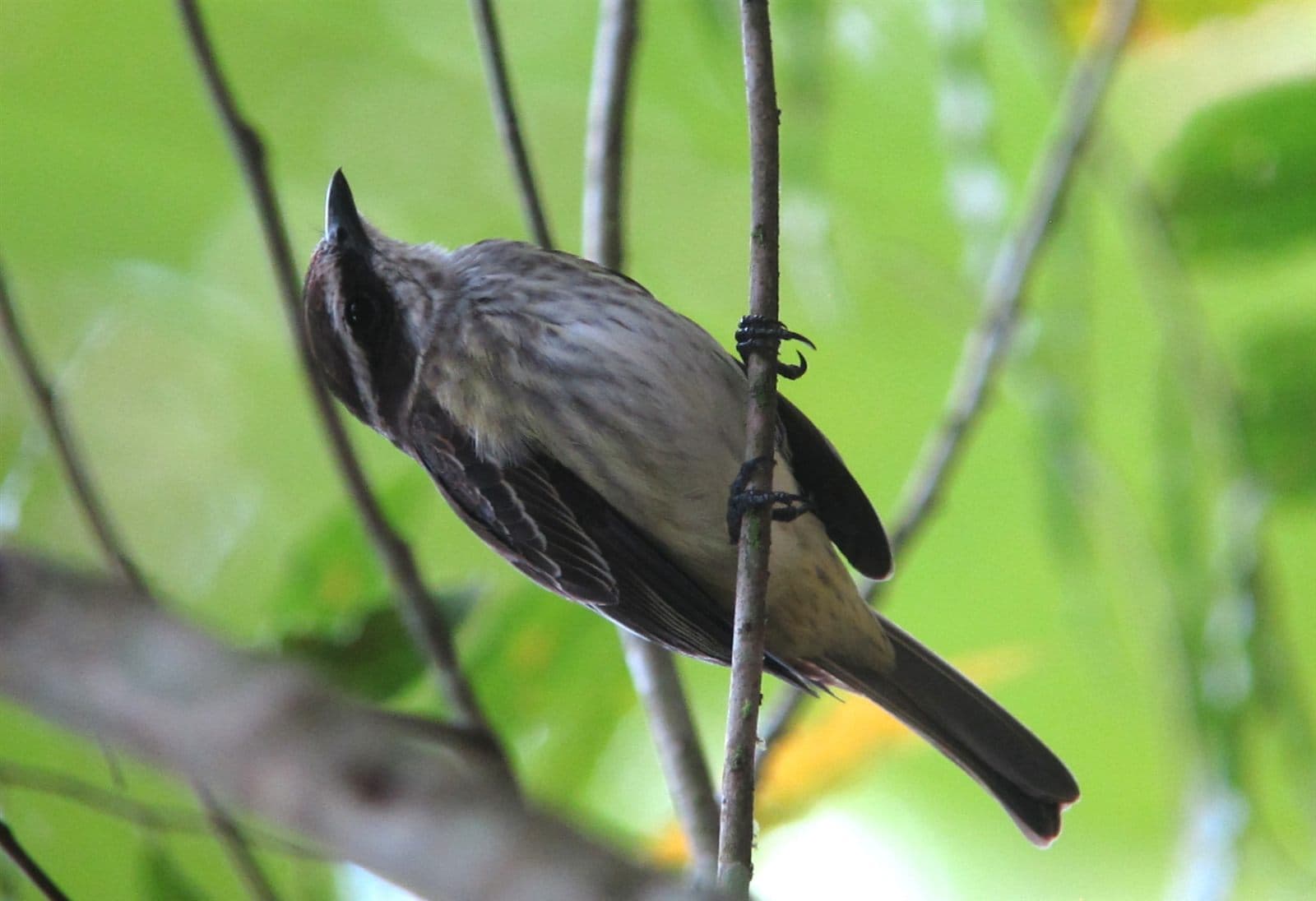
A small flycatcher around 15 to 16 cm long, olive-brown above with a dark mask through the eye, a pale supercilium, and streaked, pale yellowish underparts. A partially concealed yellow crown patch is present but rarely displayed. Its plain, somewhat streaky appearance resembles several other small flycatchers, making behaviour and habitat often more useful for identification than plumage alone.
Ecology
The Piratic Flycatcher does not build its own nest; instead, pairs persistently harass the builders of enclosed or woven nests, most often oropendolas, caciques, and other colonial nest-builders, repeatedly attacking and disturbing the rightful owners until they abandon the nest, sometimes even before it is complete, at which point the flycatcher moves in to lay its own eggs. It feeds on fruit and insects, foraging actively at forest edge and in the canopy. Some populations are migratory, moving seasonally within their range.
Status in T&T
Found in forest edge and areas near oropendola or cacique nesting colonies on both Trinidad and Tobago, its own local distribution closely tied to the presence of suitable host nests. It is not threatened. It is protected under the Conservation of Wildlife Act and is not a game species.
Threats
- Loss of host colonies (oropendola/cacique nesting trees) reducing available nest sites