Reptile
Reptile
Orange-spotted Gecko
Gonatodes humeralis
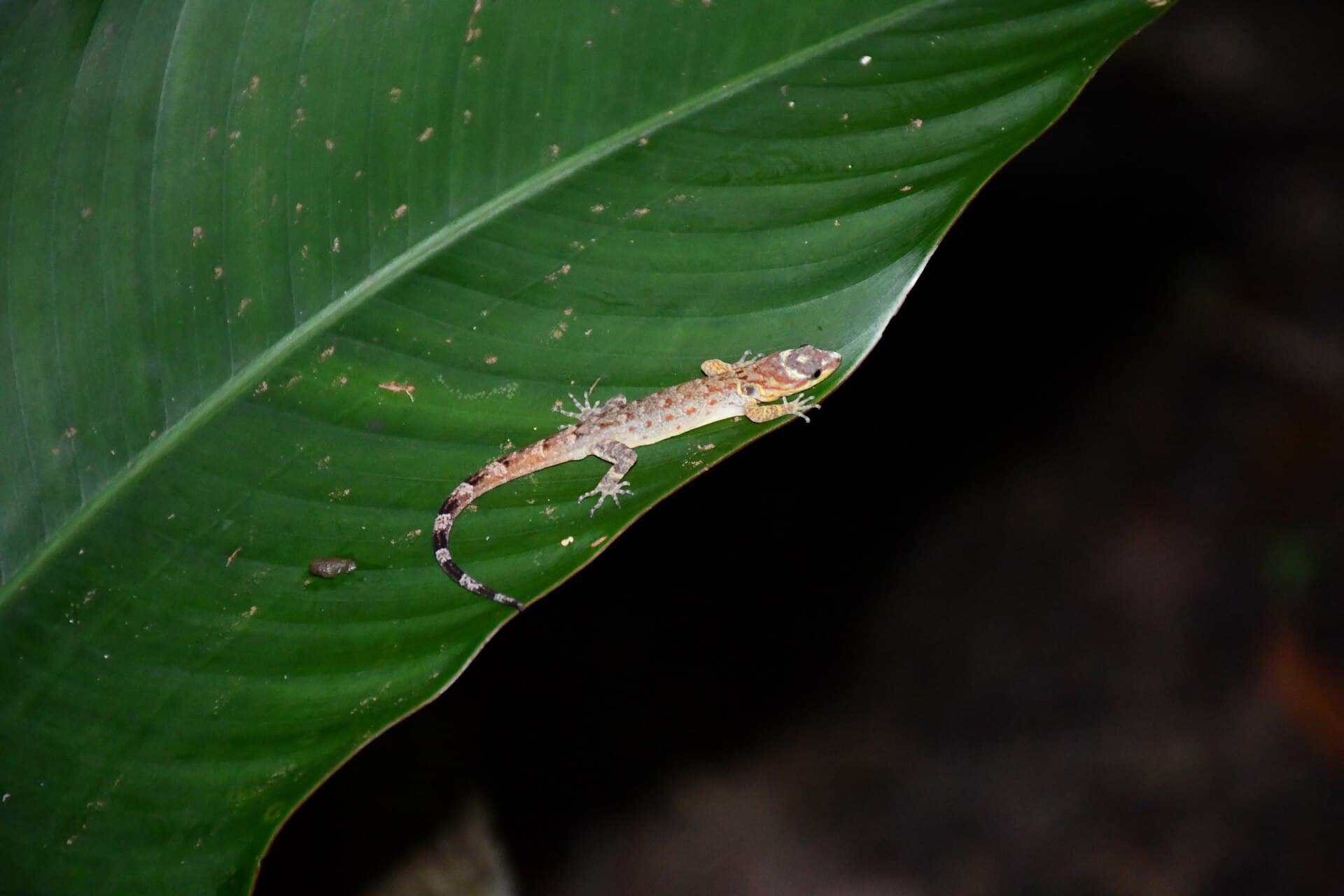
The Orange-spotted Gecko is a tiny, boldly marked forest gecko found on tree trunks, buttress roots, and leaf litter across Trinidad.
The Orange-spotted Gecko is a tiny, boldly marked forest gecko found on tree trunks, buttress roots, and leaf litter across Trinidad. Unlike the introduced house geckos familiar around buildings, it is active by day and stays close to native forest, quick to display its contrasting colours when basking in sunflecks on the forest floor.
Identification
A small gecko, typically 3 to 4 cm in body length, with pronounced sexual dimorphism: males show a grey-brown body marked with a scattering of orange to rust spots and a pale collar or "shoulder" patch, while females are more uniformly mottled brown, providing better camouflage while incubating eggs on the forest floor. Unlike climbing house geckos, it lacks expanded adhesive toe pads, relying on small claws to grip bark, logs, and leaf litter rather than smooth vertical surfaces.
Ecology
Diurnal and active on tree trunks, fallen logs, buttress roots, and leaf litter in forest understorey, hunting small invertebrates such as ants, mites, and tiny insects located visually in daylight rather than by scent or vibration. Unlike the introduced house geckos that dominate buildings at night, it avoids artificial structures entirely and remains dependent on intact native forest, rarely straying into disturbed or cleared land. Eggs are laid singly or in small clutches in moist leaf litter or under bark.
In Trinidad and Tobago
Common in Trinidad's forests, where it is a useful bioindicator of intact understorey habitat, since it rarely persists in heavily disturbed or agricultural land once forest structure is lost. It is easily overlooked due to its small size but can be reliably spotted moving over sunlit leaf litter and low tree trunks along forest trails during the day.
Threats
- Forest clearance and understorey disturbance
- Leaf litter loss from land conversion