Reptile
Reptile
Mapepire Zanana (Bushmaster)
Lachesis muta muta
The Mapepire Zanana is the largest venomous snake in Trinidad and the longest pit viper species in the world, capable of reaching 2 m in the wild.
The Mapepire Zanana is the largest venomous snake in Trinidad and the longest pit viper species in the world, capable of reaching 2 m in the wild. Found in the deep primary and mature secondary forests of Trinidad's Northern Range and southern hills, it is rarely encountered and rarely bites, but its venom is potent and a bite demands immediate medical attention. Locally it is considered the most feared snake on the island, a reputation that both reflects and exceeds the genuine risk it presents.
Description
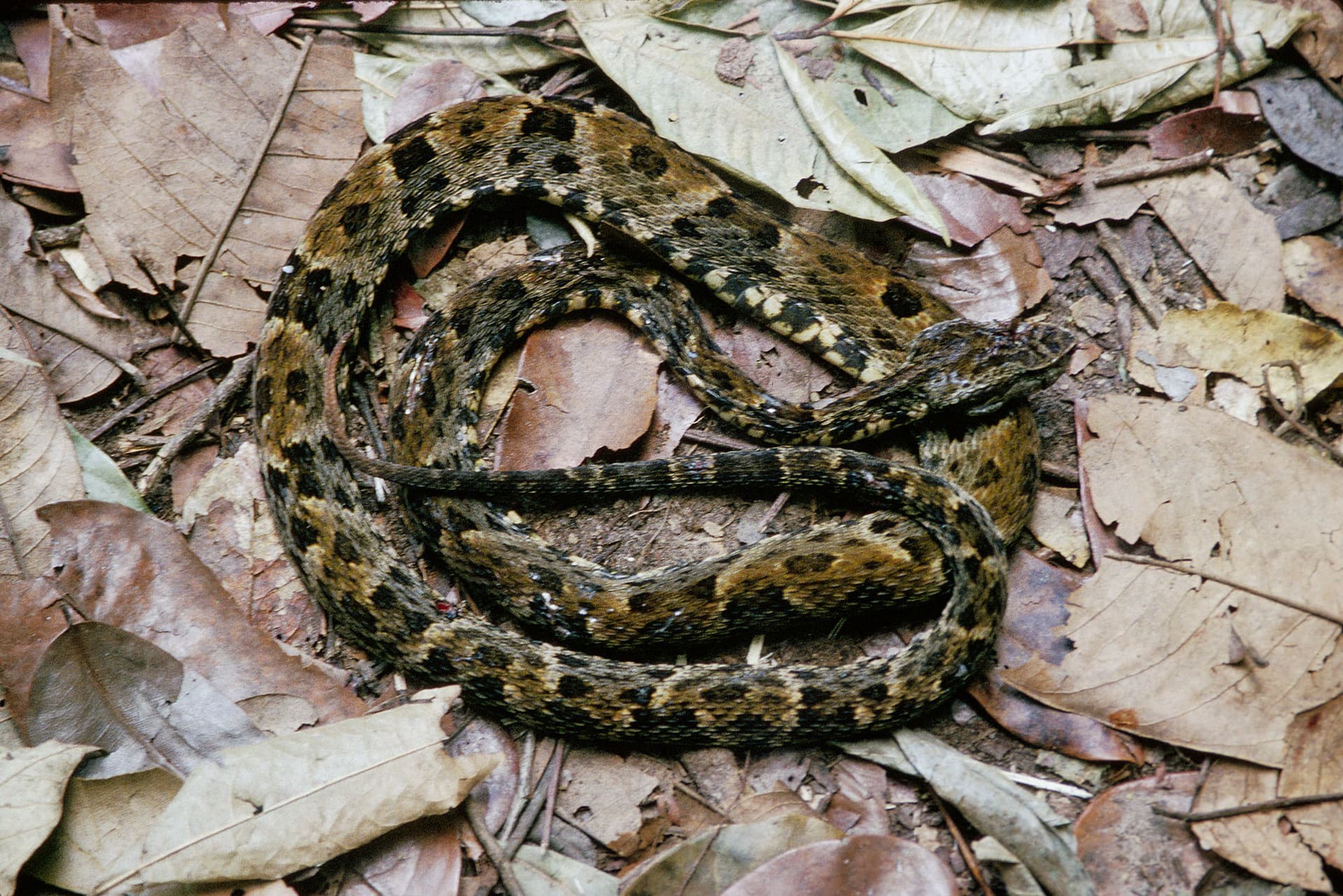
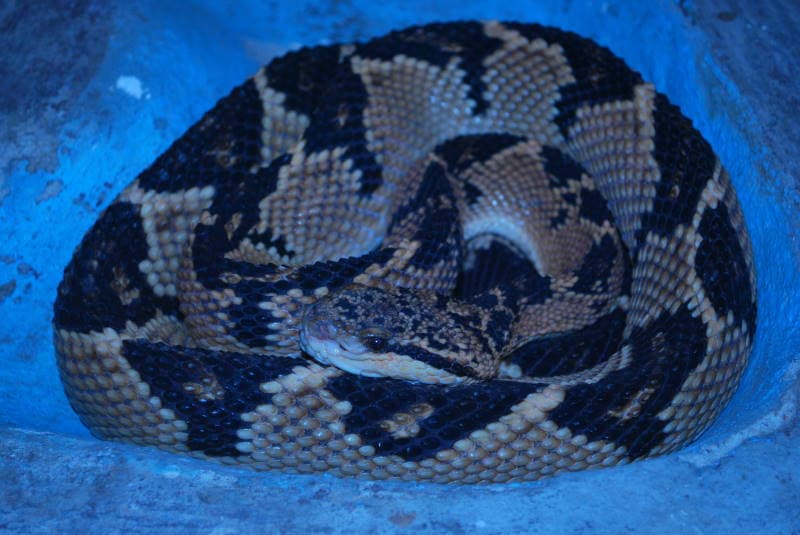
The Mapepire Zanana is an unmistakably large snake: light brown to yellow-brown in body colour, with bold darker-brown diamond-shaped saddles along the back. Each individual dorsal scale is so raised and distinct that the body appears almost rough-textured, giving the animal a rugose, toadlike look unlike any other local species. The blunt, almost squarish head bears the characteristic pit viper loreal pit between eye and nostril. The tail ends in a distinctive scaly rattle-like spine, not the rattle of a rattlesnake but a keratinous tip that vibrates against dry leaves when the snake is alarmed, producing an audible warning. Recorded globally at lengths exceeding 3 m, in Trinidad the expected maximum is approximately 2.1 m.
Ecology
Unlike the Mapepire Balsain, which tolerates degraded and agricultural habitats, the Mapepire Zanana is a creature of primary forest. It is most abundant in the wet forests of the Northern Range and is a reliable indicator of intact forest cover. Mainly terrestrial and nocturnal, it is an ambush predator that feeds on small and medium-sized mammals, particularly rodents, as well as lizards and other snakes. An egg-layer rather than a live-bearer (unusual for a pit viper), the female coils protectively around her clutch during incubation.
Natural History
The Mapepire Zanana's venom is hemotoxic and highly potent; it delivers a large venom volume relative to its body size, making untreated bites particularly dangerous. However, actual bites are rare. The species is retiring by nature, relying on camouflage rather than aggression, and most bites occur when people inadvertently step on or handle the snake in the forest. As with the Mapepire Balsain, antivenom is the correct treatment and is available in Trinidad. It is not found on Tobago.
Conservation
Folklore around the Mapepire Zanana is extensive. It has been called "the silent death of the black night" and is associated with obeah practice; its presence in primary forest has historically kept certain areas of the Northern Range less disturbed simply through the fear of encountering it. The local name "zanana" is from French Creole, with "z'anana" meaning "pineapple," a reference to the rough, scaled texture of the snake's body.
Why It Matters
The Mapepire Zanana is one of the clearest indicators of intact forest in Trinidad. Unlike the Mapepire Balsain, which can survive in degraded, agricultural, and semi-urban habitats, the zanana requires primary rainforest. Where it is present, the forest is old enough, connected enough, and intact enough to support an apex predator with large territory requirements. Its presence in the Northern Range is therefore not just a fact about a snake; it is a statement about the quality of the forest it lives in. As a predator of rodents in primary forest, the Mapepire Zanana plays a role in regulating small mammal populations in ecosystems that are otherwise difficult to study.
Its egg-laying behaviour is unusual among pit vipers and contributes to the academic interest in this species. The large venom volume and potency it deploys reflect millions of years of co-evolution with prey animals that are themselves difficult to subdue: the snake's effectiveness as a predator is the product of precisely the features that make it medically dangerous. The fear attached to the Mapepire Zanana has, paradoxically, provided a measure of indirect protection to the remote forest it inhabits. Areas of the Northern Range where locals believed the snake was common were left undisturbed for generations. That informal protection is eroding. The real protection the animal needs is the legal protection of the forest it cannot live without.
Threats
- Persecution and killing on sight
- Habitat loss: primary forest clearance directly eliminates this species
- Sensitivity to forest fragmentation; unable to persist in degraded habitats
- Road kills in forest margins