Reptile
Reptile
Mapepire Balsain (Fer-de-lance)
Bothrops atrox
The Mapepire Balsain is Trinidad's most medically significant venomous snake and the species responsible for the overwhelming majority of snakebite incidents on the island.
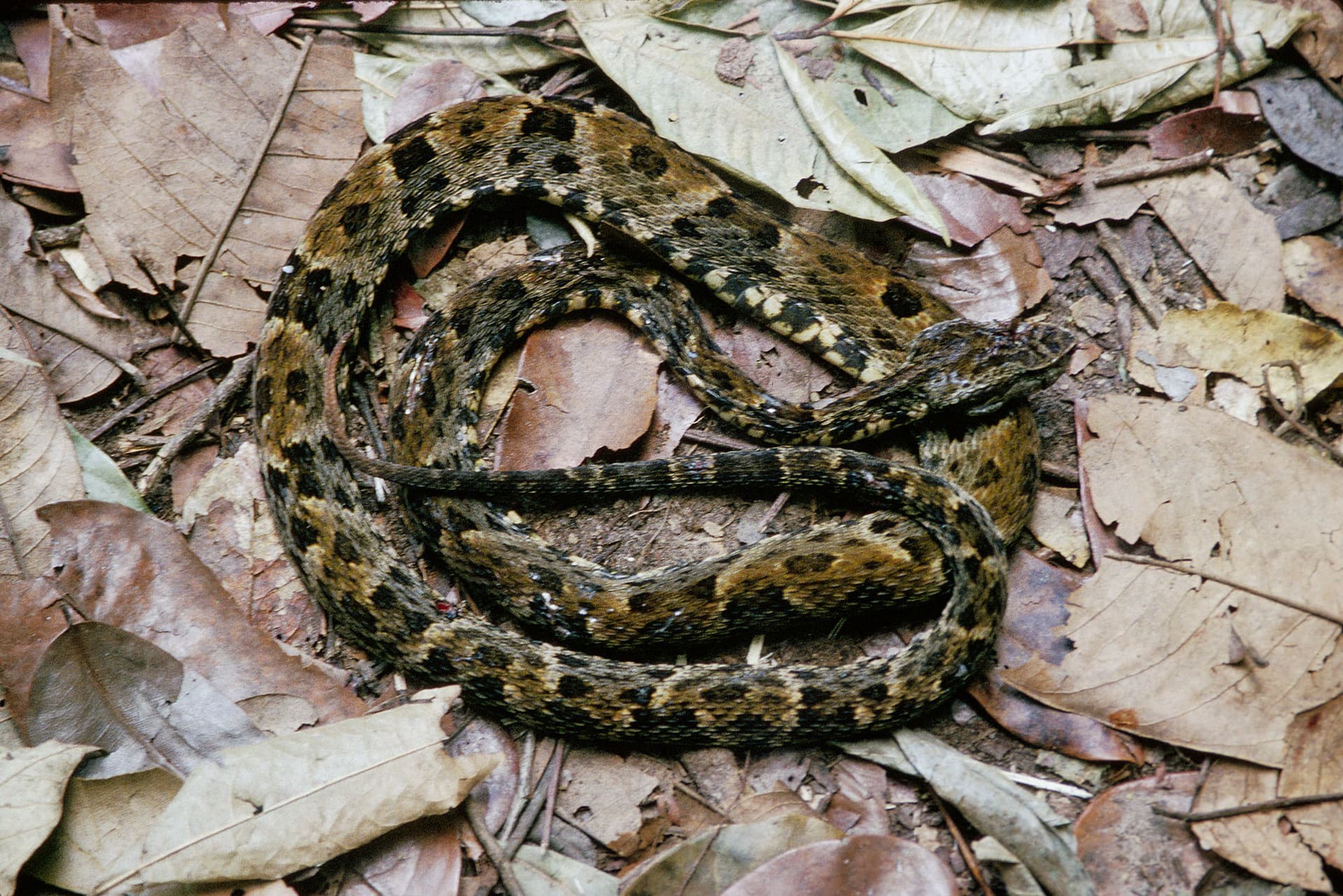
The Mapepire Balsain is Trinidad's most medically significant venomous snake and the species responsible for the overwhelming majority of snakebite incidents on the island. Known across its South American range as the fer-de-lance, it is a powerfully built pit viper found in forests, forest edges, and agricultural land throughout Trinidad. Despite a fearsome reputation (much of it warranted), it is a vital part of the island's ecosystem, controlling populations of small mammals and other prey.
Description
The Mapepire Balsain is a large, heavyset snake reaching up to 1.5 m in length. Its dorsal pattern consists of dark triangles outlined in dirty yellow or white, with apices that either meet or alternate at the midline of the back. Ground colour varies considerably across individuals, ranging from tan and dark brown to moss green or yellowish-red. The scales are finely keeled, giving the body a velvety texture. Juveniles carry a bright yellow, orange, or dirty-white tail tip, which is used to lure lizards and frogs within striking distance. The broad, distinctly triangular head, the vertical elliptical pupils, and the characteristic heat-sensing pit between eye and nostril distinguish it instantly from every harmless species on the island.
Ecology
Mainly terrestrial and preferring wet, forested habitats, the Mapepire Balsain is also found along forest edges and in cocoa and citrus estates where rodent prey is plentiful. It is most active at night and in the early morning hours. Adults prey on rats, mice, lizards, frogs, and birds; the young take lizards and small frogs. Like all pit vipers, it detects warm-blooded prey using heat-sensitive loreal pits, allowing effective hunting in complete darkness. When threatened it coils defensively and may deliver a vigorous warning display before striking.
Natural History
The venom of the Mapepire Balsain is hemotoxic and cytotoxic, causing tissue destruction, haemorrhage, and, without treatment, potentially fatal systemic effects. Medical-grade antivenom produced from Trinidadian specimens has been available since the early twentieth century through the Trinidad Regional Virus Laboratory and, subsequently, the Caribbean Epidemiology Centre (CAREC). Prompt administration of antivenom dramatically reduces mortality. The species is not found in Tobago; all pit viper bites in Trinidad and Tobago occur on Trinidad.
Conservation
Despite being the island's most feared animal, the Mapepire Balsain fills an important ecological role as a top predator of small rodents in forest and agricultural settings. Its local name derives from French Creole, with "balsain" a variant of "valsain" meaning "waltzing," a reference to the coiling, circling defensive display of a disturbed viper. Note: some modern authorities (Campbell and Lamar) classify the Trinidad population as Bothrops asper rather than B. atrox; the classification remains debated.
Why It Matters
The Mapepire Balsain is arguably the most misunderstood animal in Trinidad. Its reputation for aggression and the seriousness of its bite have made it a target for reflexive killing for generations, a cultural habit that has measurable ecological consequences. As a predator of rats and mice, the mapepire balsain provides a free and continuous rodent-control service across agricultural estates and forest margins. Remove it, and rodent populations that damage cocoa, citrus, and root-crop harvests lose a major natural check. The fear surrounding this snake is partly rational: its bite is genuinely dangerous and requires prompt medical attention. But the danger is manageable. Trinidad has had effective antivenom for decades.
Bite fatalities in the modern era, while not zero, are strongly associated with delayed treatment, not the snake's proximity. A person who sees a mapepire balsain and leaves it alone is in no danger. A person who tries to kill it or pick it up is taking an unnecessary risk. The island's four venomous species, the mapepire balsain among them, are conspicuous, identifiable, and functionally important. Every other snake in Trinidad is completely harmless to humans and is protected by law. The most effective public health response to snakebite is not the elimination of venomous snakes but the education of a population to distinguish them, leave them alone, and seek treatment promptly if bitten.
Threats
- Persecution and killing out of fear
- Habitat loss and forest fragmentation
- Road kills
- Misidentification of harmless species as venomous, leading to both unnecessary kills and accidental bites